
The global cryptocurrency sector is undergoing a profound structural evolution, moving away from speculative hype cycles and toward institutional discipline, regulatory clarity, and data-backed investment strategies. These transformative shifts took center stage at Token2049 Singapore 2025, one of the industry’s premier annual gatherings. Drawing thousands of founders, investors, and regulators from around the world, the conference served as a barometer for the Web3 venture capital ecosystem, highlighting a pragmatic recalibration in how capital is deployed, managed, and justified.
As the industry matures beyond the exuberant momentum of previous market cycles, venture capitalists (VCs) and Limited Partners (LPs) are implementing rigorous governance standards. Conversations on the ground in Singapore underscored a broader trend: the era of narrative-driven, unfettered early-stage risk-taking has given way to an environment that demands verified traction, sustainable revenue models, and meticulous liquidity management.
Chronology and Macro-Context: From Dubai to Singapore
The ideological groundwork for the sentiments expressed at Token2049 Singapore 2025 was laid earlier in the year at Token2049 Dubai. While the Dubai iteration first signaled a cooling of blind optimism, the Singapore conference confirmed a full-scale maturation of the market. General Partners (GPs) arrived in Singapore equipped with robust datasets accumulated over years of accelerator operations, enabling them to make evidence-based decisions rather than relying on momentum-driven speculation.

Parallel to this conference timeline, regional dynamics underwent significant rebalancing. Anecdotal observations from attendees noted a prioritization of Korea Blockchain Week over Singapore by certain segments of the market. This shift highlights South Korea’s increasingly formalized virtual asset framework, which has brought much-needed clarity to local custody rules, taxation, and investor protection. Simultaneously, Singapore’s Monetary Authority has expanded its licensing regime, enforcing mandatory local registration even for offshore-facing crypto entities. Together, these regional developments created a backdrop of heightened regulatory scrutiny that directly influenced the tone of institutional discussions at Token2049 Singapore.
Capital Concentration and the Evolution of Funding Stages
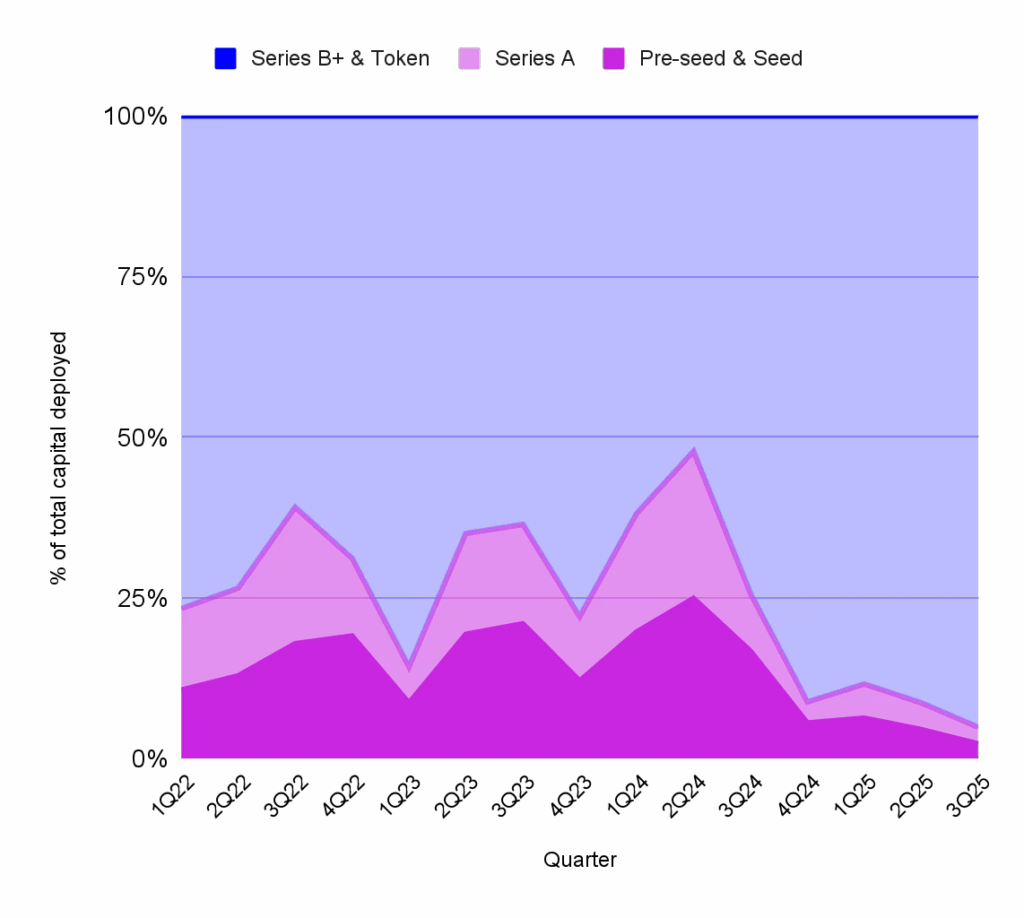
Data presented by leading market analysts, including metrics compiled by Messari and Outlier Ventures, reveal a distinct contraction in pre-seed and seed-stage allocations relative to later-stage rounds. Throughout late 2022 and leading into late 2025, venture capital deployment has increasingly concentrated in Series B and beyond.
This trend is largely attributable to the deployment lifecycle of funds raised during the 2020–2021 boom. With many of these vehicles now fully allocated, GPs have pivoted their primary focus toward managing existing portfolio winners, optimizing exits, and navigating regulatory complexities rather than chasing new, unproven bets. Furthermore, the scarcity of fresh mega-fund launches in the post-peak era has reinforced this conservative posture.
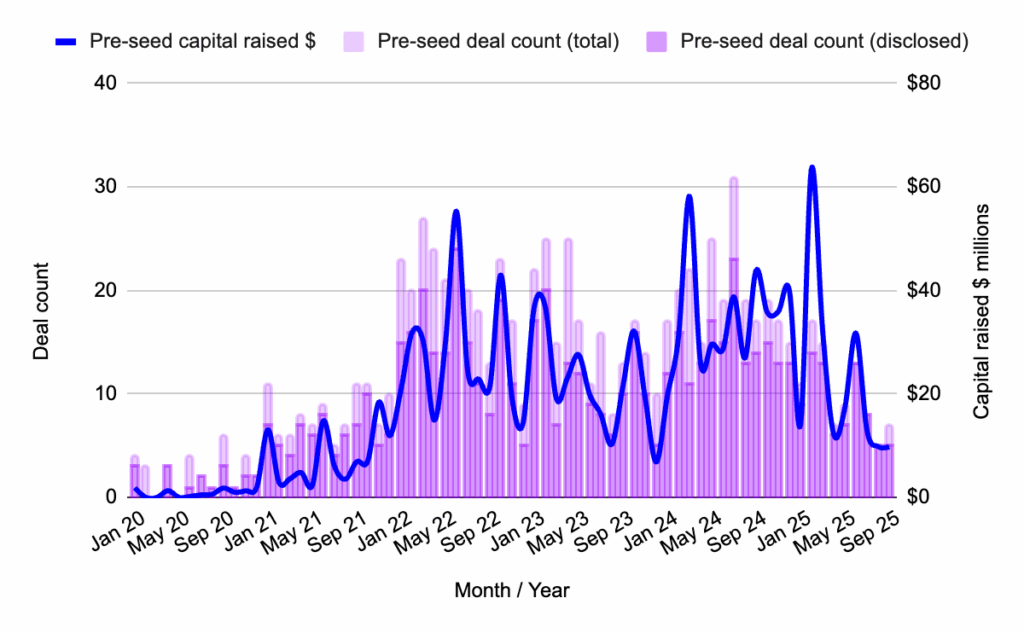
Despite the slowdown in early-stage deal counts, conviction remains exceptionally high for resilient founders capable of demonstrating tangible product-market fit, continuous usage, and revenue growth across volatile market conditions. Investors are no longer willing to fund mere concepts; they require empirical evidence of traction before committing capital.

The Rise of Data-Led Investment and Digital Asset Treasuries (DATs)
A defining revelation from Token2049 Singapore 2025 was the empowerment of GPs through advanced data analytics. Unlike previous cycles, modern venture funds possess granular performance metrics detailing which Web3 sub-sectors demonstrate structural resilience and which operational models consistently outperform market benchmarks. Consequently, redeploying capital into existing portfolio winners is increasingly viewed as a rational, fiduciary-driven strategy rather than a defensive maneuver.
To optimize capital efficiency and hedge against volatility, many funds have integrated Digital Asset Treasuries (DATs) into their operational strategies. Often discussed as a major theme—dubbed the "DAT Revolution" during conference panels—these treasuries have evolved from a theoretical bridge between traditional finance (TradFi) and decentralized finance (DeFi) into flexible instruments for short-term liquidity management.
While DATs offer sophisticated treasury management and yield-generating capabilities, industry analysts note a potential trade-off: capital locked or managed through yield protocols and treasury instruments may reduce the aggregate pool of liquidity available for early-stage startup funding. Nevertheless, their widespread adoption signals a higher degree of financial sophistication among Web3 market participants.
LP Expectations and the Scrutiny of Fund Performance
Limited Partners (LPs) are simultaneously imposing stricter evaluation criteria on venture funds seeking fresh capital. Institutional investors now demand rigorous transparency, verified historical returns, and institutional-grade governance. Closing a Web3-focused venture fund requires significantly more time and documentation than it did during earlier speculative phases.
This heightened level of scrutiny does not indicate a waning interest in blockchain technology; rather, it reflects a normalization of the asset class. Institutional allocators are treating Web3 venture capital with the same analytical rigor applied to traditional venture asset classes, favoring managers who demonstrate rigorous risk management and disciplined deployment strategies.
Founder Adaptation and Alternative Fundraising Models
For founders navigating this recalibrated landscape, the rules of capital formation have fundamentally changed. Traditional mechanisms such as Key Opinion Leader (KOL) rounds and hype-driven launchpads have largely lost institutional favor. In their place, transparency, community alignment, and fair-launch models have taken precedence.
Projects utilizing decentralized execution and community-centric distribution platforms—such as Virtuals, Hyperliquid, Echo, Coinlist, and Legion—have gained significant traction. These platforms facilitate fair, market-driven entry points that align long-term incentives between developers, early adopters, and institutional investors, offering a sustainable alternative to traditional venture funding funnels.
Industry Implications and Outlook
The collective insights emerging from Token2049 Singapore 2025 point to a structural transformation rather than an industry contraction. By prioritizing data-led conviction, liquidity discipline, and measurable utility over fleeting momentum, the Web3 venture capital ecosystem is establishing a durable foundation for long-term growth.

As regulatory frameworks crystallize globally and institutional participants demand higher standards of accountability, the market is effectively separating short-term speculation from structural necessity. For resilient founders and disciplined investors prepared to operate within this mature paradigm, the post-hype era represents not a downturn, but the genesis of sustainable digital asset innovation.

