

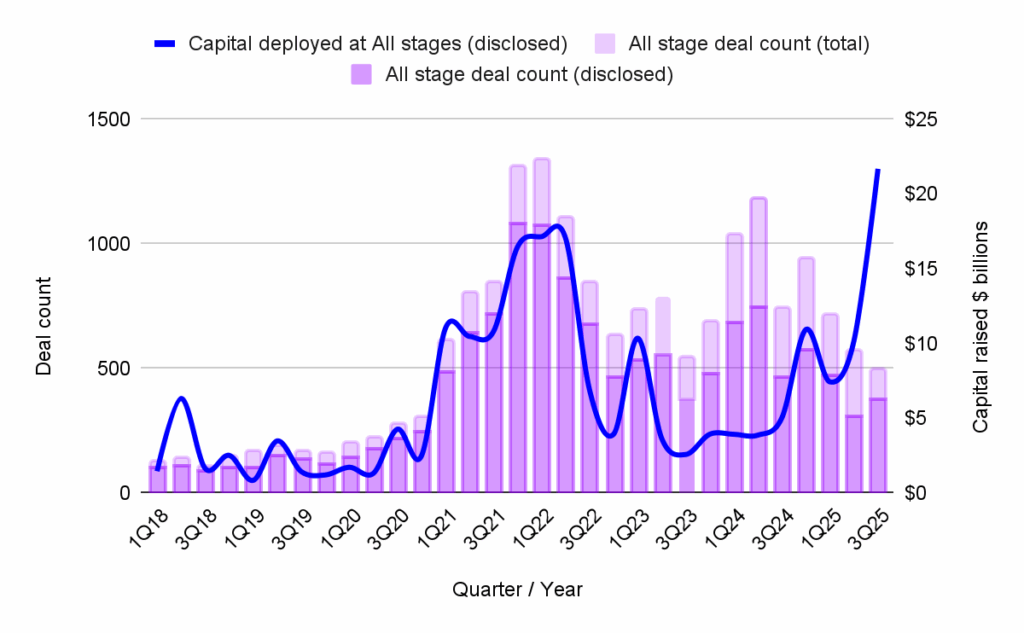
The global Web3 and cryptocurrency venture capital landscape experienced a historic transformation in the third quarter of 2025, deploying nearly $22 billion across 376 disclosed deals. According to comprehensive market data compiled by Outlier Ventures and Messari, total capital deployment skyrocketed by 113% quarter-on-quarter, leaping from $10.2 billion in the second quarter to $21.7 billion in the third. This remarkable influx of capital eclipses the raw fundraising volumes witnessed during the historic 2021 and 2022 bull markets. However, unlike previous speculative frenzies driven by a high volume of retail-focused projects and scattered pre-seed rounds, the third quarter of 2025 was characterized by profound capital concentration, strategic institutional alignment, and a preference for mature infrastructure over unproven consumer experiments.
A Closer Look at Market Dynamics and Capital Concentration

The core narrative of third-quarter fundraising centered on conviction rather than broad-based market coverage. While total capital more than doubled compared to the previous quarter, the total number of disclosed deals grew by only 22%, rising from 309 to 376. This divergence highlights a market driven by substantially larger checks directed toward late-stage projects and compliance-ready infrastructure, rather than a generalized surge in early-stage startup creation. Data from Messari indicates that the ten largest funding rounds of the quarter accounted for approximately half of all venture capital deployed globally.
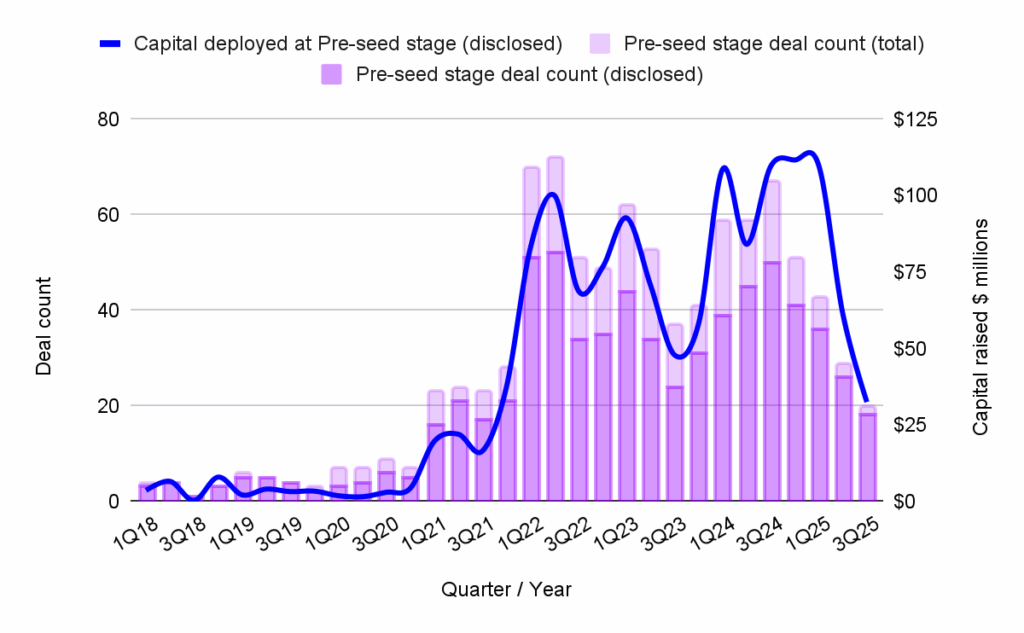
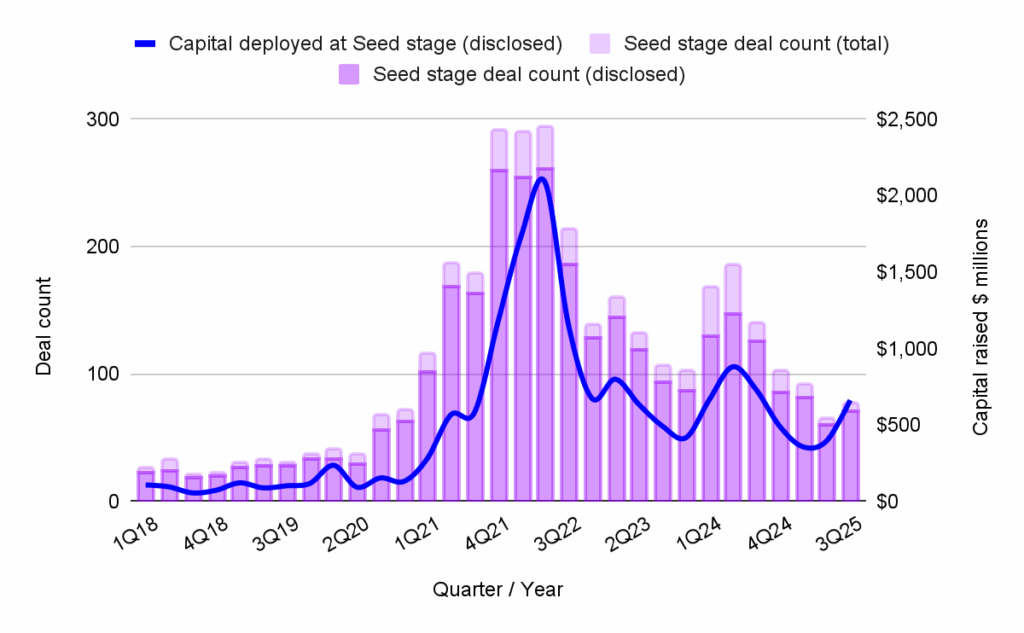
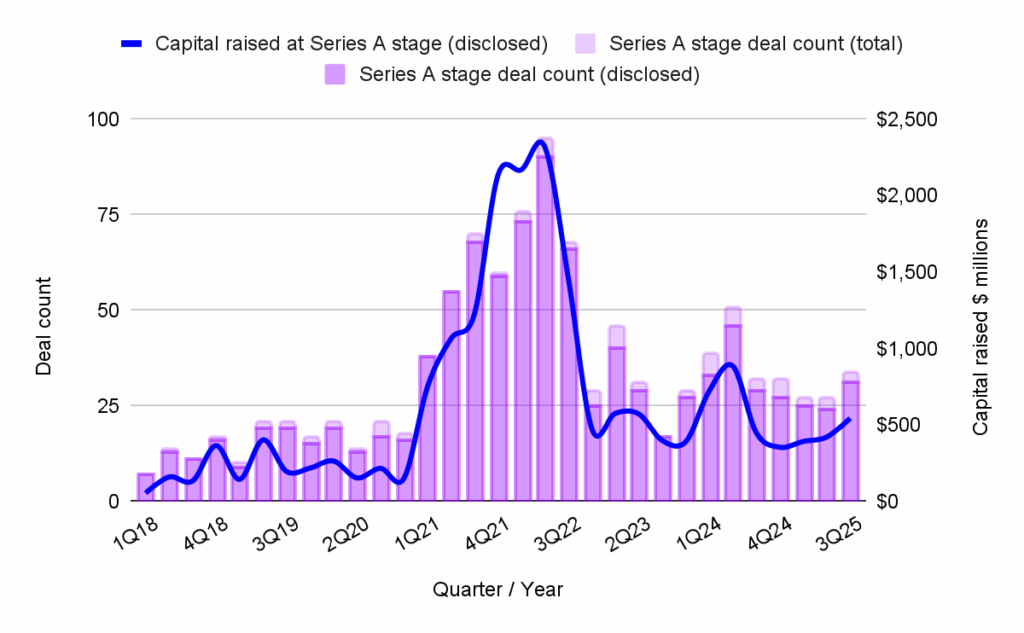
This environment reflects a broader maturation of the asset class. Institutional investors, operating under strict governance, fiduciary mandates, and short delivery horizons, prioritized ventures capable of demonstrating immediate utility and seamless integration with traditional financial systems. Consequently, early-stage pre-seed funding fell to multi-year lows in both deal count and capital raised, recording just 18 disclosed rounds totaling $32.5 million. Seed-stage fundraising appeared healthier on paper at $663 million across 71 rounds, but that figure was heavily skewed by outlier transactions such as Flying Tulip’s $200 million raise, which utilized an innovative on-chain redemption mechanism rather than standard equity structures. Meanwhile, Series A funding remained stable, logging 31 rounds totaling $545 million with a consistent 12-month running median of approximately $16 million.
The Deepening Institutional Architecture of Traditional Finance
The record-breaking capital deployment of the third quarter was directly supported by the operationalization of institutional financial rails. Following years of regulatory consultation and pilot testing, traditional financial institutions transitioned digital asset integration from concept to production. Ethereum-focused exchange-traded funds (ETFs) served as a primary catalyst, pulling in approximately $8.7 billion in the third quarter alone and surpassing Bitcoin-focused fund inflows. Total assets under management for Ethereum ETFs surged by roughly 170% quarter-on-quarter to reach $27.4 billion.
Concurrently, Digital Asset Treasuries captured approximately 3.8% of the total Ethereum supply, signaling a structural shift in corporate treasury management. Major global financial institutions advanced their blockchain integration strategies significantly. JPMorgan’s Kinexys network went live for tokenized repurchase agreement settlement, while SWIFT expanded its tokenization trials alongside major global custodians—including BNY Mellon, Citi, Clearstream, Euroclear, and Northern Trust—to test cross-network settlement of bonds and fund shares on-chain. Furthermore, Visa Direct initiated the processing of cross-border payments utilizing USDC. These developments provided a clear regulatory and operational runway, assuring institutional investors that capital allocated to compliant Web3 infrastructure would find durable, revenue-generating ecosystems.
Regulatory Catalysts and the Shift Toward Execution
Policy developments throughout 2025 reinforced this institutional pivot, transitioning the regulatory landscape from ambiguous oversight to structured execution. Legislative milestones, including the introduction of the GENIUS Act and related international policy frameworks, provided formal catalysts for stablecoin issuance and tokenization initiatives across traditional banking and payment sectors. These regulatory clarifications effectively lowered entry barriers for risk-averse institutional allocators.
However, institutional capital deployment remains inherently selective. Financial institutions managing billions of dollars face severe operational inefficiencies when distributing numerous small checks to early-stage startups. To bridge this gap, hybrid investment models have emerged. Collaborations such as Outlier Ventures’ partnership with Morgan Creek allow traditional asset managers to gain structured, risk-mitigated exposure to early-stage Web3 ventures by leveraging specialized sector due diligence and portfolio support infrastructure. For early-stage founders, this structural reality necessitates designing product architectures, governance frameworks, and compliance pathways that appeal to institutional standards from inception.
Public Token Sales Rebound as Private Markets Recede
Token fundraising patterns in the third quarter revealed a distinct rotation from private sales to public distribution mechanisms. Public token sales climbed to 47 events, generating a combined $819 million, whereas private token sales contracted to 7 events totaling $331 million. Market analysts attribute this shift to improving market depth, rising cryptocurrency market capitalization, and receding regulatory uncertainty in key jurisdictions.
Data from CoinGecko’s third-quarter report underscored broad-based improvements in trading volumes and asset valuations, prompting project teams to favor public token launches for transparent price discovery and community alignment. Additionally, the re-emergence of initial public offerings and public market listings functioned as a vital market sentiment indicator. Industry observers note that for mature Web3 enterprises, pursuing public listings serves as a form of regulatory-compliance certification, signaling institutional-grade operational maturity to the broader market.
Category Analysis: Infrastructure Dominates Capital Inflows
An examination of capital investment across all stages by category reveals an unmistakably institutional footprint. Investment Management, Marketplaces, Data Infrastructure, Financial Services, and Mining & Validation collectively absorbed approximately 70% of all venture dollars deployed during the quarter. These specific sectors directly support asset issuance, custody, settlement, analytics, and blockspace supply—areas heavily amplified by ETF inflows and corporate tokenization programs.
Data infrastructure startups secured substantial capital allocations, driven by growing corporate demand for indexing, analytics, and AI-adjacent blockchain stacks. Grayscale’s sector reports formalized AI-crypto as a distinct investable segment, concentrating capital into scaled data platforms rather than speculative consumer experiments. Conversely, consumer-facing verticals such as Metaverse, Gaming, and Wallet Security remained peripheral, as venture capitalists heavily favored underlying financial rails where revenue models and regulatory compliance are clearly defined.
Implications and Outlook for Future Quarters
The historic capital deployment of the third quarter of 2025 confirms that the convergence of cryptocurrency and traditional finance is no longer a speculative hypothesis, but an operational reality shaping institutional balance sheets. While mainstream adoption has predominantly materialized at the infrastructure layer—through bank-adopted stablecoin rails and tokenized settlement layers rather than radical shifts in consumer behavior—it has established a sustainable foundation for long-term growth.
Looking ahead to the final quarter of 2025 and into 2026, the primary challenge for Web3 founders will be demonstrating tangible product-market fit, active user adoption, and seamless enterprise integration to successfully bridge the gap between selective seed rounds and scaled Series A funding. For venture capitalists and institutional allocators, the ongoing evolution of hybrid financial instruments, regulatory compliance frameworks, and secondary market liquidity mechanisms will ultimately determine whether market capital remains tightly concentrated within institutional infrastructure or broadens to encompass the next generation of decentralized innovation.

