
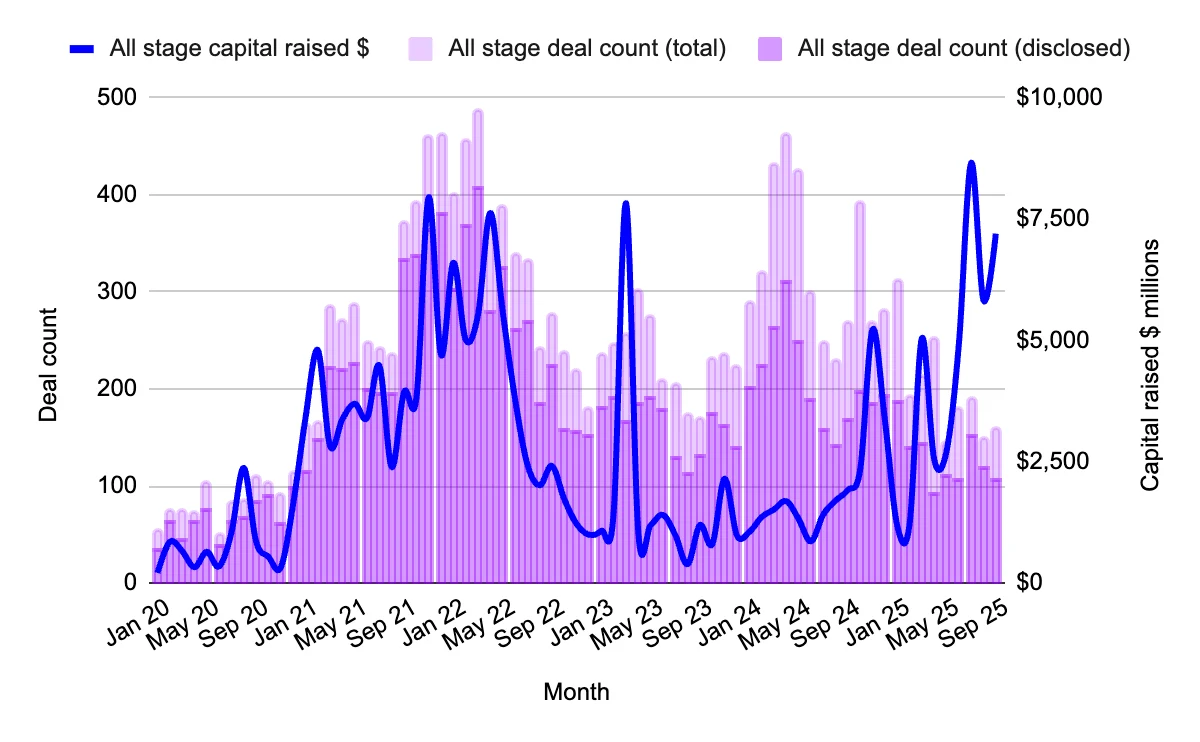
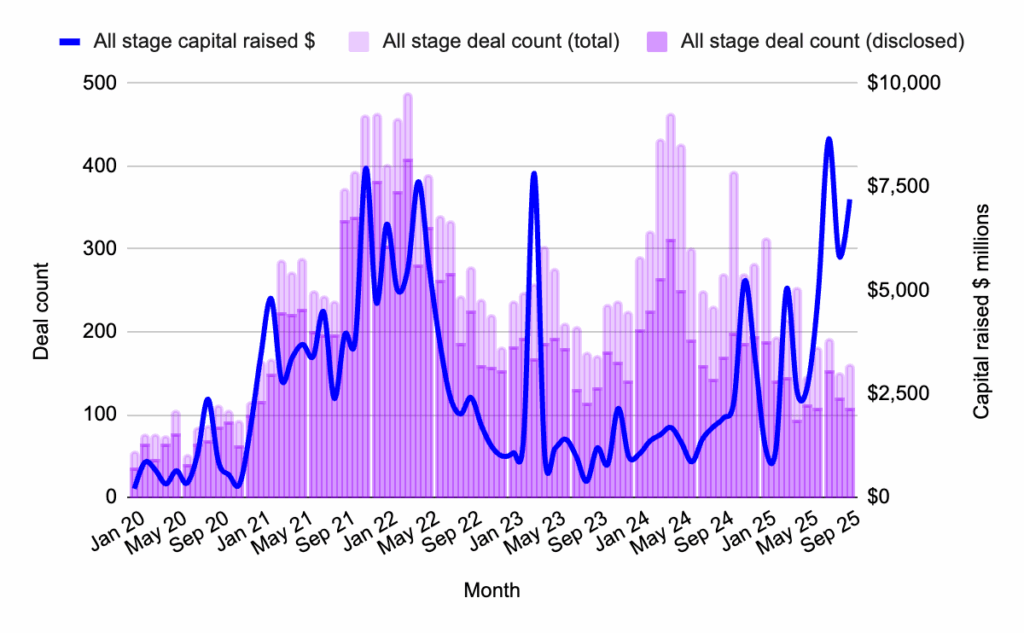
The global Web3 and cryptocurrency funding landscape experienced a robust revival in September 2025, capturing $7.2 billion across 160 distinct transactions. This performance marks the highest aggregate capital deployment since the spring surge earlier in the year. However, a deeper examination of the data reveals a highly bifurcated market: while headline figures suggest an aggressive return of investor appetite, capital deployment remains heavily top-heavy, favoring mature protocols, established later-stage enterprises, and unique liquidity-focused financing models over embryonic early-stage ventures.
According to combined data reports from Messari and Outlier Ventures, the momentum observed in September mirrors structural trends identified during recent quarterly analyses and findings from the Token2049 conference in Singapore. Venture capitalists and institutional backers are increasingly prioritizing risk mitigation, directing their resources toward ventures that demonstrate immediate market traction, clear pathways to liquidity, and robust compliance frameworks.
Market Overview and Macroeconomic Context
The broader macroeconomic environment in late 2025 has continued to shape risk sentiment across digital asset markets. As regulatory clarity slowly solidifies in major jurisdictions like the European Union and parts of Asia, venture capital firms have adjusted their deployment strategies. The era of speculative, unproven pre-seed funding rounds has largely given way to a disciplined capital allocation cycle.
September’s total of $7.2 billion demonstrates that dry powder is actively being deployed, but institutional allocators are applying rigorous due diligence standards. Rather than spraying capital across hundreds of early-stage protocols, funds are concentrating large checks into fewer, more heavily vetted enterprises. This defensive yet opportunistic posture explains why total capital raised is climbing while early-stage deal counts remain subdued.
The market composition for the month highlighted a persistent preference for mature infrastructure, cross-chain interoperability solutions, and advanced financial primitives capable of generating sustainable yields.
The Seed Stage Anomaly: The Flying Tulip Phenomenon
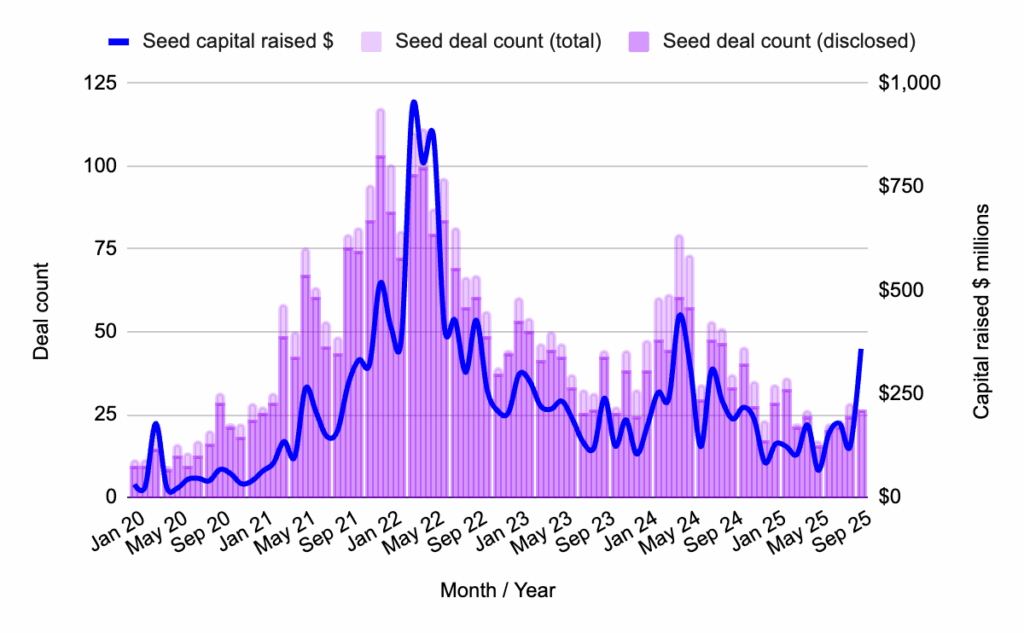
While the broader seed-stage landscape remained relatively quiet, September featured one of the largest and most unconventional early-stage funding rounds in the history of the decentralized finance sector: Flying Tulip’s $200 million seed round, which propelled the platform to a unicorn valuation of $1 billion.
Flying Tulip aims to revolutionize on-chain trading by unifying spot markets, perpetual swaps, lending operations, and structured yield generation into a single hybrid automated market maker (AMM) and order book model. Furthermore, the platform integrates cross-chain deposits and volatility-adjusted lending mechanisms designed to optimize capital efficiency for institutional and retail traders alike.
What truly distinguished the Flying Tulip raise, however, was its innovative deal structure. Eschewing traditional illiquid instruments such as Simple Agreements for Future Equity (SAFEs) or Simple Agreements for Future Tokens (SAFTs), the project implemented an on-chain redemption right for its investors. This mechanism provides institutional backers with capital security and continuous yield exposure without sacrificing long-term upside potential.
Rather than burning through the raised capital to fund initial operations, Flying Tulip utilizes decentralized finance yield-generation strategies to self-fund its growth, user incentives, and token buybacks. Financial analysts note that this DeFi-native capital efficiency model could serve as a blueprint for future protocol fundraising, signaling a shift toward instruments that offer immediate liquidity features for venture capitalists.
Pre-Seed Slump and the Rise of Niche Narratives
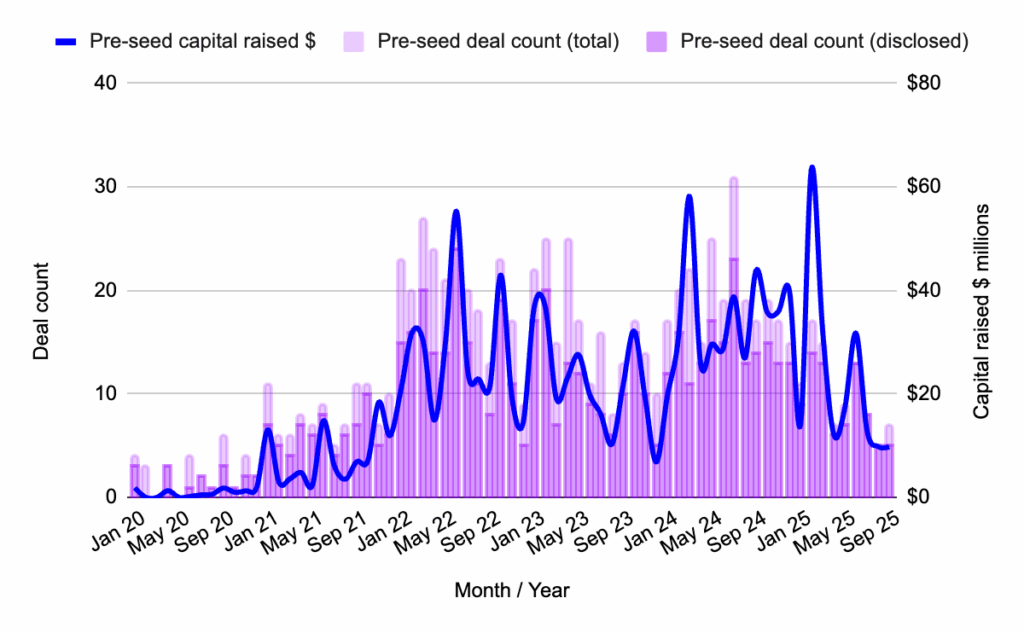
In stark contrast to the massive inflows at the top end of the market, pre-seed funding continued a nine-month downward trajectory in both aggregate capital raised and total deal volume. Early-stage founders faced an increasingly selective environment characterized by sparse participation from tier-one venture funds.
Despite the general scarcity of capital at the foundational level, select projects managed to secure backing by aligning with dominant market narratives. A prime example is Melee Markets, a Solana-based platform that successfully closed a $3.5 million pre-seed round with participation from prominent funds such as Variant and DBA. Melee Markets operates at the intersection of prediction markets and social trading, enabling users to speculate on internet influencers, cultural events, and trending social topics. The successful funding round underscores that pre-seed capital remains accessible primarily to founders who present tightly articulated narratives capable of capturing attention-flow as a viable asset class.
Series A Stabilization and Asian Market Influence
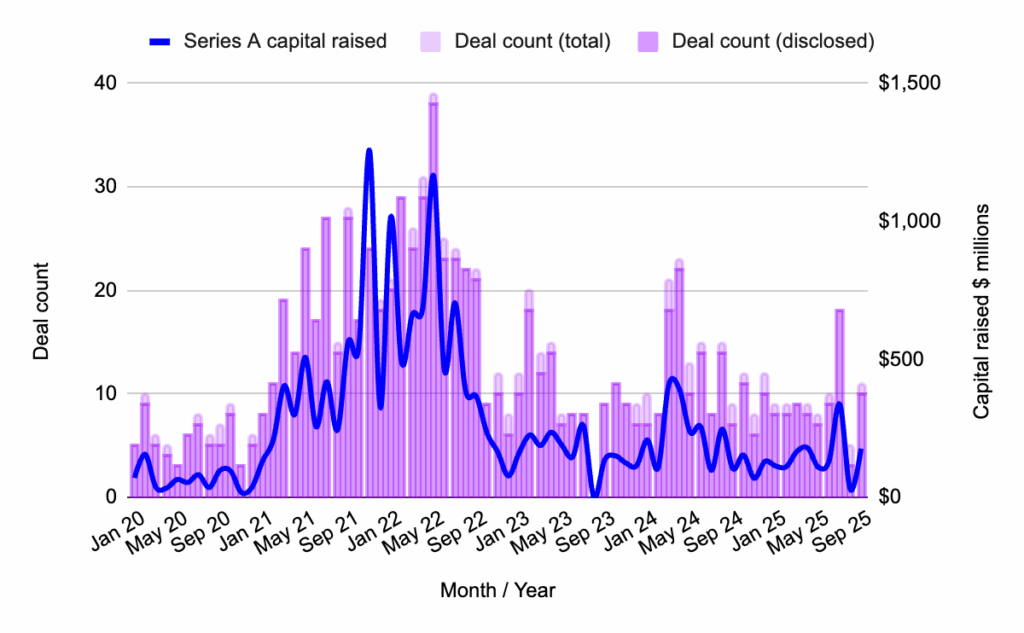
Series A funding staged a modest recovery in September following a sharp contraction in August, though it failed to break out into a major expansion phase. Deal volume and capital deployment aligned closely with the 2025 historical average, reinforcing the thesis that institutional investors are waiting for verifiable product-market fit before committing substantial growth-stage capital.
A notable highlight within this tier was Digital Entertainment Asset (DEA), a Singapore-based firm that secured $38 million in a Series A extension round. Backed by strategic heavyweights including SBI Holdings and ASICS Ventures, DEA focuses on developing Web3 gaming, environmental, social, and governance (ESG) initiatives, and advertising ecosystems featuring real-world utility and payouts. Industry observers noted that this transaction highlights the continued vigor of the Asian Web3 market, where traditional conglomerates and venture funds actively bridge blockchain technology with mainstream consumer industries.
Private and Public Token Sales: Exchanges and Bitcoin Yield
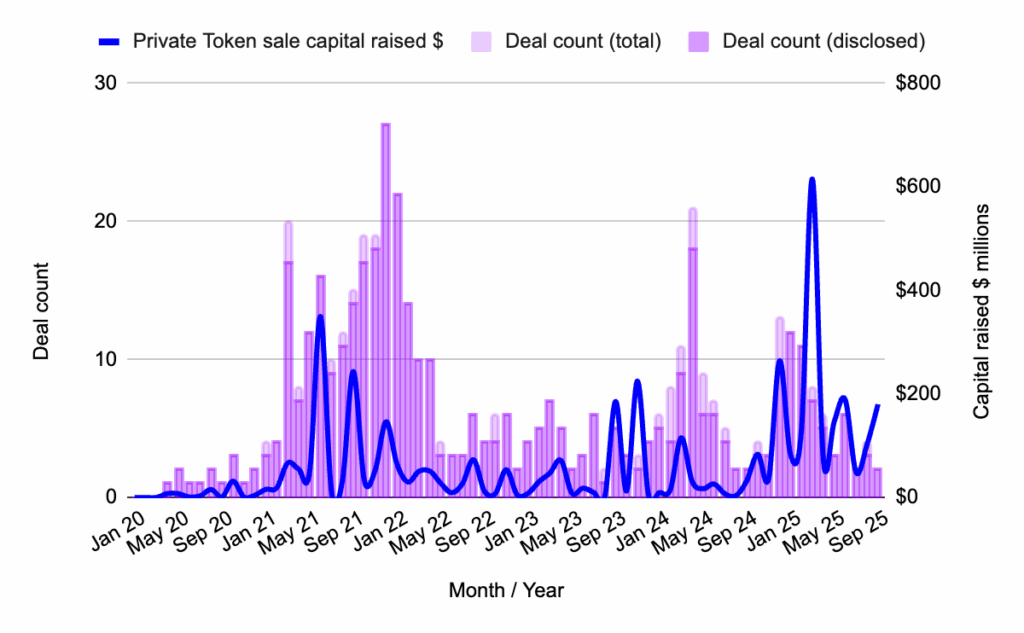
Private token sales during September followed the established pattern of recent quarters: fewer total rounds, significantly larger check sizes, and a heavy concentration of liquidity-driven plays centered around established exchange ecosystems.
The most prominent transaction in this category involved Crypto.com, which raised $178 million through a private placement reportedly executed in strategic partnership with Trump Media. The capital injection is intended to fuel the platform’s ongoing global expansion and the development of mass-market consumer spending tools. While market analysts debate the long-term strategic alignment of the partnership, the sheer size of the raise highlights the enduring capacity of major centralized exchanges to attract institutional capital.
Meanwhile, public token sales remained exceptionally dynamic, anchored by two dominant thematic narratives: Bitcoin yield generation (frequently termed "BTCFi") and autonomous artificial intelligence agents. Public markets demonstrated a clear appetite for protocols capable of unlocking the dormant economic potential of the world’s largest cryptocurrency.
Lombard stood out in the public token sale category, securing $94.7 million to accelerate the adoption of its flagship product, LBTC. Designed as a yield-bearing, cross-chain liquid Bitcoin asset, Lombard seeks to unify fragmented Bitcoin liquidity across disparate blockchain ecosystems. The success of the round reflects a broader macroeconomic shift within crypto asset management, as holders increasingly demand yield-generating utilities for native assets that traditionally remained idle.
Venture Fund Formation: Smaller, Highly Thematic Vehicles
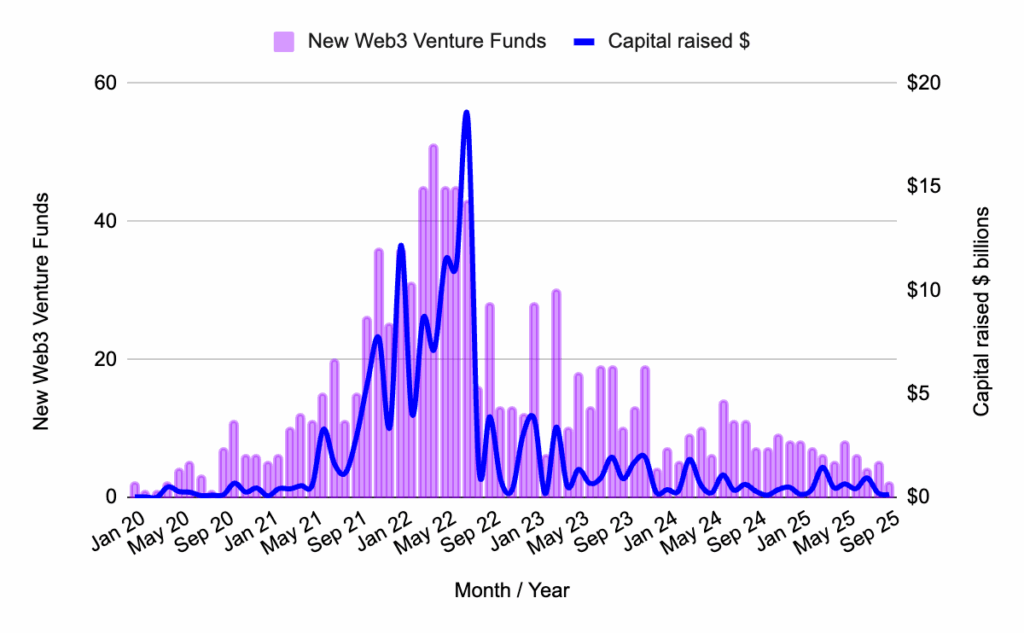
The formation of new crypto-native venture capital funds experienced a notable cooling period in September 2025. Only two new investment vehicles were officially launched during the month, both of which were characterized by smaller capitalization targets and highly specialized investment mandates.
Industry analysts interpret this contraction in fund formation not as a lack of investor interest, but as evidence of a structural maturation. General partners are moving away from massive, generalized "spray and pray" funds in favor of leaner, highly thematic vehicles designed to target specific technological verticals, such as zero-knowledge cryptography, decentralized physical infrastructure networks (DePIN), and modular blockchain architecture.
Implications and Future Outlook
The funding data from September 2025 paints a comprehensive picture of a maturing Web3 venture capital ecosystem. The concentration of capital in late-stage rounds, private token placements, and groundbreaking structural experiments like Flying Tulip indicates that institutional investors are increasingly risk-averse regarding early-stage illiquidity.
For early-stage founders, the message is clear: navigating the current market requires rigorous technical conviction, innovative tokenomic designs, and alignment with high-performance ecosystems—such as the initiatives currently being fostered by specialized builders’ cohorts like the Injective Ecosystem Catalyst program.
As the fourth quarter of 2025 approaches, the market trajectory suggests that while overall funding totals will remain healthy, driven by macro liquidity and institutional participation in proven assets, the barrier to entry for new protocols will remain exceptionally high. The era of speculative excess has officially been replaced by an era of structural efficiency, yield-driven tokenomics, and selective, high-conviction capital deployment.

