
Token2049 Singapore 2025 has cemented its position as one of the premier global gatherings for the digital asset industry, drawing thousands of founders, investors, and developers to the heart of Southeast Asia. However, the atmosphere on the ground marked a profound departure from the speculative euphoria that characterized previous market peaks. Rather than focusing on high-risk narratives and unbounded growth projections, discussions among venture capitalists, Limited Partners (LPs), and founders centered squarely on structural maturity, data-driven discipline, and rigorous capital efficiency.
This recalibration reflects a broader institutional evolution across the Web3 venture capital ecosystem. As the industry transitions out of its post-hype cycle, global investors are fundamentally rethinking asset allocation strategies, placing a premium on liquidity management, regulatory alignment, and verified product-market fit.
A Evolving Regulatory Landscape and Regional Shifts
The lead-up to Token2049 Singapore 2025 highlighted a notable geographical rebalancing within the Asian Web3 market. Anecdotal evidence from conference attendees suggested that a significant portion of capital allocators prioritized Korea Blockchain Week over Singapore this year. This subtle shift underscores diverging regional regulatory trajectories and rising enthusiasm in South Korea.
South Korea has made steady progress in formalizing its virtual asset framework, establishing clearer guidelines regarding digital asset custody, taxation, and investor protection. This methodical approach has provided institutional participants with greater operational predictability. Meanwhile, Singapore has maintained its reputation as a rigorous financial hub through the Monetary Authority of Singapore’s (MAS) expanded licensing regime. These rules now require even offshore-facing cryptocurrency entities to establish local registration and compliance structures.
Together, these regulatory frameworks have fostered a more structured operational environment across Asia. South Korea has signaled openness within well-defined parameters, while Singapore has tightened its filters to guarantee long-term market stability. These regional dynamics served as a crucial backdrop for Token2049 Singapore, influencing panel discussions, private investor dinners, and strategic partnership announcements throughout the week.
Market Discipline and the Evolution of VC Maturity
The overarching sentiment at Token2049 Singapore 2025 was one of pragmatic realism. While earlier iterations of the conference were dominated by speculative optimism—a trend that Token2049 Dubai earlier in the year also began to challenge—the Singapore installment confirmed that the ecosystem has firmly entered an era of data-led decision-making.
Industry veterans note that this shift does not represent a contraction of the venture asset class, but rather a natural evolution. For established Web3 venture firms, such as Outlier Ventures, data and historical benchmarks now dictate investment conviction, replacing narrative-driven hype with rigorous quantitative analysis. General Partners (GPs) are increasingly relying on proprietary metrics accumulated over multiple market cycles to assess startup viability, ensuring that capital is deployed exclusively into teams capable of demonstrating sustained revenue growth and operational resilience.
Capital Concentration and Later-Stage Dominance
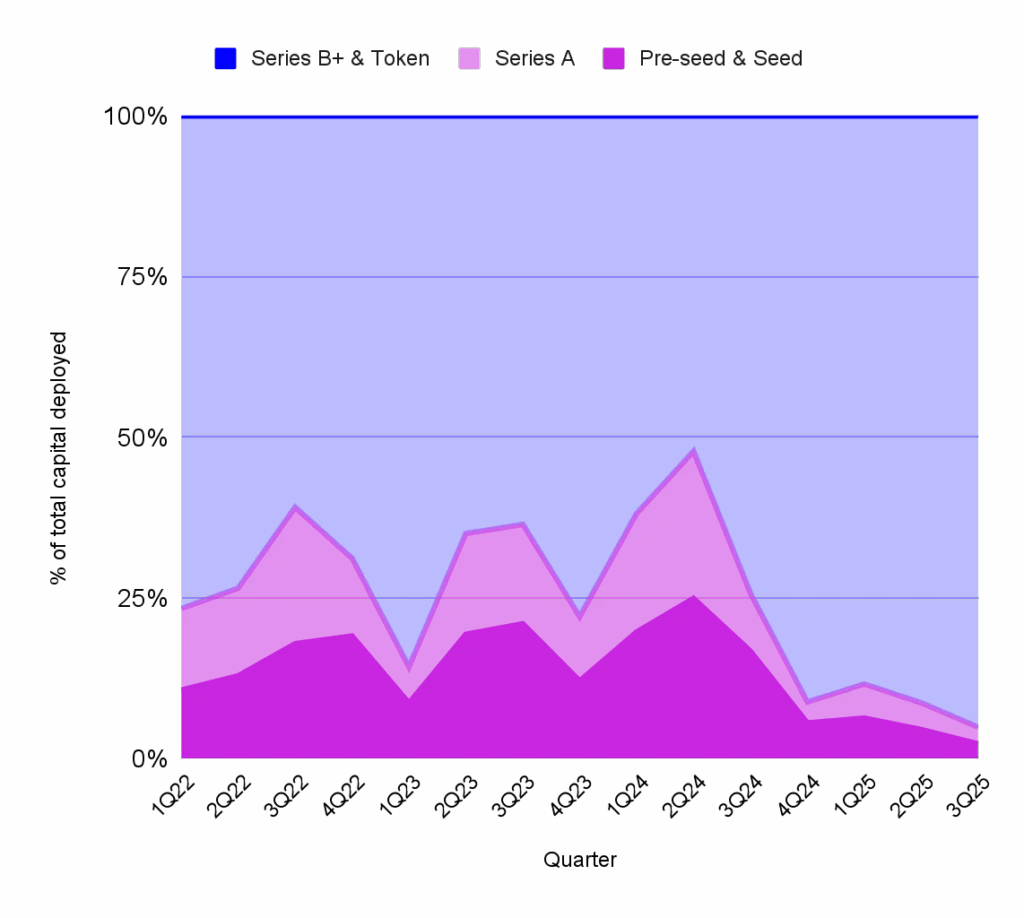
Data presented at the conference aligned closely with fundraising trends observed throughout the year. Analysis of Web3 fundraising data leading into the third quarter of 2025 reveals a distinct deceleration in pre-seed and seed-stage allocations. Conversely, later-stage rounds, particularly Series B and beyond, have continued to capture the lion’s share of investor focus and capital concentration.
This preference for later-stage maturity is largely driven by fund deployment cycles. Many venture vehicles raised during the 2020–2021 boom are now fully allocated, leaving GPs with the primary responsibility of managing existing portfolio winners and pursuing liquidity events rather than initiating a high volume of new early-stage bets. Furthermore, the scarcity of fresh fund launches in the wake of that peak period has reinforced a defensive yet strategic posture among institutional managers.

Despite the tightening of early-stage pipelines, investor conviction remains exceptionally high for resilient founders. Teams capable of exhibiting genuine user traction, retention, and clear revenue paths through macroeconomic fluctuations continue to secure funding. This endurance demonstrates that the market is actively rewarding operational execution over speculative potential.
Data-Led Investments and Advanced Portfolio Management
A primary takeaway from the panel sessions in Singapore was the unprecedented availability of granular data for fund managers. Unlike previous cycles, current GPs possess extensive historical intelligence regarding sector resilience, founder performance, and market outperformance.
Armed with this information, redeploying capital into existing portfolio winners has transformed from a defensive maneuver into a rational, value-maximizing strategy. Several venture funds have expanded their operational scopes, establishing internal liquidity teams or over-the-counter (OTC) trading capabilities to acquire positions in high-performing assets that they may have missed during initial funding rounds. This precision-oriented approach reflects a broader institutionalization of Web3 venture capital, where portfolio management is treated with the same quantitative discipline found in traditional private equity.
The Rise of Digital Asset Treasuries (DATs)
Liquidity management emerged as one of the most heavily debated topics at Token2049 Singapore 2025, frequently overshadowing traditional venture topics. A focal point of these discussions was the rapid proliferation of Digital Asset Treasuries (DATs), often referred to on conference stages as part of the "DAT Revolution."
Originally conceived as institutional bridges connecting traditional finance (TradFi) with decentralized ecosystems, DATs have matured into flexible instruments designed to optimize short-term capital efficiency. For many funds, allocating a portion of capital into liquid assets and yield-generating protocols serves as a vital hedge against market volatility, ensuring that treasuries remain productive between major deployment cycles.
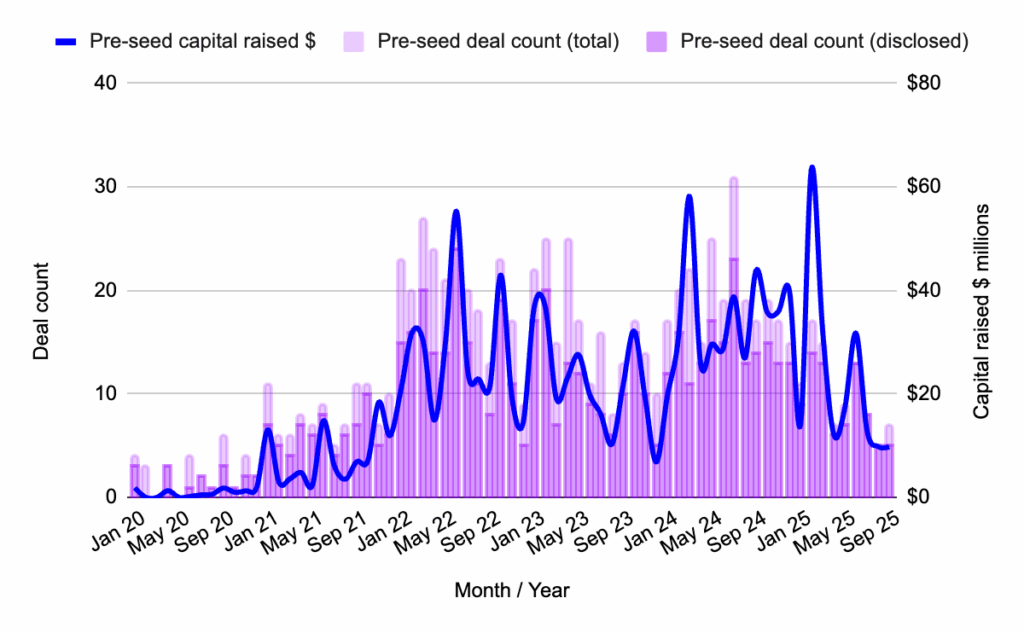
However, the widespread adoption of DATs introduces notable trade-offs. As more capital is directed toward liquid treasury strategies and later-stage rounds, the total pool of available liquidity for early-stage startups contracts further. Nevertheless, market analysts view the rise of DATs not as a temporary narrative, but as a permanent shift toward financial sophistication and responsible fiduciary management within the digital asset space.
LP Expectations and Fundraising Headwinds
For emerging Web3 venture funds, the fundraising climate remains fiercely competitive. Limited Partners (LPs)—including pension funds, university endowments, and family offices—are enforcing significantly stricter evaluation criteria. Today’s institutional investors demand rigorous proof of realized returns, transparent governance structures, and robust risk management frameworks before committing capital.
Discussions at Token2049 Singapore emphasized that this heightened scrutiny should not be interpreted as fading interest in the asset class. Instead, it signals a maturing market where fund managers must substantiate their strategies with verifiable performance data. While new funds continue to enter the market, the closing process has lengthened considerably, favoring established managers with proven track records over first-time general partners relying solely on thematic momentum.
Founder Perspectives: Adapting to Higher Standards of Validation
Founders attending Token2049 Singapore 2025 demonstrated a clear willingness to adapt to the new economic reality. Traditional fundraising models centered around speculative token launches, key opinion leader (KOL) hype rounds, and heavily discounted private placements have largely fallen out of favor with sophisticated investors.
Instead, founders are increasingly leaning toward bootstrapping, revenue-first architectures, and transparent market-driven distribution models. Emerging platforms facilitating fair launches and community-led token rounds—such as Virtuals, Hyperliquid, Echo, Coinlist, and Legion—have gained significant traction. These alternative avenues allow projects to build genuine user alignment and long-term liquidity without relying exclusively on traditional venture capital gatekeepers. The prevailing consensus among founders is unequivocal: while compelling narratives may capture initial market attention, only sustained operational performance and verifiable utility can secure long-term viability.

Broader Implications and Future Outlook
The collective insights gathered from Token2049 Singapore 2025 paint a portrait of an industry undergoing a deliberate and constructive transformation. The Web3 venture ecosystem is shedding its reliance on speculative excess, replacing momentum-driven trading with fundamentals-based conviction.
Although capital concentration in later stages and the institutionalization of treasury management may present hurdles for nascent startups, these developments ultimately point to a more resilient financial architecture. As LPs demand greater transparency, regulators establish clearer operational boundaries, and founders prioritize real-world utility, the digital asset sector is building a solid foundation for sustainable, long-term growth. The overarching message from Singapore is clear: the era of unmitigated speculation has given way to an era of disciplined execution, setting a higher benchmark for all participants in the global Web3 economy.

