
The annual pilgrimage of the global cryptocurrency and blockchain community to Marina Bay Sands for Token2049 Singapore 2025 painted a vivid picture of an industry undergoing a profound metamorphosis. As one of the largest and most influential gatherings on the global Web3 calendar, the event traded the unchecked speculative euphoria of previous bull markets for a pragmatic, institutional tone. Global venture capitalists, founders, and limited partners converged not to chase transient market narratives, but to re-evaluate capital allocation, regulatory alignment, and liquidity management in a post-hype cycle environment.
This year’s conference highlighted a systemic recalibration across the venture capital landscape. While the energy remained palpable, conversations among General Partners (GPs) and Limited Partners (LPs) centered heavily on structural stability, data-driven decision-making, and the hard lessons learned from prior market cycles. Outlier Ventures and other leading market participants noted that the Web3 venture ecosystem is shifting rapidly from momentum-driven trading to fundamentals-based conviction.
Regional Shifts and Regulatory Maturation
The build-up to Token2049 Singapore 2025 was marked by a noticeable geographical rebalancing of attention within the Asian crypto market. Anecdotal and logistical metrics suggested that many global attendees prioritized South Korea Blockchain Week over Singapore this year, a shift driven by shifting regulatory frameworks and escalating local enthusiasm.
South Korea has made significant strides in formalizing its virtual asset regime, introducing clearer legal parameters around digital asset custody, corporate taxation, and consumer protection. This regulatory clarity has fostered an environment where institutional capital and local builders can operate with predictable guidelines. Conversely, Singapore’s Monetary Authority (MAS) has continued to tighten its licensing requirements, mandating strict compliance and local registration even for offshore-facing entities.

Together, these contrasting regional dynamics created a backdrop of heightened regulatory maturity during Token2049 Singapore 2025. Rather than evading oversight, institutional investors and venture funds increasingly view compliance as a prerequisite for long-term scalability. This environment has effectively filtered out speculative operations, leaving behind resilient entities capable of weathering multi-year market cycles.
Capital Concentration and the Early-Stage Funding Squeeze
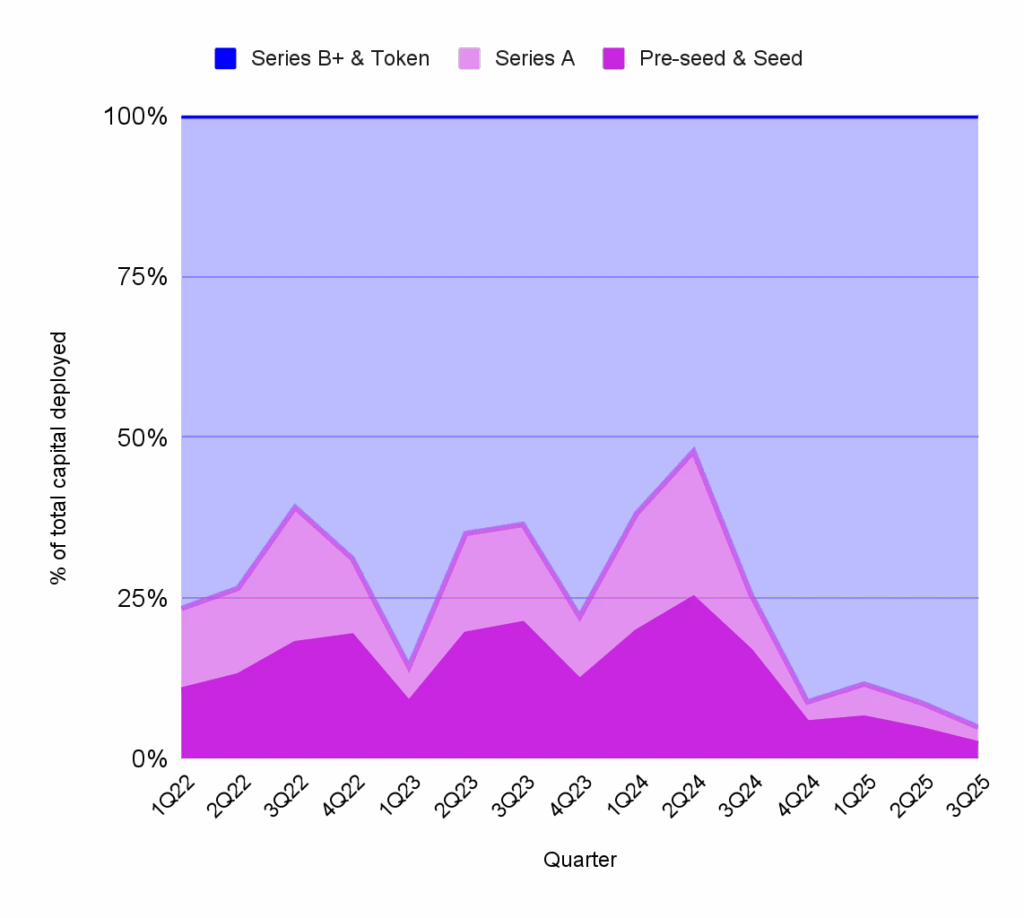
Data presented at the conference underscored a widening chasm between early-stage investments and later-stage capital deployment. According to aggregate analyses by Messari and Outlier Ventures tracking venture funding from the first quarter of 2022 through the third quarter of 2025, pre-seed and seed allocations have experienced a noticeable contraction in relative capital share.
Conversely, Series B and later-stage rounds have continued to command investor attention and larger average check sizes. This capital concentration is largely a byproduct of macroeconomic and fund-lifecycle realities. Many venture funds raised during the 2020–2021 market peak are now fully deployed. With limited fresh fund formations successfully closing in the subsequent downturn, GPs are forced to prioritize the triage and growth of existing portfolio winners over speculative new bets.
This dynamic has created a rigorous environment for early-stage founders. Venture capital firms are no longer funding ideas based on whitepaper promises or KOL (Key Opinion Leader) hype. Instead, early-stage teams are expected to demonstrate immediate product-market fit, sustainable revenue generation, and verifiable usage metrics before securing institutional backing.
The Rise of Data-Led Investing and Portfolio Optimization

A defining takeaway from Token2049 Singapore 2025 was the sophisticated use of data by venture capitalists. Unlike previous cycles where investments were frequently driven by narrative momentum, contemporary GPs are leveraging robust data analytics to guide their deployment strategies.
With years of performance metrics, cohort behavior, and sector resilience data now available, venture funds are increasingly pivoting toward redeploying capital into proven winners. This strategy is viewed not as a defensive posture, but as a rational allocation of resources. Some mature funds have even established internal over-the-counter (OTC) trading desks or dedicated liquidity management units to acquire secondary positions in top-tier protocols that they missed during initial financing rounds.
For firms like Outlier Ventures, which has operated accelerators for over a decade, this data-centric approach validates a long-held thesis. By relying on proprietary benchmarking tools and historical traction data, venture partners can mitigate downside risk while identifying structural growth areas within decentralized finance, infrastructure, and real-world asset tokenization.
Digital Asset Treasuries (DATs) and Liquidity Management
Liquidity management emerged as a primary strategic pillar for funds navigating the current market architecture. A prominent concept discussed extensively across stages and side events was the "DAT Revolution"—the rise of Digital Asset Treasuries.
Initially conceptualized as a basic bridge between traditional finance (TradFi) and the blockchain economy, DATs have matured into flexible financial instruments designed to optimize short-term capital efficiency. Funds are increasingly balancing traditional equity holdings with liquid digital assets and yield-generating protocols to hedge against market volatility and ensure continuous capital productivity.
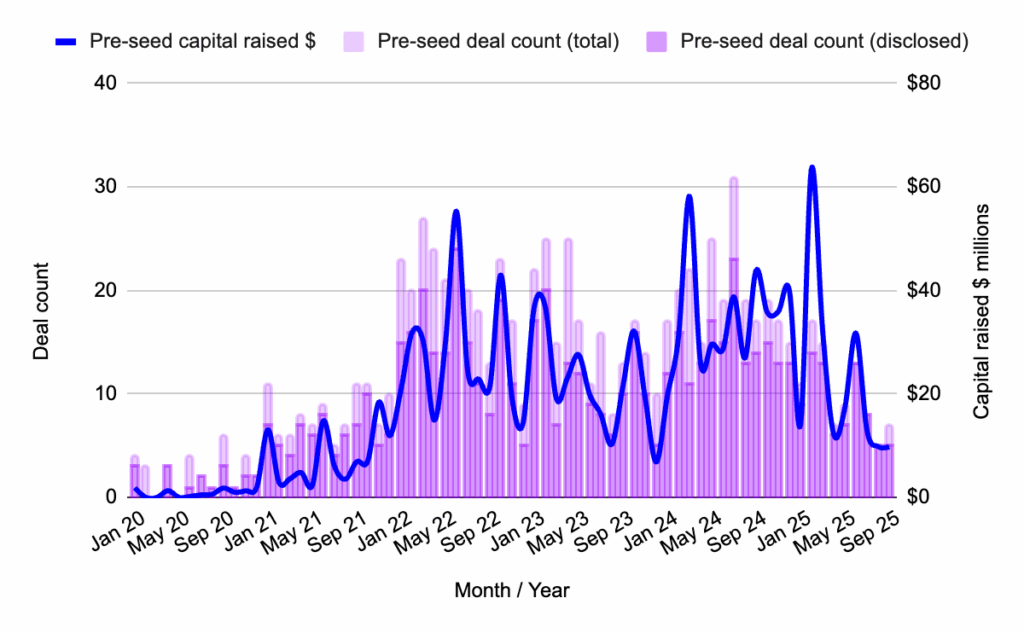
However, the widespread adoption of DAT strategies introduces a complex trade-off. As more capital is directed toward liquid treasuries and secondary market positioning, proportionately less liquidity flows into early-stage venture rounds. While this exacerbates the early-stage funding squeeze, it simultaneously reflects an industry transitioning from reckless speculation to corporate and financial maturity.
Limited Partner Scrutiny and Fundraising Headwinds
For venture capital managers seeking to raise new funds, the fundraising climate remains fiercely competitive. Limited Partners—including pension funds, endowments, and family offices—are enforcing significantly stricter evaluation criteria.
LPs are demanding comprehensive transparency, clear liquidity pathways, and rigorous governance frameworks before committing capital to new Web3 vehicles. Consequently, closing a new crypto fund takes considerably longer than it did during the 2021 boom. Industry analysts note that this increased friction is a healthy sign of institutional maturation rather than a permanent withdrawal of capital. Funds that successfully raise capital in this environment must demonstrate proven track records, repeatable investment theses, and undeniable operational discipline.
Founder Adaptability and the Shift in Capital Formation
Founders attending Token2049 Singapore 2025 expressed a clear understanding of the new capital paradigm. The era of relying exclusively on high-profile marketing campaigns or speculative token launches has largely ended. Revenue-first models, sustainable tokenomics, and bootstrapping have become standard operating procedures.

To navigate the scarcity of early-stage venture capital, founders are increasingly exploring alternative capital formation models. Fair-launch platforms like Virtuals and Hyperliquid, alongside community-driven token sale networks such as Echo, Coinlist, and Legion, have gained substantial traction. These platforms enable projects to align long-term incentives directly with users and early adopters, fostering organic community growth and transparent price discovery without relying solely on traditional institutional gates.
Ecosystem Catalysts and Institutional Integration
As the Web3 venture landscape stabilizes, ecosystem-specific support mechanisms are playing an increasingly vital role in founder success. Programs tailored to specialized layer-1 and layer-2 networks—such as Outlier Ventures’ Injective Ecosystem Cohort—are designed to bridge the gap between early-stage conviction and scalable execution. By embedding founders within established network architectures, these programs help teams navigate complex technical challenges, cross-chain liquidity integration, and decentralized governance.
Outlook: From Momentum to Necessity
Token2049 Singapore 2025 served as a clear indicator that the Web3 venture capital ecosystem has graduated from its experimental adolescence into a disciplined, institutionalized asset class. While capital concentration, rigorous LP scrutiny, and the rise of treasury management tools have altered the fundraising playbook, they have ultimately laid a stronger foundation for sustainable innovation.
The consensus leaving Singapore was definitive: the market has traded short-term speculative momentum for long-term operational necessity. For investors equipped with robust data analytics and founders capable of proving tangible utility, the post-hype landscape represents not a contraction, but the fertile ground upon which the next generation of decentralized infrastructure will be built.

