
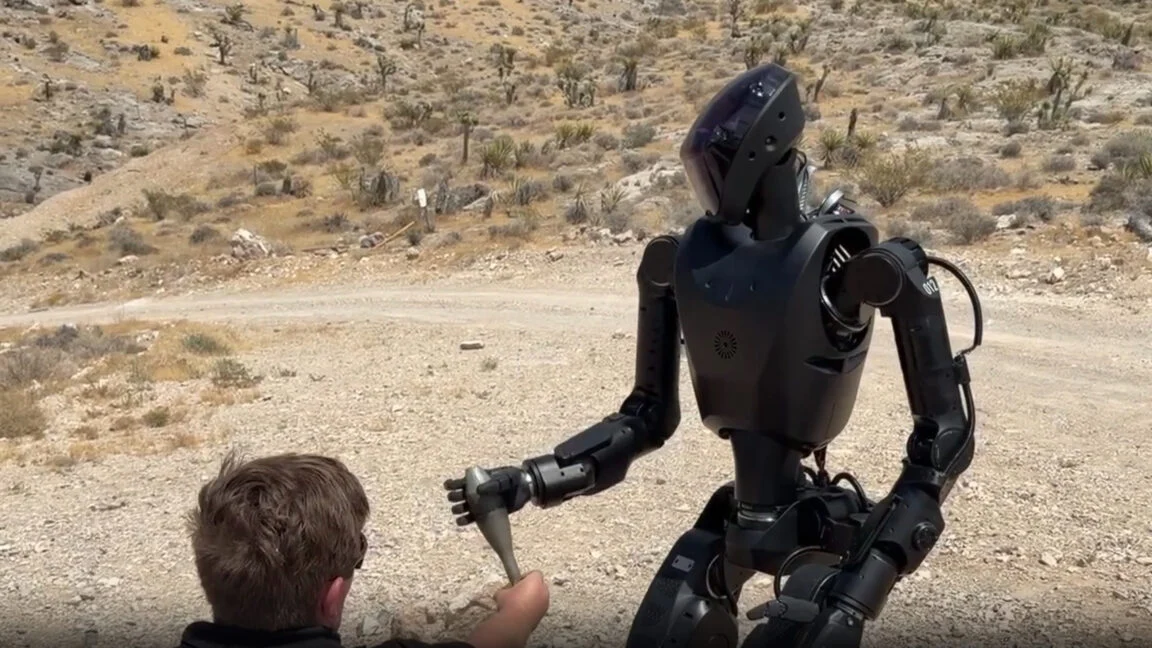
The promise of humanoid robotics in military applications has long occupied the space between science fiction and venture capital pitch decks. However, recent developments concerning Foundation, a startup claiming to deploy humanoid robots to the frontlines of the conflict in Ukraine, have highlighted a stark discrepancy between marketing narratives and the operational realities of modern warfare. Independent journalist and host of the Eye on AI podcast, Craig Smith, has shed light on the logistical failures surrounding Foundation’s claims, casting doubt on the company’s assertion that its "Phantom" robots have successfully reached the Ukrainian theater.
According to Smith, who documented his attempt to track the delivery of these systems, the Foundation robots never actually crossed the border into Ukraine. Instead, the shipment was halted at the Polish-Ukrainian border, leaving the robots stranded in a logistical limbo that contradicts the company’s public-facing narrative. When confronted with these findings, Foundation’s leadership, including spokesperson LeBlanc, failed to provide verification of arrival. Furthermore, LeBlanc retreated from previous assertions that the company had conducted formal demonstrations for Brave1, the Ukrainian government’s cluster for defense technology. This retraction suggests that the integration of humanoid platforms into the Ukrainian defense ecosystem is significantly less advanced—or perhaps non-existent—than promotional materials have implied.
The Marketing vs. Mechanics Gap
The promotional media released by Foundation serves as a case study in the current disconnect between robotics R&D and combat utility. A video released by the company in May 2026, labeled a "mortar demo," depicts a humanoid robot performing the task of loading a mortar shell. The movement is notably slow and deliberate, highlighting a fundamental issue: humanoids, while visually impressive, lack the speed, stability, and ruggedization required for high-intensity combat zones.
In a battlefield environment, where seconds translate to life or death, the deliberate, controlled motions of current humanoid hardware are liabilities. The "mortar demo" showcases a controlled, static environment that bears no resemblance to the chaotic, mud-filled, and explosive-heavy reality of the Donbas or southern frontlines. The mechanical complexity of a humanoid robot—which requires thousands of actuators, intricate sensors, and high-energy battery systems—makes it inherently fragile compared to the simplified, hardened chassis of established military hardware.
The Evolution of Unmanned Ground Vehicles (UGVs)
While startups chase the humanoid dream, the Ukrainian military has pioneered a more pragmatic and effective approach to robotic warfare. The actual "robots" making an impact on the frontlines are not bipedal figures, but Unmanned Ground Vehicles (UGVs). These platforms, characterized by their robust caterpillar tracks or high-traction wheels, represent the current apex of combat robotics.
The tactical utility of these UGVs is defined by their modularity and durability. Unlike humanoids, which are optimized for human-scale environments and balance, UGVs are engineered for heavy lifting, traverse, and survivability. As the Ukrainian military continues to face a significant personnel deficit compared to the Russian armed forces, these systems have become essential force multipliers.
Data from the 2026 tactical reports indicate that ground robots are now being used for a wide spectrum of operations:
- Logistical Resupply: Autonomous or remotely operated vehicles carrying ammunition, food, and water to forward operating bases (FOBs) that are too dangerous for human drivers.
- Casualty Evacuation (CASEVAC): Specially modified UGVs capable of carrying wounded soldiers from the "zero line" to triage points, significantly reducing the exposure of medical personnel to enemy fire.
- Combat Engagement: Armed variants, often mounted with remote weapon stations (RWS), are utilized to provide suppressing fire or serve as mobile, expendable "loitering" explosive platforms.
Chronology of Robotic Deployment in Ukraine
The integration of unmanned systems into the Ukrainian counteroffensive has followed a rapid, iterative timeline.
- Early 2024: Ukraine begins experimenting with small, commercial off-the-shelf (COTS) ground robots for mine clearing and basic surveillance.
- Late 2024–2025: The shift toward dedicated, military-grade UGVs accelerates. The Ukrainian Ministry of Defense formalizes partnerships with local tech startups to mass-produce reliable, low-cost tracked vehicles.
- April 2026: A surge in robotic deployment is observed, with ground robots being used in conjunction with aerial drone swarms to conduct reconnaissance and localized attacks.
- July 2026: Advanced tactics emerge, including the delivery of UGVs behind enemy lines via amphibious landings and heavy-lift drone airdrops.
- September 2026: During tactical offensives, the use of airdropped robots to breach minefields and neutralize fortified Russian positions proves to be a turning point in breaking through pincer movements.
Analysis: Why Humanoids Struggle in Combat
The failure of the humanoid model to gain traction in the Ukrainian war effort is rooted in engineering physics. A humanoid robot must maintain a complex center of gravity, which is easily disrupted by uneven terrain, debris, or the impact of concussive shockwaves from nearby artillery. Conversely, a UGV with a low center of gravity and a wide wheelbase is inherently stable.
Furthermore, the "general-purpose" claim often leveled by humanoid manufacturers fails to account for the specialization required on the frontlines. A robot in a factory, where floors are level and lighting is consistent, can rely on high-fidelity sensors and pre-mapped environments. On a battlefield, the environment is dynamic, unpredictable, and saturated with electronic warfare (EW) signals that can disrupt the wireless communication links upon which these robots depend.
The current military standard, therefore, favors "dumb" but reliable automation over "smart" but fragile humanoids. The Ukrainian military’s success is a direct result of selecting platforms that can be mass-produced, easily repaired in the field, and effectively operated by personnel with minimal training.
Official Responses and Industry Implications
The ambiguity surrounding Foundation’s claims serves as a warning for investors and military planners alike. When questioned by reporters, industry analysts noted that the "Brave1" certification process is rigorous and transparent. By failing to substantiate their claims or provide evidence of official integration, Foundation has inadvertently exposed the fragility of the "Silicon Valley" approach to defense contracting.
The broader implication is that the defense industry is entering a new era of scrutiny. As states continue to integrate robotics into their national defense strategies, the premium will be placed on verifiable performance metrics rather than aesthetic appeal. Companies that pivot away from the "humanoid hype" and toward the "utility-first" engineering model—focusing on ruggedized, task-specific, and cost-effective ground vehicles—are likely to see the greatest success in securing long-term government contracts.
Conclusion: The Future of the Robotic Battlefield
The battlefield of the future will almost certainly be dominated by autonomous and semi-autonomous systems, but it will not look like the humanoid-filled landscapes depicted in speculative fiction. It will be characterized by a diverse ecosystem of specialized machines: aerial swarms providing constant surveillance, tracked ground vehicles handling the brunt of logistical and frontline combat, and high-speed sensors processing data in real-time.
For Foundation and other startups in the humanoid sector, the path forward requires a shift in priorities. If these companies wish to contribute to modern defense, they must move beyond the marketing videos that show robots performing choreographed tasks in safe, interior environments. They must instead address the harsh realities of front-line duty: the need for rapid repair in the field, the requirement for high-level resistance to electronic jamming, and the necessity of navigating the literal and metaphorical terrain of modern, high-intensity conflict. Until then, the "Phantom" robots—and the hype surrounding them—will remain largely confined to the borderlands, while the real work of robotic warfare continues on the frontlines, performed by machines that prioritize function over form.

