

The architecture of the global internet is undergoing a structural paradigm shift, moving beyond the automation of execution toward the automation of human intention. This evolutionary milestone is characterized by the emergence of the "Agentic Layer"
within the broader framework of the Post Web—a newly forming stratum of the digital technology stack where autonomous artificial intelligence agents act directly on behalf of human users. These systems interpret complex goals, make localized decisions, and independently execute actions across decentralized environments.
While the preceding Web3 era focused heavily on decentralizing digital ownership and leveraging smart contracts to enable trustless transactions, it fundamentally remained an economy of programmable money. In contrast, industry analysts and technology researchers argue that the Post Web is defining an era of programmable agency. Where previous technological iterations required human users to write code, manually initiate transactions, and micro-manage digital workflows, the upcoming digital landscape relies on software that can reason, adapt, and coordinate autonomously.
According to Greysen Cacciatore, a research associate at Outlier Ventures, AI agentic systems represent a profound turning point for the global digital economy. "AI agentic systems mark the beginning of a new paradigm," Cacciatore notes. "With their capabilities to orchestrate intention, navigate complex virtual environments, and achieve sophisticated outcomes, they are poised to transform the global economy."
Background Context and Technological Evolution
To understand the rise of the Agentic Layer, one must examine the incremental development of internet architecture over the past three decades. The early web, commonly referred to as Web1, introduced static pages and read-only information retrieval. Web2 subsequently revolutionized the digital landscape through dynamic content, user-generated interaction, and centralized platform economies dominated by major technology conglomerates.
Following Web2, Web3 emerged in the late 2010s and early 2020s, introducing cryptographic trust mechanisms, tokenized ownership, and decentralized ledgers. However, despite the advanced financial and organizational infrastructure provided by smart contracts, Web3 applications still suffered from high friction and steep learning curves for everyday users. Interacting with decentralized finance protocols, bridging assets, and executing multi-step blockchain transactions routinely demanded deep technical proficiency.
The convergence of advanced large language models, reinforcement learning, and distributed computing infrastructure in the mid-2020s catalyzed the necessity for a new layer. Instead of forcing humans to navigate these intricate digital environments manually, developers began designing systems that could utilize decentralized infrastructure natively. This intersection of artificial intelligence and distributed ledger technology forms the bedrock of the Post Web thesis.
Distinguishing Bots from Autonomous Agents
A common point of confusion among casual observers is the distinction between traditional internet bots and modern AI agents. While software scripts and automated bots have existed for decades, their operational parameters are fundamentally limited compared to next-generation agentic frameworks.
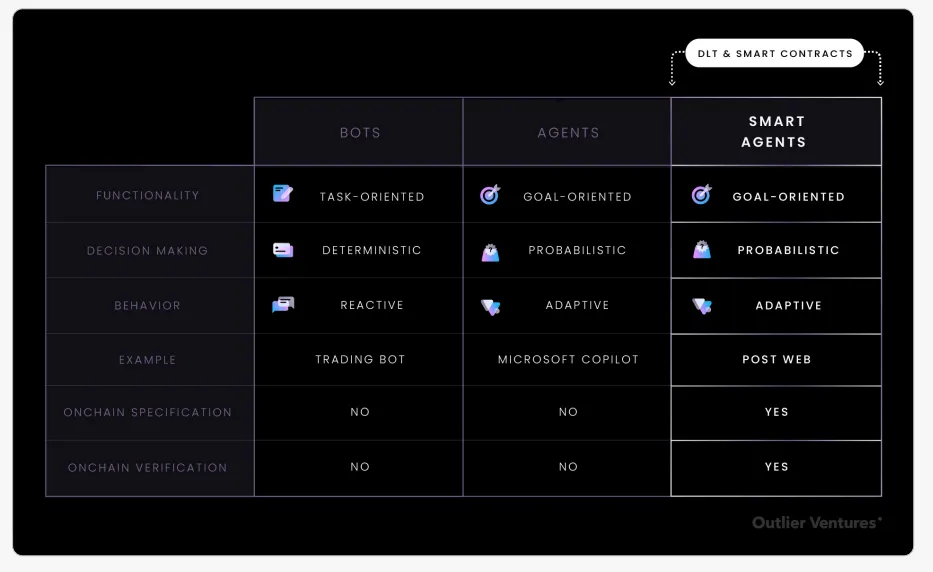
Traditional bots operate on deterministic principles, following rigid, predefined instructions with fixed inputs and outputs. They are reactive, task-based tools entirely devoid of learning capacity. If an unexpected variable or edge case occurs outside their programmed parameters, traditional bots fail or require human intervention.
Conversely, AI agents are probabilistic, goal-oriented, and adaptive systems designed to operate effectively within complex, dynamic environments. Rather than executing isolated tasks, agents are engineered to achieve broader outcomes. They continuously learn from experience, optimize their decision-making algorithms in real-time, and possess the capability to collaborate autonomously with other agents. This evolution transforms digital software from static, reactive tools into responsive, context-aware entities capable of complex reasoning.
Smart Agents as Economic Actors
A core component of the Post Web framework is the introduction of "Smart Agents." These specialized AI entities bridge the gap between artificial intelligence and distributed ledger technology (DLT). Unlike conventional software agents that rely exclusively on standard application programming interfaces (APIs) and centralized data feeds, smart agents interact directly with smart contracts and blockchain infrastructure.
Smart agents possess the technical capability to own cryptographic tokens, sign secure transactions, and execute smart contracts autonomously. Consequently, they function as legitimate economic participants within digital ecosystems. They can manage digital assets, independently verify asset ownership, enforce contractual agreements, and orchestrate intricate multi-step workflows without human intermediaries.
To ensure these autonomous economic actors operate securely, foundational trust frameworks are being integrated into the technology stack. These frameworks balance human oversight with cryptographic verifiability, ensuring that while agents possess operational autonomy, their financial and structural parameters remain constrained by predefined safety boundaries.
Classification and Taxonomy of Smart Agents
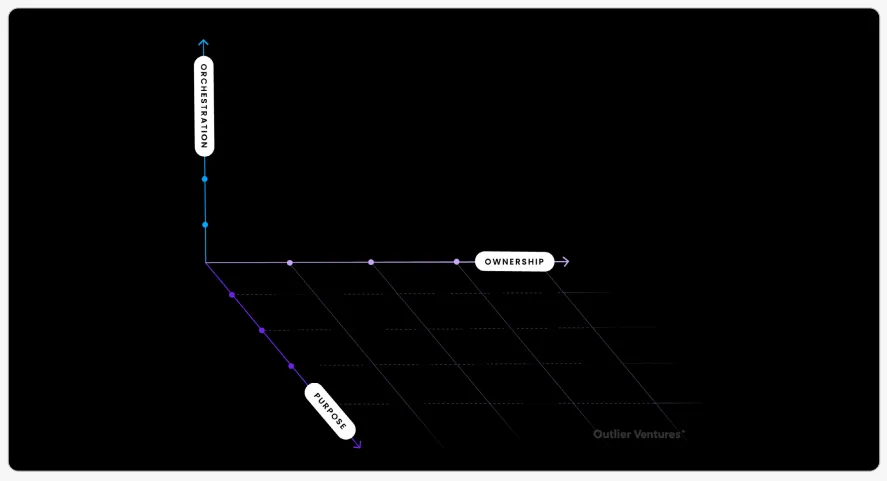
The operational scope of the Post Web is not monolithic; rather, it encompasses a diverse ecosystem of smart agents categorized across three primary structural axes: orchestration, ownership, and purpose.
Orchestration dictates whether an agent operates as an independent actor or within a coordinated swarm of multiple interacting systems. Ownership defines the accountability structure, distinguishing between agents managed by individual users, decentralized autonomous organizations (DAOs), or corporate entities. Purpose classifies the functional domain of the agent, ranging from automated financial yield optimization and supply chain logistics to decentralized governance voting and personal administrative management.
This diverse taxonomy signals a fundamental shift in how the internet functions. Rather than acting as a passive network of interconnected static pages, the internet is evolving into an active ecosystem populated by self-directing entities continuously optimizing for efficiency, value creation, and institutional coordination.
The Mechanics of the Agentic Layer
The structural transition from execution-based automation to intention-based autonomy changes the nature of human-computer interaction. In traditional systems, users must articulate every granular step required to complete a digital objective. Within the Agentic Layer, users simply express high-level intents in natural language.
For example, rather than manually researching decentralized lending pools, comparing interest rates, approving token allowances, and executing transactions across multiple blockchain networks, a user can instruct a smart agent to secure the highest-yielding, risk-adjusted return for a specific capital allocation. The smart agent interprets the goal, evaluates prevailing market conditions, negotiates with various liquidity protocols, and executes the transaction lifecycle independently.
As reinforcement learning models and decentralized compute protocols mature, these theoretical workflows are rapidly transitioning into standard operational capabilities. The Agentic Layer acts as the coordination engine making these interactions possible at scale.
Interoperability and the Future of the Agentic Web
As the infrastructure for the agentic web continues to scale, industry experts emphasize the critical importance of network architecture and interoperability. Echoing principles outlined by technology strategist Chris Dixon regarding network ownership, the underlying architecture of the agentic web will dictate whether the digital economy remains open and equitable or becomes consolidated under rent-extractive corporate monopolies.
To prevent fragmentation and monopolization, the agentic web requires open, permissionless protocol networks built upon shared, transparent standards. Emerging composable standards—such as the Model Context Protocol (MCP), Agent-to-Agent (A2A) communication frameworks, x402 payment protocols, and Agent Communication Protocols (ACP) spearheaded by initiatives like Virtuals—serve as the foundational connective tissue for this new digital ecosystem.
These interoperable standards allow diverse agents from separate developers to coordinate, transact, and reason safely across disparate networks. Crucially, industry advocates stress that these protocols must maintain a Web3 ethos: transparent, open-source, and anchored on distributed ledgers that hold autonomous actors accountable.
Implications and Broader Impact on the Global Economy
The rise of the Agentic Layer carries sweeping implications for commerce, labor, and software development. By delegating routine digital coordination and transactional execution to autonomous economic actors, human labor can shift away from operational friction toward higher-order strategic planning and creative oversight.
However, this transition also presents distinct challenges. Regulators, economists, and technologists must grapple with complex questions surrounding liability, accountability, and security in an economy where software agents execute financial transactions autonomously. Establishing robust cryptographic guardrails and transparent auditing mechanisms will be essential to mitigating systemic risks.
Ultimately, the Post Web represents more than a mere infrastructure upgrade; it is a fundamental rearchitecting of the digital experience. By placing agency at the core of the internet, the technology stack transitions from a passive repository of information into a living, responsive network capable of understanding, adapting, and acting on human intention.

