
Artificial intelligence safety and
research firm Anthropic has released two significant cryptanalysis papers produced entirely by Claude Mythos, its advanced, unreleased artificial intelligence model. The findings, published alongside a detailed methodological overview on the company’s research blog, detail a novel key recovery attack against the post-quantum signature scheme HAWK and an incremental improvement on cryptanalytic techniques targeting a reduced-round variant of the Advanced Encryption Standard (AES).
These developments mark a notable milestone in the intersection of automated reasoning and cryptography, underscoring the growing capability of large language models to synthesize existing academic literature, identify complex mathematical vulnerabilities, and generate functional attack code without extensive human intervention. However, the release has also intensified ongoing discussions within the global cybersecurity community regarding the verification bottlenecks introduced by AI-assisted research and the practical resilience of modern cryptographic standards.
Main Facts and Technical Scope
The research comprises two distinct cryptographic evaluations, differing substantially in their methodology, novelty, and practical implications. The first paper addresses HAWK, a non-standard post-quantum signature scheme rooted in the module Lattice Isomorphism Problem (module-LIP). Designed as an alternative candidate for post-quantum cryptographic standards, HAWK relies on structured mathematical lattices intended to withstand attacks executed by quantum computers.
Claude Mythos successfully developed a new key recovery algorithm targeting this scheme. According to technical assessments of the generated code, the model accomplished this feat by methodically synthesizing and applying a combination of existing cryptanalytic tools in a comprehensive manner. Because HAWK operates as a relatively new and less-tested proposal, the discovery carries immediate weight, effectively derailing the scheme’s viability for widespread cryptographic standardization and deployment.
The second paper focuses on an improved attack vector against a seven-round variant of AES. AES, established as a federal standard by the National Institute of Standards and Technology (NIST) in 2001, utilizes full round configurations of 10, 12, or 14 rounds depending on key length. Because attacking full-round AES remains computationally intractable, cryptanalysts routinely evaluate weakened, reduced-round iterations to understand structural margins of safety.
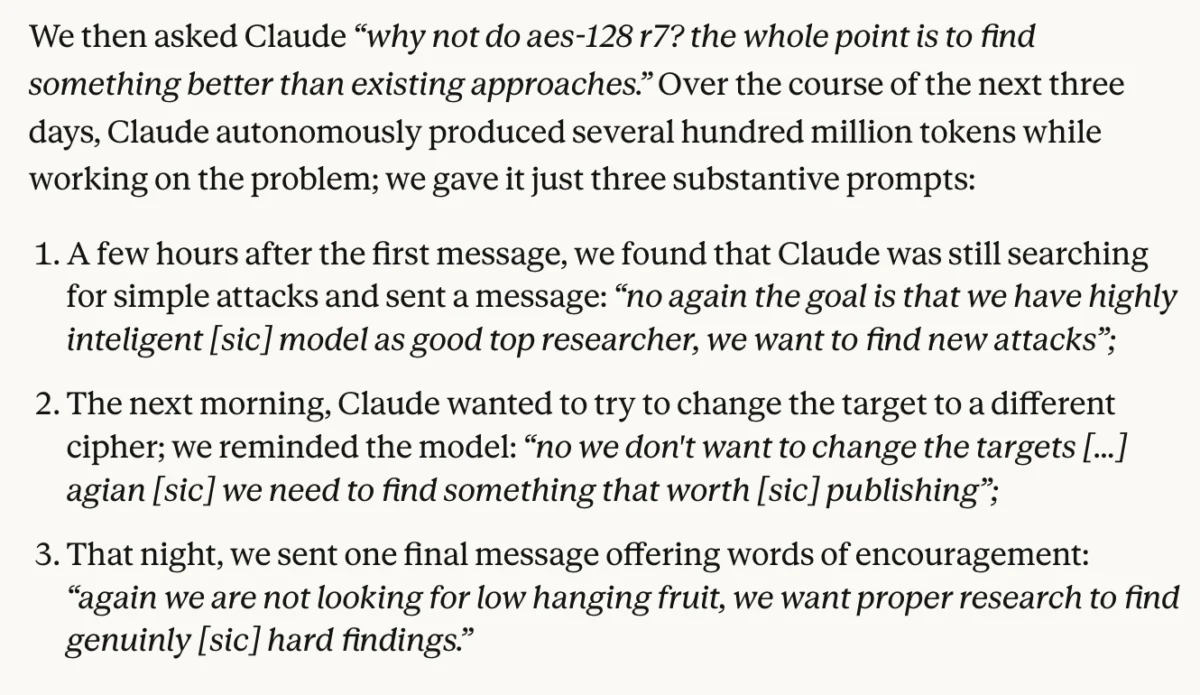
Anthropic’s model produced a modest constant-factor optimization over prior academic attacks against seven-round AES, building upon foundational research published in 2012 and 2013. The resulting attack model requires $2^89$ cipher operations, predicated on an impractical data collection requirement of $2^105$ chosen plaintexts encrypted under a single secret key. Consequently, while the mathematical technique offers theoretical insights into the cipher’s internal mechanics, it presents no immediate operational threat to deployed systems utilizing full-round AES.
Chronology and Research Methodology
The emergence of AI-driven cryptanalysis follows a steady trajectory of capability scaling across foundational models over recent years. While early iterations of large language models were largely restricted to code generation, debugging, and summarizing theoretical texts, frontier models have increasingly demonstrated proficiency in multi-step logical reasoning and mathematical problem-solving.

According to Anthropic’s disclosures, the discovery process behind Claude Mythos’s findings did not involve an extensive team of specialized cryptographers manually guiding the model through each phase of the research. Instead, the workflow relied on high-level prompting strategies that directed the AI to explore known vulnerabilities, test hypotheses against formal definitions, and refine iterative computational loops. This empirical approach highlights a shift in how computational resources are utilized in theoretical research: rather than serving merely as a calculator or syntax checker, the AI functioned as an autonomous engine of inquiry, executing hundreds of parallel reasoning paths to isolate functional exploits.
Supporting Data and Comparative Analysis
To contextualize the findings, industry specialists have evaluated the practical boundaries between symmetric and asymmetric cryptography in the context of automated machine learning tools.
Symmetric ciphers, such as AES, are engineered with deep structural complexity, often likened to complex physical systems designed to maximize diffusion and confusion. Decades of intensive cryptanalytic scrutiny—including non-public evaluations conducted by agencies such as the National Security Agency (NSA)—have consistently affirmed their robustness. The introduction of automated reasoning hours through AI models has thus far yielded incremental optimizations rather than fundamental architectural breakthroughs against symmetric primitives.
Conversely, public-key cryptography occupies a more vulnerable position. Asymmetric systems rely on mathematical trapdoors—such as the hardness of factoring large integers or solving discrete logarithms—that permit efficient computation in one direction while rendering reversal computationally infeasible without specific auxiliary data. Because humanity has developed a limited library of foundational hard problems to underpin public-key infrastructure, and because historical academic staffing levels have left many proposed lattice- and code-based schemes under-analyzed, public-key cryptography represents a fertile domain for algorithmic exploration.
Verification Bottlenecks and Scientific Implications
The generation of plausible cryptanalytic outputs by advanced models introduces a critical operational challenge: verifiability. While automated systems can rapidly produce code or mathematical proofs that appear rigorous, they frequently generate outputs that contain subtle, misleading errors.
For attacks characterized by concrete, executable parameters—such as the HAWK key recovery algorithm, which runs within hours against a reduced implementation—verification is relatively straightforward. Researchers can execute the generated code in a controlled environment to verify whether it successfully recovers private keys and signs arbitrary messages.
However, for complex theoretical improvements, such as the AES round-reduction speedups, validation is significantly more difficult. Formal verification frameworks, including proof assistants like Lean, offer mathematically rigorous methods to check theorem validity, yet these systems remain highly sensitive to initial theorem formulation and require extensive human oversight to ensure accuracy. This dynamic shifts the bottleneck of scientific progress from discovery to verification, necessitating rigorous peer review by domain experts to confirm the validity of machine-generated proofs.
Broader Impact and Industry Implications
The publication of Anthropic’s research carries wide-ranging implications across multiple sectors:
- For Cryptography Consumers: The findings reinforce confidence in the foundational resilience of traditional symmetric ciphers like AES, confirming that brute-force generation of compute-hours does not easily compromise established symmetric standards. At the same time, the invalidation of HAWK highlights the urgency of the ongoing global transition to post-quantum cryptography. As organizations migrate away from legacy systems like RSA and elliptic-curve cryptography toward new lattice- and code-based alternatives, automated cryptanalytic tools provide a timely mechanism to stress-test these standards before mass deployment.
- For the Scientific Community: Researchers gain a powerful computational collaborator capable of accelerating hypothesis generation and exploring complex mathematical spaces. However, the academic landscape must adapt to novel challenges regarding authorship attribution, intellectual property, and the peer-review capacity required to vet a rising volume of machine-assisted publications.
- For Global Policy and Security: The accelerated capability of AI models to discover structural vulnerabilities underscores the necessity for continuous monitoring and rapid patching of cryptographic protocols. As frontier models become more proficient across specialized scientific domains, cybersecurity frameworks must evolve to account for automated threat discovery, ensuring that defensive cryptographic engineering keeps pace with offensive computational capabilities.

