

The modern internet presents a fundamental design paradox: users demand absolute privacy when navigating digital spaces, while service providers require robust anti-abuse mechanisms to defend against automated botnets, credential-stuffing attacks, and distributed denial-of-service (DDoS) vectors. For decades, platforms attempted to resolve this tension by deploying increasingly aggressive tracking measures, device fingerprinting, and friction-heavy verification challenges such as Completely Automated Public Turing tests to tell Computers and Humans Apart (CAPTCHAs). However, these invasive methods routinely compromise user privacy by aggregating behavioral data across disparate websites.
To resolve this conflict, computer scientists and cryptographers have increasingly turned to anonymous credentials. Building upon foundational theoretical frameworks established in the late twentieth century, contemporary cryptographic engineering has successfully scaled these systems to support billions of daily active users worldwide. This evolution marks a decisive shift from abstract academic proposals to hardened, standardized internet protocols that quietly power the security infrastructure of major technology conglomerates.
Understanding the Mechanics of Anonymous Credential Systems
At its core, an anonymous credential system is architected around three distinct operational entities: the Issuer, the Resource, and the User. The Issuer acts as the authority that authenticates a user’s identity through traditional, non-anonymous means, such as an established account registration or hardware-backed device attestation. Upon successful verification, the Issuer dispenses one or more cryptographically blinded credentials to the User.
The User subsequently interacts with one or more Resources—typically web services, application endpoints, or content delivery networks. When the User attempts to access a Resource, they present their credential through a mathematical "show" procedure. A properly implemented anonymous credential protocol ensures absolute unlinkability. Neither the Resource, the Issuer, nor both entities acting in collusion can correlate a specific redemption event back to the original issuance transaction. This mathematical guarantee severs the historical link between authentication and user tracking.
Evolution and Standardization of Privacy Pass
The most pervasive implementation of this architecture is Privacy Pass, a standardized framework formalized across Internet Engineering Task Force (IETF) Request for Comments (RFC) 9576, 9577, and 9578. Originally conceived by researchers at Cloudflare alongside academic collaborators to mitigate the friction of anti-abuse challenges, Privacy Pass has evolved into a foundational web standard.
Today, variants of the Privacy Pass protocol are deployed globally by major technology ecosystems. Apple implements the standard through its "Private Access Tokens" framework, Google utilizes "Private State Tokens," and the Brave web browser incorporates native protocol support. Even Microsoft integrates the standard into the Edge browser architecture. Industry telemetry suggests that billions of consumer devices utilize Privacy Pass protocols daily, frequently operating transparently in the background without explicit user interaction.

Chronology and Deployment Milestones
The architectural lineage of Privacy Pass traces back to foundational cryptographic principles introduced in the early 1980s, most notably David Chaum’s pioneering work on blind signatures.
- 1982: Cryptographer David Chaum publishes the conceptual framework for blind signatures, allowing a signer to authorize a message without learning its underlying content.
- 2018: Academic researchers and infrastructure engineers, led by teams at Cloudflare, introduce Privacy Pass at the Privacy Enhancing Technologies Symposium (PETS) as a mechanism to streamline CAPTCHA clearance.
- 2021–2023: Major technology firms begin proprietary integrations, transitioning the protocol from a niche browser extension to operating-system-level implementations across iOS, macOS, Android, and desktop browsers.
- 2024: The IETF formally publishes RFCs 9576, 9577, and 9578, establishing official Internet Standards for Privacy Pass architecture, token types, and cryptographic issuance protocols.
Cryptographic Design: Publicly Verifiable versus Privately Verifiable Tokens
To achieve high-speed authentication at scale, Privacy Pass defines distinct issuance protocols optimized for varying threat models and performance requirements.
Publicly verifiable tokens rely heavily on blind RSA signature schemes, mirroring Chaum’s original cryptographic constructs. In this workflow, a user blinds a unique token identifier and sends it to the Issuer. The Issuer signs the blinded token using its private key and returns the signature. The user then unblinds the signature, resulting in a valid credential consisting of a token type, metadata, serial number, and cryptographic signature. Because verification depends entirely on the Issuer’s public key, the Resource does not require shared secret key material to validate the user’s credential.
Despite their architectural elegance, RSA-based blind signatures introduce computational overhead. RSA algorithms require large key lengths—typically a minimum of 2,048 bits to achieve equivalent security margins to 112-bit symmetric encryption—resulting in larger data payloads and slower processing velocities.
Conversely, for environments demanding ultra-low latency, Privacy Pass supports privately verifiable tokens utilizing oblivious pseudorandom functions (OPRFs) and message authentication codes (MACs). These elliptic-curve-based primitives execute significantly faster than their RSA counterparts. However, this performance gain introduces an operational trade-off: the Resource must possess the Issuer’s secret key material to verify incoming credentials, necessitating a higher degree of trust and tighter infrastructural coordination between the entities.
Metadata Binding and Session-Specific Credentials
A critical capability within the Privacy Pass architecture is the integration of metadata strings ($MD$). Metadata allows a user to cryptographically bind a credential to a specific application, domain, or operational timeframe. For example, a user requesting access to a specific news portal can bind the credential to a domain string and a date variable. When the credential is presented, the target Resource verifies the embedded metadata before granting access.
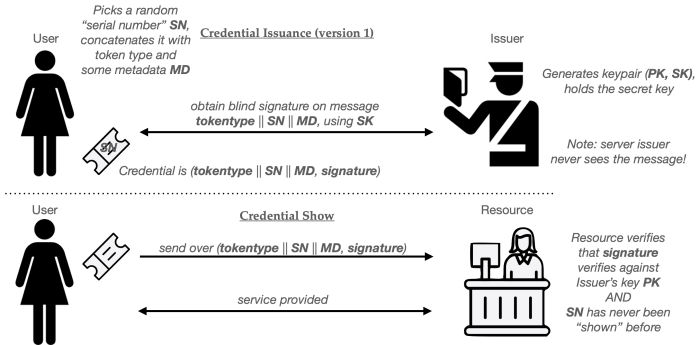
Crucially, the Issuer remains entirely blind to this metadata string. The selection is performed exclusively by the User, preventing the Issuer from tracking which specific resources the user intends to access.
This capability underpins session-specific credential issuance. Rather than obtaining static credentials in advance, a user initiates a session with a protected resource (such as a Cloudflare-shielded web property) and subsequently requests a real-time, context-bound credential. While this real-time approach offers enhanced security by restricting credential longevity—preventing users from stockpiling tokens for future use—it introduces notable operational vulnerabilities.
Technical Implications and Security Analysis
The implementation of real-time credential issuance introduces dependency risks. If the Issuer infrastructure experiences an outage, users lose the ability to acquire fresh credentials, effectively cutting off access to downstream Resources. Furthermore, real-time issuance introduces potential timing correlation vulnerabilities. If an Issuer and a Resource are operated by the same corporate entity, sophisticated traffic analysis could theoretically attempt to correlate the precise timestamps of issuance requests and token redemptions.
Security audits and empirical traffic analyses indicate that at the scale operated by infrastructure giants like Cloudflare—processing hundreds of thousands of transactions per second—such timing correlation attacks are exceptionally difficult to execute effectively. Nevertheless, architectural mitigation remains an ongoing focus for cryptographic engineers.
Broader Industry Impact and Future Horizons
Privacy Pass has successfully demonstrated that large-scale anonymous authentication is viable, scalable, and economically sustainable for commercial deployment. By reducing reliance on invasive tracking mechanisms, the standard represents a major step forward for user privacy on the open internet.
However, Privacy Pass remains fundamentally limited by its design scope. As a single-use "wristband" credential architecture, it excels at binary validation—confirming simply that a user possesses a valid credential without revealing identity. It does not natively support complex attribute validation, such as proving that an individual meets a specific age threshold without disclosing their exact date of birth or identity.
As regulatory bodies worldwide push for digital identity verification and age-assurance mandates, the cryptographic community is actively exploring advanced successors. Upcoming standards, including zero-knowledge proof-based credential frameworks currently undergoing standardization by organizations like Google, aim to bridge this gap. These next-generation systems promise to deliver granular, attribute-based privacy guarantees, signaling the next major evolution in secure internet communications.

