

The architecture of modern internet privacy has undergone a profound evolution, transitioning from abstract mathematical theories into robust, large-scale deployments that protect billions of users daily. Building upon foundational principles of anonymous authentication, the practical implementation of these systems moves past theoretical paradigms to address real-world challenges faced by major technology ecosystems. At the forefront of this operational shift is Privacy Pass, the most widely deployed anonymous credential standard globally, alongside emerging frameworks designed to tackle complex verification demands such as digital age assurance.
Background Context and Historical Foundations
The concept of anonymous credentials traces its roots back to pioneering cryptographic research from the early 1980s, most notably David Chaum’s introduction of blind signature schemes. For decades, these advanced cryptographic constructs remained largely confined to academic literature due to computational overhead, latency concerns, and the absence of standardized protocols. However, the exponential growth of automated abuse, aggressive web scraping, and pervasive bot traffic forced major web infrastructure providers to rethink online security. Traditional anti-abuse mechanisms—such as Completely Automated Public Turing tests to tell Computers and Humans Apart (CAPTCHAs)—frequently imposed significant usability penalties on human users while inadvertently leaking telemetry data that compromised individual privacy.
To reconcile the competing demands of rigorous anti-abuse enforcement and user confidentiality, industry researchers collaborated to translate cryptographic theory into standard web protocols. This effort culminated in the development of Privacy Pass, designed to decouple a user’s browsing identity from their authorization to access protected digital resources.
Chronology and Standardization of Privacy Pass
The deployment and formalization of Privacy Pass followed a deliberate trajectory from a niche browser extension to an Internet Engineering Task Force (IETF) standard, integrated deeply into the core operating systems and web browsers used worldwide.
The timeline of deployment and standardization reflects a coordinated industry push:
- 2017 to 2018: Researchers from Cloudflare, the University of Waterloo, and Royal Holloway University of London introduce Privacy Pass as an experimental browser extension aimed at reducing repetitive CAPTCHA challenges.
- 2018: The academic protocol is formally presented at the Privacy Enhancing Technologies Symposium (PETS), demonstrating its efficacy in reducing abuse without tracking users.
- 2021 to 2022: Major technology corporations adopt parallel implementations of the underlying protocol. Apple launches Private Access Tokens in iOS and macOS, while Google integrates Private State Tokens into the Privacy Sandbox initiative for the Chromium ecosystem.
- 2024: The IETF formally publishes Privacy Pass specifications across a suite of Request for Comments documents, specifically RFC 9576, RFC 9577, and RFC 9578, cementing its status as an open web standard.
Core Architecture and Technical Mechanisms

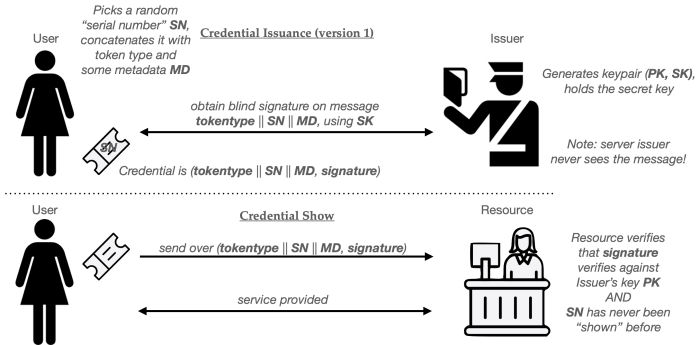
An anonymous credential system fundamentally relies on three distinct entities: an Issuer responsible for verifying user eligibility in a non-anonymous context, a Resource (such as a website or content delivery network) that requires proof of authorization, and the User who holds and presents the credentials.
The standard Privacy Pass framework utilizes single-use, wristband-style tokens. The issuance process heavily leverages blind signatures. In this procedure, a user generates a blinded token token—obscuring its contents from the Issuer—and transmits it to the Issuer for cryptographic signing. Once signed and returned, the user unblinds the token, yielding a valid credential consisting of a token type, metadata, a serial number, and a cryptographic signature. When the user later accesses a Resource, they present this credential. Because the signature was applied blindly, neither the Issuer nor the Resource can link the issuance event to the redemption event, effectively severing any persistent tracking vector.
Session-Specific Bindings and Metadata Integration
To enhance security and prevent token hoarding or illicit marketplace trading, modern iterations of Privacy Pass incorporate metadata strings into the credential structure. This metadata allows tokens to be cryptographically bound to specific applications, domains, or precise time windows.
Under a session-specific issuance flow, users acquire credentials dynamically during their initial interaction with a protected site rather than pre-fetching them in batches. For instance, a user navigating to a Cloudflare-protected domain can engage in a real-time issuance exchange where the metadata string incorporates the target domain and timestamp (e.g., domain.com || 2026-03-31). This ensures that the resulting credential holds zero utility outside that precise operational context.
While session-specific credentials grant robust control over real-time traffic management, they introduce operational vulnerabilities. If the centralized Issuer experiences downtime, access to the dependent Resource collapses because users cannot acquire fresh tokens on demand. Furthermore, critics have noted potential metadata correlation risks: if an Issuer and a Resource are operated by the same corporate entity, analyzing timestamps across both endpoints could theoretically enable traffic timing correlation attacks. However, given the massive scale of networks handling hundreds of thousands of transactions per second, such attacks remain computationally and statistically impractical for standard observers.
Cryptographic Variants: Public vs. Private Verifiability
To accommodate diverse performance requirements, the Privacy Pass architecture accommodates two distinct issuance protocols, each relying on different cryptographic foundations:
-
Publicly Verifiable Tokens: Utilizing blind RSA signatures modeled after Chaum’s original 1980s protocols, these tokens enable any Resource to verify a user’s credential using solely the Issuer’s public key. This eliminates the necessity for shared secret keys between the Issuer and the Resource. However, the primary drawback lies in the computational expense and large key sizes associated with RSA—typically requiring keys of 2,048 bits or greater to maintain modern security parity—which increases network payload and processing latency.
-
Privately Verifiable Tokens: Designed for high-throughput environments demanding minimal latency, these tokens substitute heavy asymmetric operations with an oblivious Message Authentication Code (MAC) derived from an oblivious pseudorandom function. Operating over elliptic-curve cryptography primitives, these tokens can be generated and validated with exceptional speed. The operational trade-off is that the verifying Resource must possess the Issuer’s secret key material to validate credentials, necessitating a higher degree of trust and secure key distribution channels between organizational partners.
Broad Industry Adoption and Market Implications
The ubiquity of Privacy Pass across the modern web is unprecedented for an anonymous credential standard. It operates natively across major operating systems and browsers, including Apple devices via Private Access Tokens, Google Chrome and associated Chromium browsers via Private State Tokens, Cloudflare’s edge network infrastructure, and Microsoft Edge. Billions of end-users interact with these protocols daily, often without explicit awareness that cryptographic proofs are silently clearing them past anti-abuse gates.
Despite this massive deployment footprint, industry analysts note inherent limitations in the architecture. Privacy Pass remains fundamentally a binary authorization tool—confirming merely that a client possesses a valid, unspent token. It does not natively support complex attribute disclosures, such as proving that a user belongs to a specific demographic or meets localized regulatory age requirements, without continuously polling an Issuer.
Broader Impact and Future Outlook
The success of Privacy Pass has validated anonymous credentials as a viable, production-grade technology for enterprise web infrastructure. By proving that privacy-enhancing cryptography can operate at scale without degrading user experience or overwhelming server capacity, it has paved the way for more sophisticated cryptographic applications.
As regulatory pressures mount regarding digital age verification and data minimization, the limitations of simple single-use tokens are driving research toward more advanced frameworks. Emerging proposals, such as zero-knowledge proof credentials currently undergoing standardization pipelines by major technology stakeholders like Google, seek to expand upon the foundation laid by Privacy Pass. These advanced systems aim to allow users to make specific, verifiable assertions about their identity or attributes—such as proving they are above a legal age threshold—without revealing any underlying personal data, marking the next critical chapter in the evolution of internet privacy engineering.

