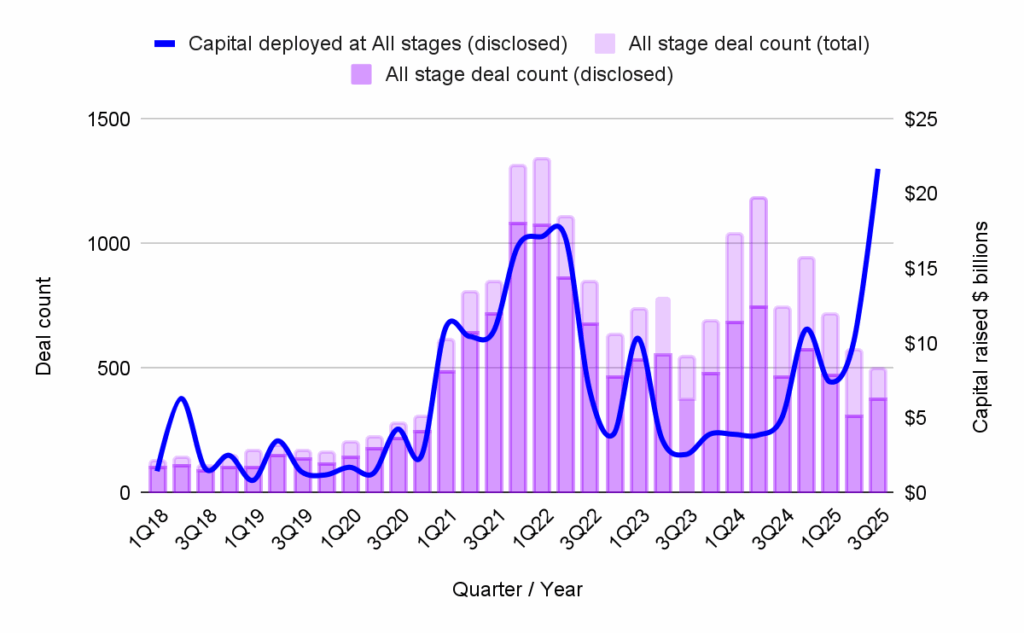
The third quarter of 2025 marked a historic inflection point for the blockchain and digital asset industry, with Web3 fundraising surging to a new cycle high of nearly $22 billion deployed across 376 disclosed deals, according to comprehensive data compiled by Outlier Ventures and Messari. This staggering figure represents more than a 113% increase in capital deployed compared to the previous quarter, which stood at $10.2 billion across 309 deals. However, this capital expansion did not translate into a proportional rise in overall deal volume, revealing a market decisively characterized by larger, highly concentrated institutional allocations rather than a broad-based surge in startup activity.
This quarter’s performance shattered previous benchmarks, eclipsing capital-raising metrics seen even during the peak bull market periods of 2021 and 2022. Analysts note that this divergence between capital volume and deal count underscores a broader industry evolution. Rather than funding a long tail of experimental consumer applications, institutional channels—including exchange-traded funds (ETFs), digital asset treasuries (DATs), tokenization protocols, and enterprise settlement rails—transitioned firmly from theoretical promises to operational execution. This structural maturation fundamentally shaped where, how, and to whom capital was distributed throughout the quarter.

Chronology and Market Evolution Through 2025
To understand the mechanics of third-quarter fundraising, it is essential to trace the trajectory of the broader 2025 market cycle. The year began with a wave of cautious optimism in the first quarter, defined largely by regulatory consultations and the initial post-approval positioning of institutional crypto products. During this phase, early-stage founders faced an increasingly selective venture environment, forcing a pivot toward strict product-market fit and regulatory compliance.
By the second quarter of 2025, market participants adopted a distinctly strategic and selective posture. While aggregate capital stabilized around $10.2 billion, venture capitalists and institutional allocators grew increasingly hesitant to deploy funds into unproven projects. Regulatory uncertainty, particularly within the United States and Europe, led to delayed token launches and a temporary contraction in public token sales. Investors rotated capital defensively into stablecoins and yield-bearing assets, tightening the venture funnel for early-stage startups.
As the industry entered the third quarter, these foundational shifts culminated in a bifurcated market. Regulatory milestones, such as the advancement of official stablecoin recommendations and the operational rollout of banking-grade tokenization initiatives, lowered institutional barriers. Consequently, capital flooded back into the market during the third quarter, but it bypassed early-stage experimentation in favor of later-stage infrastructure, regulatory-compliant financial services, and public-market listings such as the high-profile market debuts of Bullish and Figure.
Supporting Data and Capital Concentration
A granular examination of the third-quarter data highlights extreme capital concentration. Industry reports indicate that the ten largest fundraising rounds of the quarter accounted for approximately half of all venture dollars deployed. This phenomenon illustrates that the resurgence in funding has not yet trickled down into a generalized recovery for early-stage venture capital appetite.
Furthermore, third-quarter data revealed an unusual divergence: it was the only recent period in which the number of disclosed deals increased even as overall venture activity remained subdued. Because larger, later-stage fundraises are far more likely to be announced publicly than smaller seed or pre-seed rounds, this increase in disclosures further confirms that the quarter’s momentum was entirely concentrated in high-value, mature transactions.
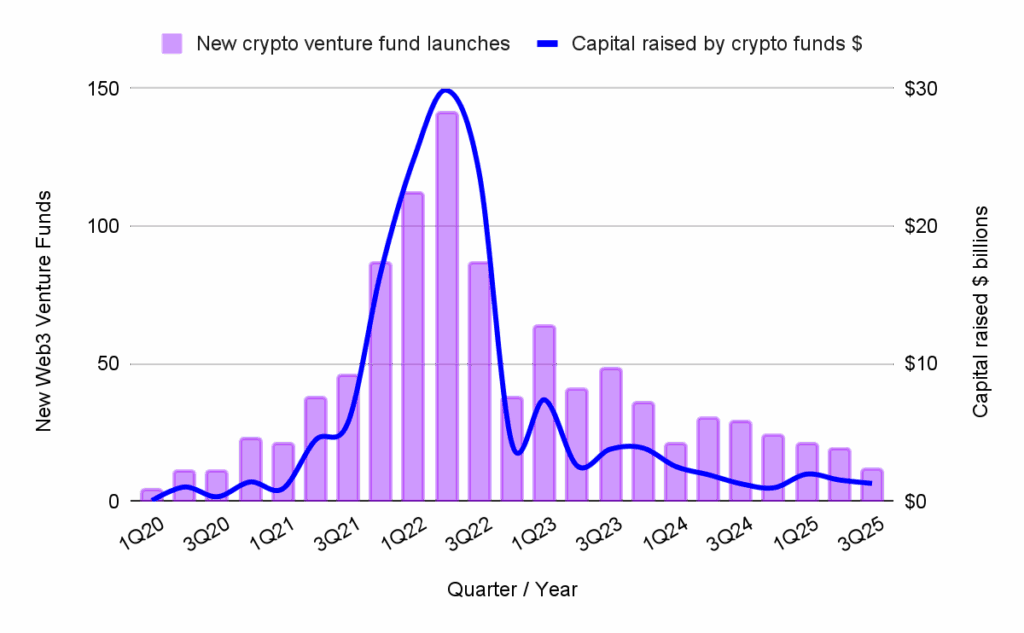
Fund formation similarly reflected an atmosphere of cautious capital preservation. Only 11 new crypto venture funds were launched globally during the quarter, securing a combined $1.3 billion. This continues a multi-quarter downward trend in new fund creation, with launch rates now mirroring the conservative environment of mid-2020. Industry observers describe this period as a "recycling phase," wherein general partners rely heavily on existing dry powder and limited partners prioritize secondary market liquidity and exits over new venture commitments.
The Institutionalization of Financial Rails and Traditional Finance Convergence
The driving force behind the third-quarter capital surge was the deep integration of traditional financial architecture with digital asset infrastructure. Market data shows that Ethereum-focused ETFs experienced massive inflows, taking in approximately $8.7 billion during the quarter and surpassing Bitcoin-focused funds. Total assets under management (AUM) for Ethereum ETFs surged by roughly 170% quarter-on-quarter to reach $27.4 billion.
Concurrently, Digital Asset Treasuries captured roughly 3.8% of the total Ethereum supply, signaling a profound shift in corporate treasury management. Major financial institutions transitioned their blockchain initiatives from sandbox testing into production environments. Notable developments included the activation of JPMorgan’s Kinexys network for tokenized repurchase agreement settlements, and SWIFT’s expanded tokenization trials in collaboration with global custodians such as BNY Mellon, Citi, Clearstream, Euroclear, and Northern Trust to test cross-network bond and fund share settlements. Additionally, Visa Direct began processing cross-border payments utilizing USD Coin (USDC).
Policy developments provided vital tailwinds for this institutional adoption. Reports from major financial institutions like DBS highlighted that 2025 marked a definitive transition from regulatory consultation to operational execution. Legislative frameworks and official recommendations acted as clear catalysts, enabling banks and payment providers to deploy capital at scale. Because large financial institutions operate under strict governance mandates and short delivery horizons, they naturally favored later-stage, compliance-ready infrastructure over high-risk early ventures, resulting in massive check sizes for established market players.
To bridge the gap between traditional institutional capital and early-stage Web3 innovation, the market increasingly relied on hybrid investment models. Strategic partnerships, such as collaborations between traditional asset managers and specialized crypto venture firms, allowed institutional investors to gain structured exposure to early-stage ventures while leveraging specialized due diligence and portfolio support to mitigate operational risks.
Stage-by-Stage Venture Breakdown
Early-stage fundraising performance during the third quarter remained tightly constrained, heavily rewarding proven traction over speculative promises:
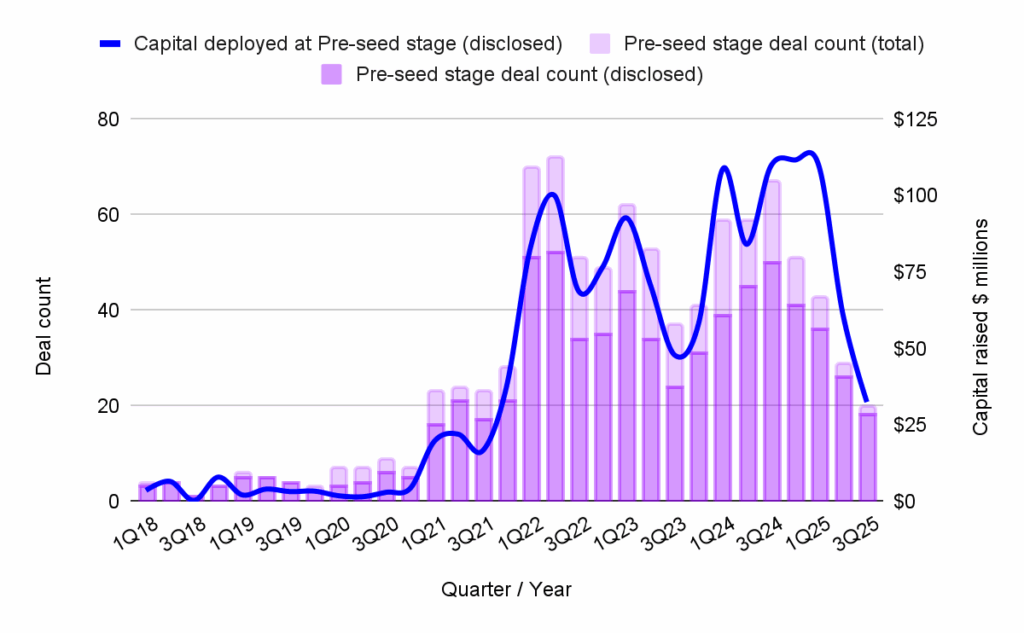
Pre-Seed Stage: The pre-seed market experienced its weakest quarter in years, recording just 18 disclosed rounds totaling $32.5 million. The 12-month running median slipped to just under $2.5 million. A sharp drop in accelerator activity further restricted the pipeline for idea-stage startups, raising the barrier to entry significantly.
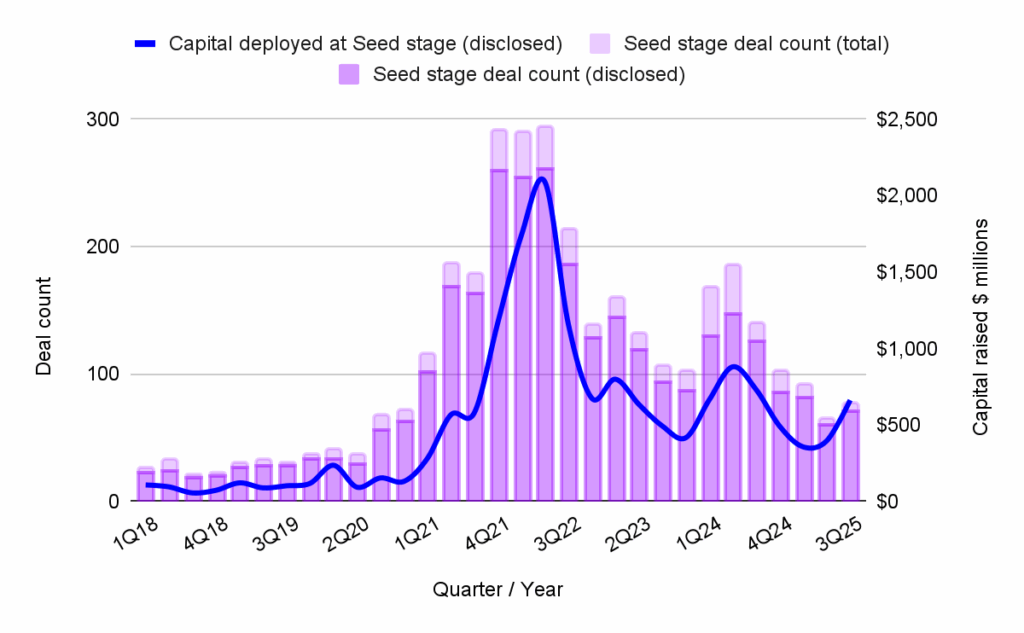
Seed Stage: Seed-stage fundraising reached 71 disclosed rounds totaling nearly $663 million. However, this headline figure was heavily skewed by outlier transactions, most notably Flying Tulip’s $200 million raise, which accounted for roughly a third of all seed capital. Structured unconventionally, the financing granted investors on-chain redemption rights and yield-bearing exposure, illustrating a growing investor preference for liquid, capital-efficient financial instruments over traditional illiquid agreements.
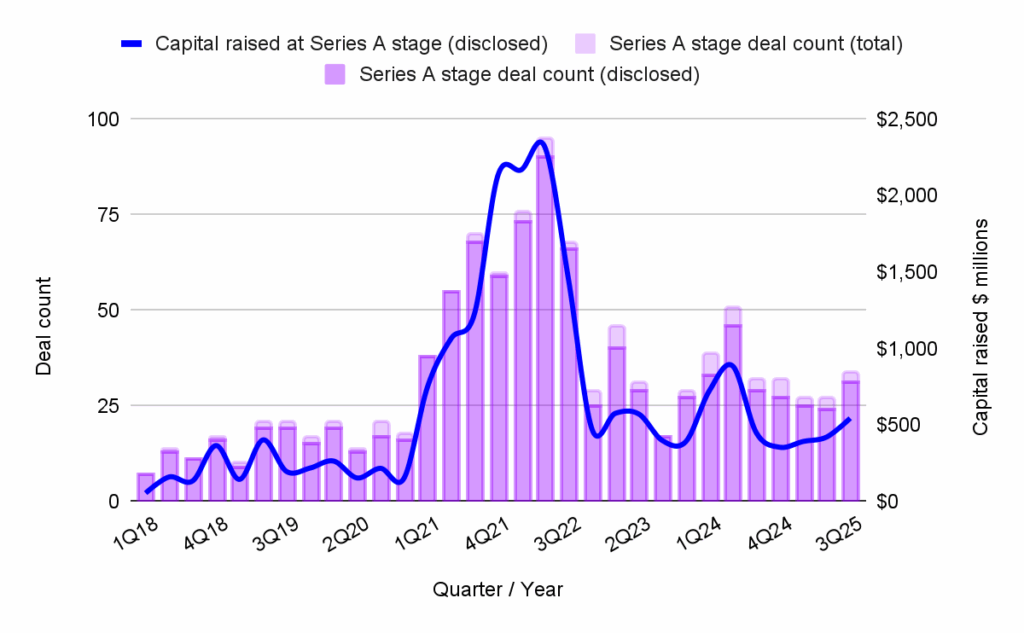
Series A Stage: The Series A market demonstrated remarkable stability, logging 31 disclosed rounds totaling nearly $545 million, with the 12-month running median holding steady around $16 million. Projects aligning closely with institutional rails—such as payments, data services, and tokenization infrastructure—secured the vast majority of these allocations, hinting at a potential stabilization of investor appetite for mid-stage growth companies.
Category Concentration and Token Fundraising Dynamics
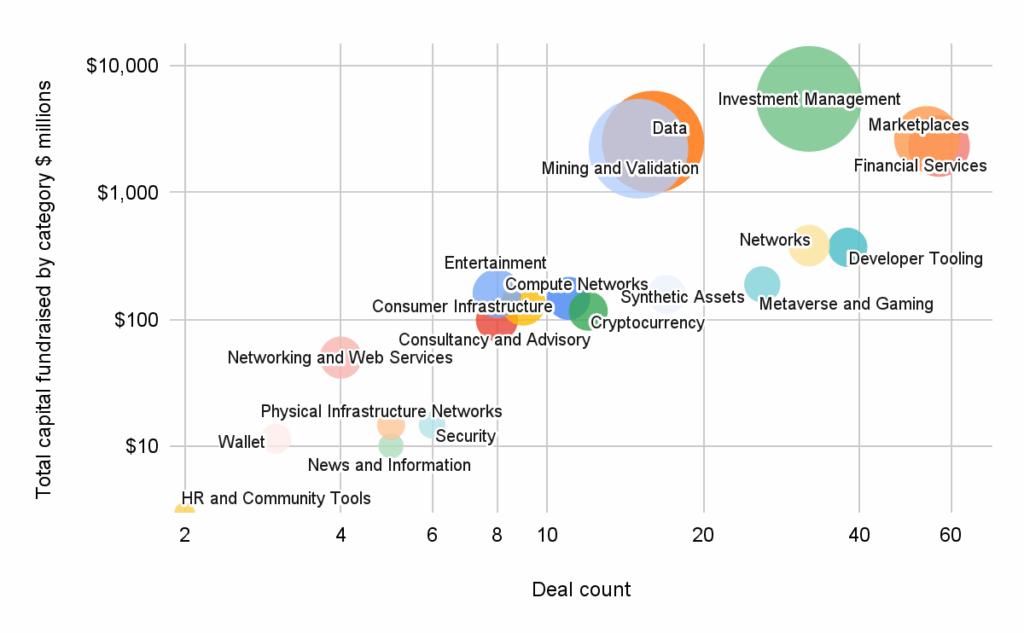
Sector-specific data indicates that investment management, marketplaces, data infrastructure, financial services, and mining operations absorbed approximately 70% of all venture dollars deployed during the third quarter. These sectors map directly to blockspace supply, custody, settlement, and issuance—areas experiencing direct tailwinds from ETF inflows and enterprise adoption. Conversely, consumer-facing categories such as gaming, metaverse development, and retail wallets remained largely peripheral as capital decisively favored infrastructure over consumer applications.
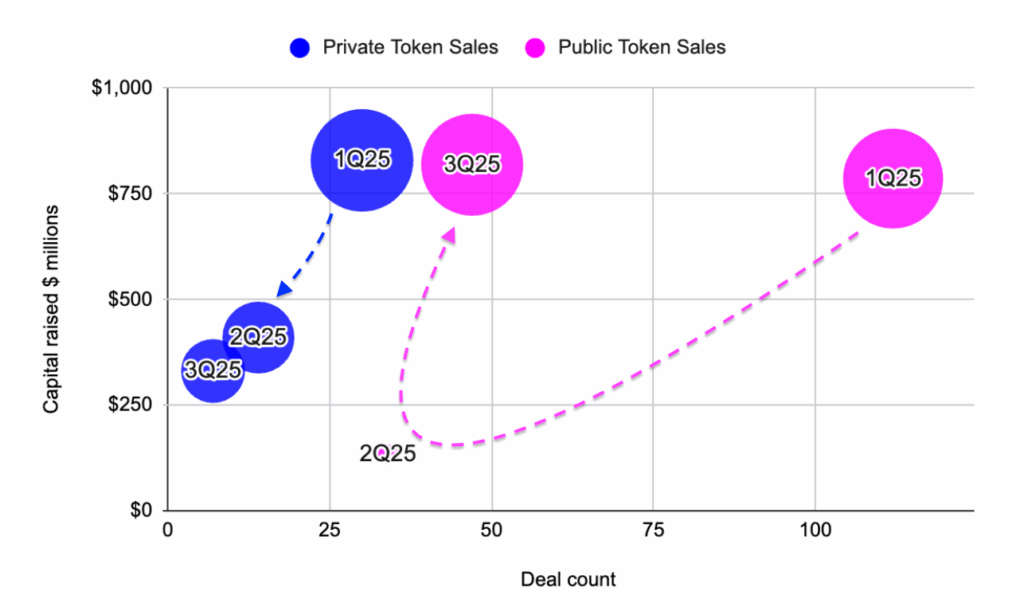
Token fundraising exhibited a distinct shift back toward public distribution channels. Public token sales climbed to 47 events totaling $819 million, while private token sales contracted to 7 events totaling $331 million. Improved market depth, rising trading volumes, and receding policy risks encouraged project teams to utilize public token sales for effective price discovery and community alignment. Furthermore, the tentative reopening of the initial public offering (IPO) window for crypto-native firms functioned as a critical market sentiment indicator, signaling that public markets are increasingly receptive to regulated digital asset exposure.
Implications and Outlook for Upcoming Quarters
The third quarter of 2025 conclusively demonstrated that the convergence of cryptocurrency and traditional finance is no longer an abstract thesis, but the primary baseline shaping capital allocation. While mainstream integration has successfully taken root at the infrastructure and settlement layers—largely out of sight of the average retail consumer—it has established a sustainable foundation for long-term growth.
Looking ahead to the final quarter of 2025 and into 2026, the central challenge for early-stage founders will be successfully converting seed-stage validation into institutional-grade Series A traction. Venture capitalists and institutional allocators alike will continue to demand verifiable product utility, robust regulatory compliance, and tangible enterprise integration. Whether the unprecedented liquidity witnessed in the third quarter will eventually broaden to encompass earlier-stage ventures remains the defining question for the next phase of the digital asset market cycle.