

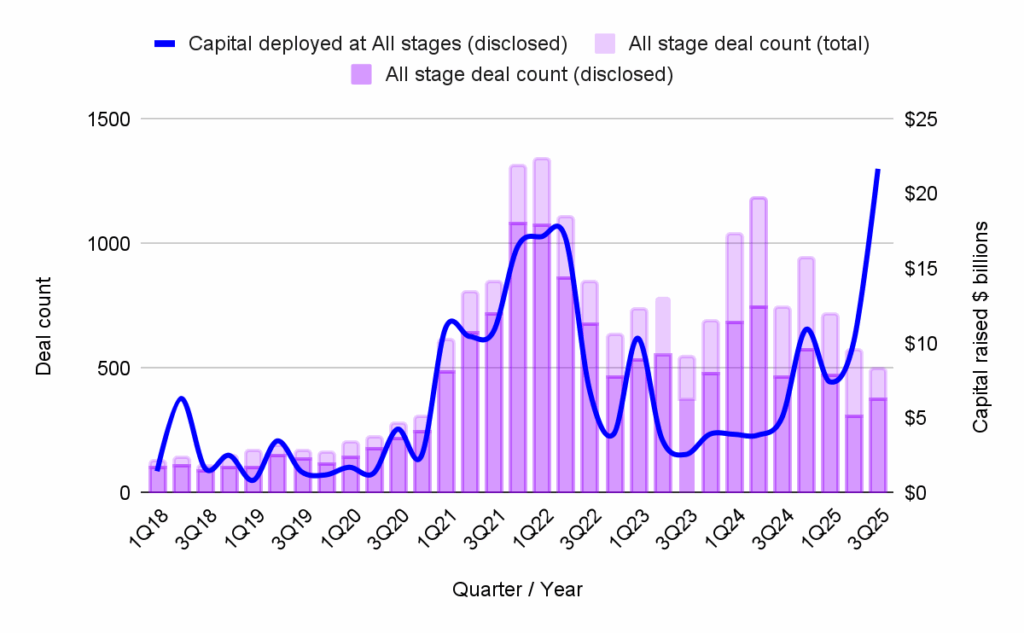
The global Web3 and cryptocurrency venture capital landscape experienced a dramatic resurgence in the third quarter of 2025, recording nearly $22 billion in deployed capital across 376 disclosed deals. According to comprehensive market data compiled by Outlier Ventures and Messari, total funding surged by an impressive 113% quarter-on-quarter, leaping from $10.2 billion in the second quarter to $21.7 billion. This performance marks a historic high for capital deployment, eclipsing the peak volumes observed during the monumental crypto bull run of 2021 and 2022.
However, beneath the headline-grabbing figures lies a deeply selective market dynamic. While capital inflows doubled, the total number of disclosed deals grew by only 22%, indicating that the quarter’s expansion was overwhelmingly driven by larger check sizes rather than a broad-based surge in early-stage startup activity. Industry analysts note that this trend underscores a prevailing "conviction over coverage" philosophy among institutional investors, who are increasingly funneled toward mature infrastructure projects, regulatory-compliant frameworks, and scalable public-market routes rather than speculative consumer-facing experiments.

The Institutionalization of Crypto Capital Flows
The structural shift defining the third quarter of 2025 is the deep integration of traditional financial institutions (TradFi) into the digital asset architecture. Unlike previous market cycles characterized by retail-driven euphoria, the current wave of liquidity is anchored by operationalized institutional products, including spot exchange-traded funds (ETFs), digital asset treasuries (DATs), tokenized settlement rails, and enterprise-grade blockchain pilots.
Market reports from Messari highlight that Ethereum-focused ETFs experienced unprecedented demand during the quarter, pulling in approximately $8.7 billion and surpassing Bitcoin-focused counterparts in net quarterly inflows. Consequently, Ethereum ETF Assets Under Management (AUM) surged by roughly 170% quarter-on-quarter to reach $27.4 billion. Simultaneously, Digital Asset Treasuries successfully captured about 3.8% of the total circulating Ethereum supply, signaling a permanent evolution in corporate balance sheet management.
Major financial institutions also transitioned their blockchain initiatives from experimental sandboxes to live production environments. JPMorgan’s Kinexys network went live for the settlement of tokenized repurchase agreements, while SWIFT expanded its monumental tokenization trials alongside global financial heavyweights such as BNY Mellon, Citi, Clearstream, Euroclear, and Northern Trust. Furthermore, payment giants like Visa integrated USDC cross-border settlement capabilities via Visa Direct, solidifying the operational infrastructure necessary to attract multi-million-dollar institutional investments.
Regulatory Clarity and Policy Catalysts
The acceleration of institutional capital deployment has been significantly bolstered by evolving global regulatory frameworks. According to the third-quarter Digital Assets Update published by DBS, the year 2025 marked a definitive turning point from prolonged regulatory consultation to active execution. Legislative milestones, including the introduction of the GENIUS Act and other international policy recommendations, successfully lowered the compliance barriers preventing major banking institutions and payment networks from interacting with stablecoins and tokenized assets.
Despite these favorable regulatory tailwinds, institutional mandates continue to dictate strict deployment parameters. Major financial actors operate under stringent governance, risk management, and return-on-investment guidelines. Deploying numerous modest checks into early-stage, unproven startups remains operationally inefficient and exposes institutional decision-makers to unacceptable career risk. To bridge this structural divide, hybrid venture models have emerged—such as the strategic partnership between Outlier Ventures and Morgan Creek—allowing traditional asset managers to gain structured, risk-mitigated exposure to early-stage Web3 ventures through seasoned due diligence and portfolio support infrastructure.
Fund Formation and the Secondary Market Recycling Phase
While late-stage capital deployment reached record highs, the creation of new crypto-focused venture funds remained remarkably subdued. Industry data reveals that only 11 new crypto venture funds were established in the third quarter of 2025, raising a combined $1.3 billion and extending a prolonged downward trend observed throughout the year.
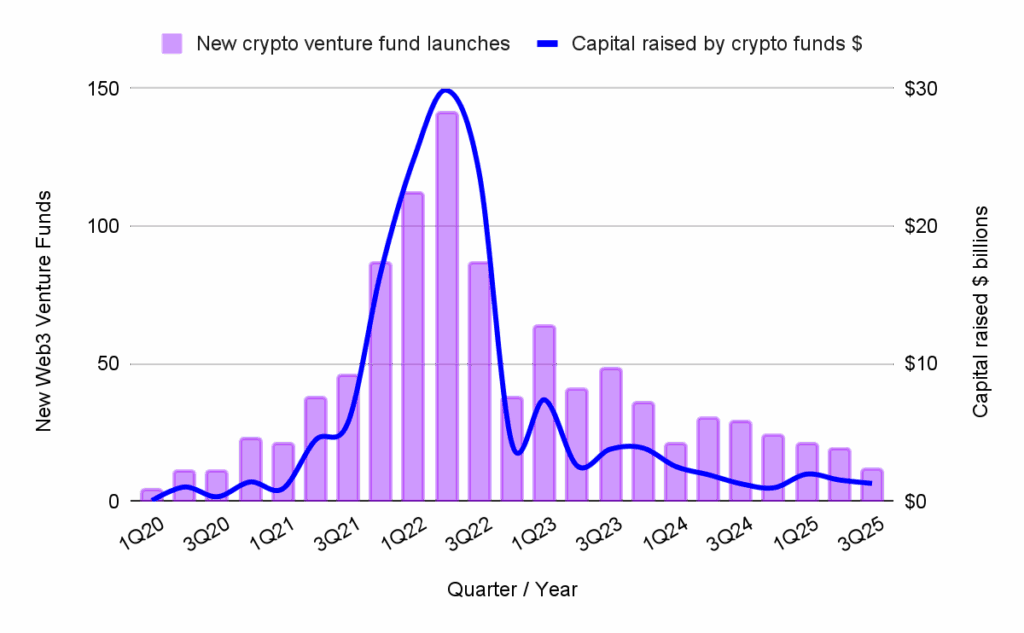
Historically, the velocity of new fund formations mirrors the cautious environment of mid-2020. General partners are increasingly choosing to deploy remaining dry powder from existing vehicles rather than launching fresh fundraising mandates, while limited partners exhibit extreme selectivity. According to secondary market analyses by PM Insights, the broader ecosystem is currently navigating a "recycling phase," wherein capital continuously circulates through secondary transactions, asset restructuring, and mature exits rather than initiating brand-new venture creation.
Early-Stage Divergence: Pre-Seed Squeeze and Seed Concentration
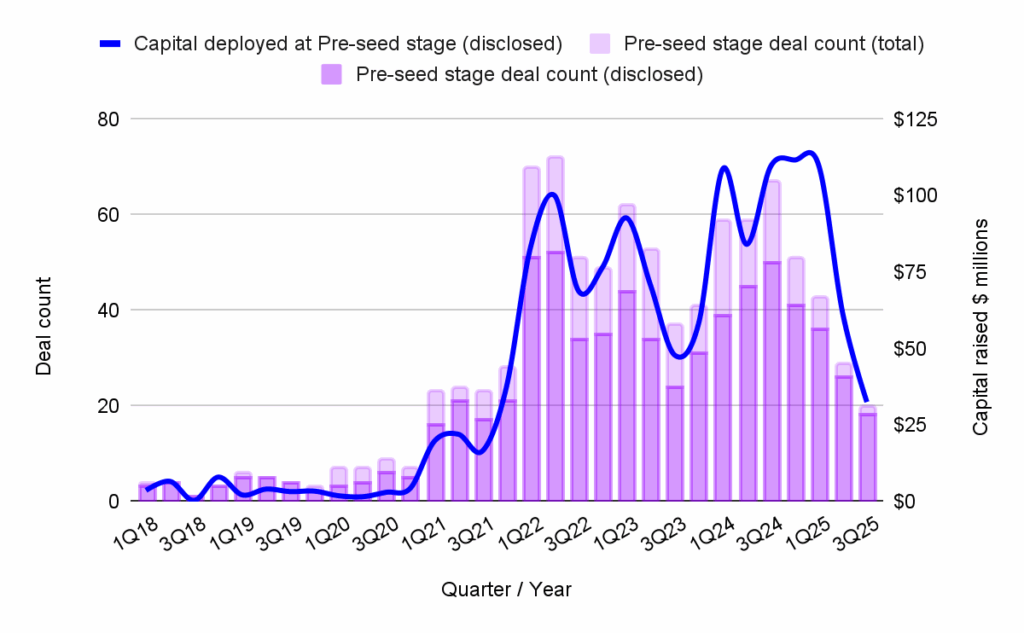
The polarization of the fundraising market was acutely visible across different developmental stages. Pre-stage and seed-stage metrics diverged sharply from the macro growth figures, revealing an intensely competitive environment for nascent founders.
The pre-seed sector experienced its weakest quarter in recent history, recording just 18 disclosed rounds totaling $32.5 million, with the 12-month running median slipping below $2.5 million. This contraction coincided with a noticeable slowdown in global accelerator activity, creating a highly restrictive funnel for new entrepreneurial ideas.
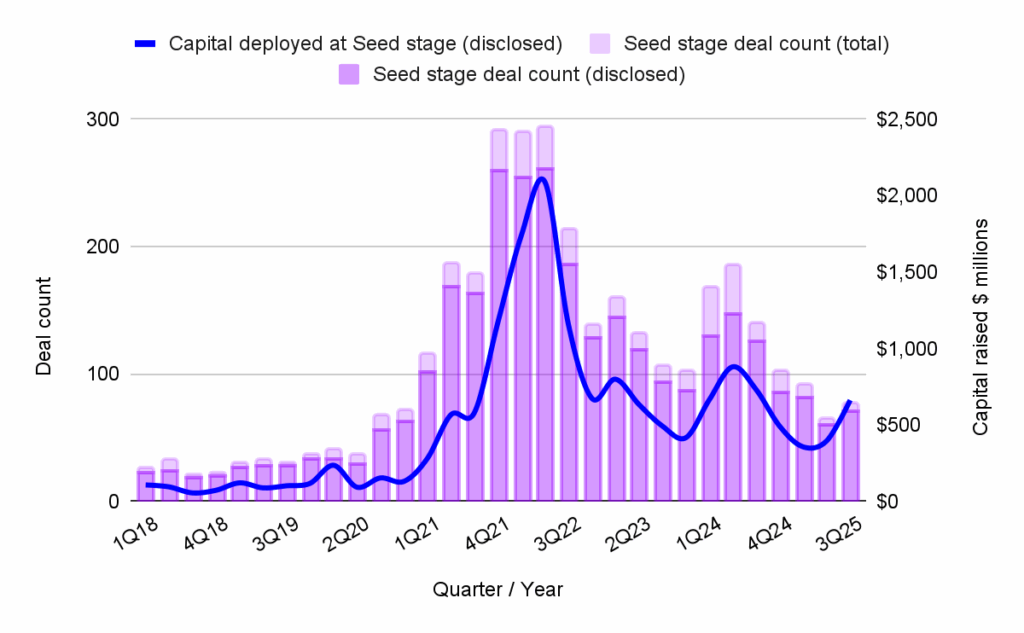
Conversely, the seed stage appeared healthier on paper, registering 71 disclosed rounds totaling nearly $663 million. However, this figure was heavily distorted by a single monumental transaction: the $200 million raise by Flying Tulip, which accounted for nearly one-third of all aggregate seed capital for the quarter. Unconventional in its financial structure, the Flying Tulip round utilized an on-chain redemption mechanism that granted investors callable, yield-bearing exposure to decentralized finance (DeFi) yields rather than traditional illiquid equity instruments, signaling a broader investor preference for capital-efficient, liquid structures over standard SAFEs and SAFTs.
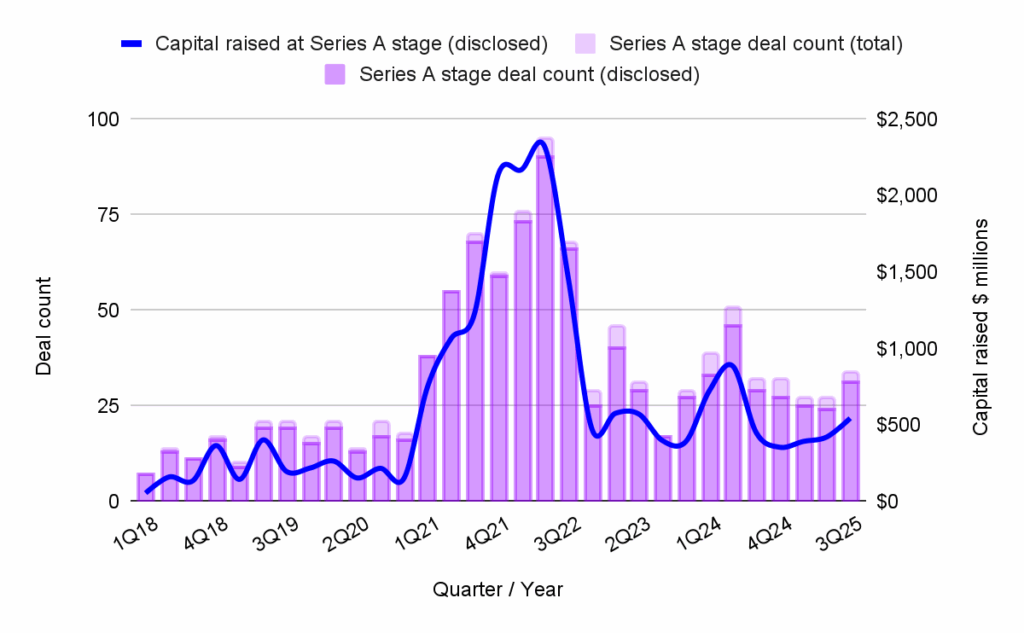
Meanwhile, Series A fundraising demonstrated steady resilience, logging 31 disclosed rounds totaling approximately $545 million, with a stable 12-month running median hovering around $16 million. Mid-stage capital strongly favored projects with clear operational adjacencies to institutional rails, payments, tokenization, and enterprise data services.
Category Concentration: Infrastructure Over Consumer Applications
An analysis of capital allocation by sector in the third quarter of 2025 reveals an unmistakable institutional bias. Investment management platforms, financial services, data infrastructure, marketplaces, and mining operations collectively absorbed roughly 70% of all deployed venture capital.
Investment management tech attracted massive ticket sizes to support the booming ETF and DAT ecosystems. Similarly, data infrastructure firms specializing in blockchain indexing, analytics, and AI-adjacent tech stacks secured substantial late-stage funding. This trend aligns with institutional sector reports, such as those from Grayscale, which formally classified AI-crypto intersections as core investable segments.
In stark contrast, consumer-oriented sectors—including metaverse gaming, consumer-facing applications, and retail wallet security—remained largely peripheral. Capital explicitly favored foundational infrastructure, regulatory compliance tools, and back-end settlement rails where revenue generation and institutional legibility are proven.
Public Token Sales Rebound as Private Markets Retreat
The market for token fundraising underwent a notable structural rotation during the third quarter, shifting away from private token sales toward public market distribution. Public token sales surged to 47 recorded events raising a combined $819 million, whereas private token sales dropped to just 7 events totaling $331 million.
Supported by rising global cryptocurrency market capitalizations and expanding trading volumes, project founders increasingly utilized public sales to achieve efficient price discovery and foster decentralized community alignment. Furthermore, the reopening of initial public offering (IPO) pathways for select blockchain enterprises functioned as an important sentiment indicator. As noted by digital asset research groups, prospective IPOs allow premier Web3 firms to establish a formal "regulatory compliance certification mark," reassuring institutional allocators of their long-term operational viability.
Implications and Outlook for Upcoming Quarters
The third quarter of 2025 has firmly established that the convergence of cryptocurrency markets and traditional finance is no longer a speculative hypothesis, but an operational reality. While institutional capital continues to flood the ecosystem, it flows exclusively through narrow, deep channels tied to regulatory compliance, institutional issuance, and high-utility infrastructure.
For early-stage founders navigating the current fundraising environment, the mandate is clear: speculative whitepapers and unproven consumer concepts are no longer sufficient to secure venture backing. Survival and growth require rigorous product-market fit, demonstrable enterprise utility, and architectures designed to be institutionally digestible from inception. As the industry looks toward the final quarter of 2025 and into 2026, the critical challenge for venture capitalists and founders alike will be discovering innovative mechanisms to bridge the widening gap between the restrictive early-stage funding funnel and the massive liquidity concentrated at the institutional apex.

