The intersection of traditional finance (TradFi) and digital asset infrastructure reached a significant milestone in late summer 2026, as leading zero-fee digital asset trading platform MEXC released its operational performance data for August. The report highlights an unprecedented expansion in user engagement across equity-linked derivatives, tokenized stocks, and exchange-traded fund (ETF) spot markets. Total trading volume across stock, index, and ETF futures recorded a staggering 130% month-on-month increase, underscoring a broader paradigm shift in how retail and institutional market participants seek global exposure.
Simultaneously, the breadth of available financial instruments on the platform expanded significantly. MEXC reported a 35% increase in its available contract offerings, pushing the total count past the 400-asset threshold. This rapid portfolio scaling coincided with a robust 30% month-on-month growth in tokenized stocks and ETF spot trading volume, establishing August as one of the platform’s most dynamic trading periods in terms of product adoption and cross-market capital flows.
The explosive growth observed in August did not occur in a vacuum; it represents the culmination of a multi-year trajectory toward the convergence of decentralized finance (DeFi) rails and traditional equity markets. Over the past several quarters, macroeconomic headwinds, fluctuating interest rate expectations, and an insatiable global appetite for artificial intelligence (AI) and semiconductor hardware have driven traders to seek continuous, borderless market access. Traditional stock exchanges, bound by rigid operating hours and localized clearinghouses, have increasingly struggled to satisfy the demands of a 24/7 global investor base.
Platforms bridging this gap have experienced exponential growth. MEXC’s strategic positioning—allowing users to trade products linked to U.S., Korean, and Hong Kong equities utilizing Tether (USDT) through a unified account architecture—has served as a primary catalyst for this shift. By eliminating traditional brokerage barriers and introducing zero-fee trading structures, the platform has effectively democratized access to instruments that were previously constrained by geographical boundaries, high minimum capital requirements, and restrictive trading schedules.
A deep dive into the August metrics reveals a structural evolution in market preferences, characterized by a decisive pivot away from broad-based index tracking toward hyper-focused sector exposure. Throughout the month, trading activity within Stock Futures broadened dramatically, moving away from isolated single-asset dominance to a multi-faceted rally centered on memory, storage, and semiconductor equities across both U.S. and Korean markets.
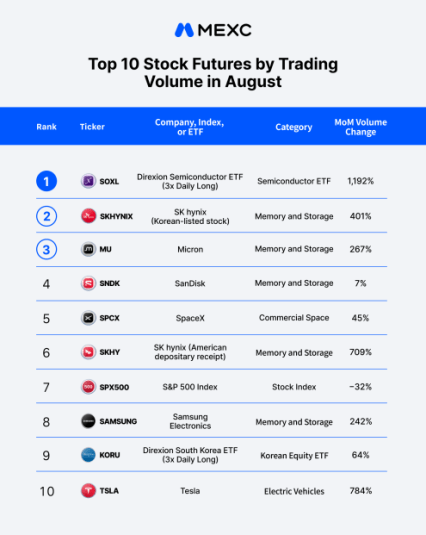
Data from August shows that five of the top ten Stock Futures by trading volume were dedicated entirely to memory and storage enterprises. Highlighting this trend, SKHYNIX (SK hynix) secured the second overall position and ranked first among individual stock futures, registering a monumental 401% month-on-month surge in trading volume. Not far behind, MU (Micron) claimed the third spot with a 267% volume increase.
The regional concentration of these trades was equally pronounced. The combined trading volume for Stock Futures tracking Korean companies and benchmark indices—specifically SKHYNIX, SKHY, SAMSUNG, and KORU—skyrocketed by approximately 348%. Consequently, Korean-linked assets expanded their footprint, commanding 27% of total Stock Futures trading volume in August, up significantly from 14% in July. Meanwhile, SNDK (SanDisk) continued to record positive volume growth, although its proportional share of total volume adjusted from 25% to 11% as capital diversified into a wider array of regional semiconductor plays.
The semiconductor enthusiasm extended beyond individual equities into leveraged and inverse ETF products. SOXL Stock Futures, which track a semiconductor ETF providing three times daily long exposure, claimed the number one ranking overall. Trading volume for SOXL surged by an astronomical 1,192%, driving its market share from under 4% in July to an impressive 20% in August. Its counterpart, SOXS Stock Futures—offering three times inverse daily leveraged exposure to the U.S. Semiconductor Index—also experienced robust demand, logging a 436% volume expansion.
In sharp contrast to the booming semiconductor segment, broader macroeconomic indices faced a cooling-off period. Trading volume for SPX500 Stock Futures, which track the benchmark S&P 500 Index, declined by approximately 32%. Market analysts attribute this contraction not to a lack of risk appetite, but rather to a deliberate capital reallocation by traders who favored high-beta, sector-specific momentum over passive, broad-market exposure.
Beyond the technology and semiconductor sectors, niche growth stories played a pivotal role in shaping August’s volume distributions. Trading activity for SPCX (SpaceX) and TSLA (Tesla) Stock Futures climbed roughly 45% and 784%, respectively. Securing the fifth and tenth positions in the rankings, these assets highlighted persistent, speculative investor enthusiasm surrounding commercial space exploration, private aerospace equity valuation, and the electric vehicle ecosystem.
Parallel to the derivatives expansion, MEXC’s spot market for tokenized stocks and ETFs enjoyed substantial momentum. Spot trading volume within this segment grew by approximately 30% month-on-month, elevating its share of total TradFi spot trading volume from 63% in July to 73% in August.
Crucially, this growth demonstrated structural health rather than speculative concentration. Approximately 99% of all existing tokenized listings recorded upward volume trajectories. Furthermore, the top ten individual assets accounted for a modest 12% of the segment’s total volume, proving that retail and institutional participants were actively distributing capital across a wide basket of equities rather than chasing a single viral asset.
Within the spot rankings, CRCL (Circle) captured the top position, buoyed by a 69% increase in monthly trading volume. Other crypto-adjacent and fintech equities, notably COIN (Coinbase) and HOOD (Robinhood), also anchored positions within the top ten. Combined trading volume across these three digital-asset-linked listings rose by 47%, reflecting strong sentiment correlation between native cryptocurrency markets and their publicly traded corporate proxies.
Artificial intelligence infrastructure also maintained a formidable presence in the spot market. NBIS (Nebius), a specialized AI cloud infrastructure enterprise, ranked third overall, delivering a staggering 188% volume growth rate—the highest among all top-ten spot listings. Simultaneously, semiconductor giant NVDA (Nvidia) claimed the fifth spot with a 54% volume increase. This dual representation of Nebius and Nvidia illustrates that AI-driven capital flows successfully permeated both hardware manufacturing and backend cloud computing layers throughout the month.
The acceleration of volume on platforms like MEXC is heavily underpinned by structural innovations in trading accessibility. By collapsing the barriers between traditional equity markets and digital asset infrastructure, platforms enable global participants to execute complex hedging and speculative strategies around the clock.
A prime example of this utility is weekend trading behavior. During August’s ten weekend days—periods when traditional New York, Seoul, and Frankfurt stock exchanges remain shuttered—MEXC’s Stock Futures trading still accounted for approximately 11% of the entire monthly volume. This statistic provides empirical proof of sustained, unyielding global demand for price discovery and risk management during off-hours, a capability historically unavailable to retail investors reliant on legacy brokerages.
To incentivize participation and reward its expanding user base, MEXC rolled out targeted promotional infrastructure during the period. The MEXC 0808: Stock Season zero-fee trading event served as a major acquisition and retention driver, successfully attracting more than 86,000 active participants. Collectively, the event saved traders over $1 million in operational fees, supercharging liquidity depth across both spot and derivative books.
Reacting to the robust monthly data, Vugar Usi, Chief Executive Officer of MEXC, emphasized the broader macroeconomic significance of the platform’s growth trajectory.
"The sustained growth in stock-related trading across multiple asset classes and markets underscores the accelerating global demand for accessible, diversified market exposure," stated Usi. "We remain committed to expanding our equity-linked offerings and simplifying access for users worldwide, consolidating trading into a single account and delivering on our core proposition: trading Wall Street, without walls."
Industry analysts evaluating the August data point toward several key implications for the future of global finance. First, the hyper-growth of tokenized equities and 24/7 stock derivatives signals that traditional financial institutions can no longer ignore the operational efficiency of blockchain-backed settlement and perpetual trading rails. As retail investors increasingly demand continuous access to equities, legacy exchanges face mounting pressure to adapt or risk losing market share to agile, crypto-native multi-asset platforms.
Second, the intense concentration of capital in AI, semiconductors, and memory components demonstrates that macroeconomic trading themes remain intensely sector-driven. Traders are actively utilizing leveraged instruments—such as the 3x long SOXL contracts—to amplify directional bets on secular technological shifts.
Finally, the success of multi-asset platforms in onboarding tens of thousands of users through zero-fee initiatives suggests that cost friction remains a primary deterrent in legacy financial markets. By systematically removing fee barriers and streamlining account requirements, platforms are effectively unlocking dormant retail liquidity from emerging and developed economies alike.
Established in 2018, MEXC has evolved into a premier global multi-asset trading platform engineered to serve as a zero-fee gateway to worldwide financial opportunities. Operating across more than 170 markets, the platform provides streamlined access to cryptocurrencies, traditional equities, tokenized assets, and sophisticated derivatives through a unified account framework.
Driven by a core philosophy of deep liquidity, zero trading fees, and expansive asset coverage, MEXC caters to modern retail and professional traders seeking to navigate both traditional and decentralized financial ecosystems without artificial barriers. As the boundaries separating crypto assets from traditional financial instruments continue to dissolve, MEXC remains positioned at the forefront of this financial transformation, empowering users worldwide to access global markets with speed, security, and efficiency.