

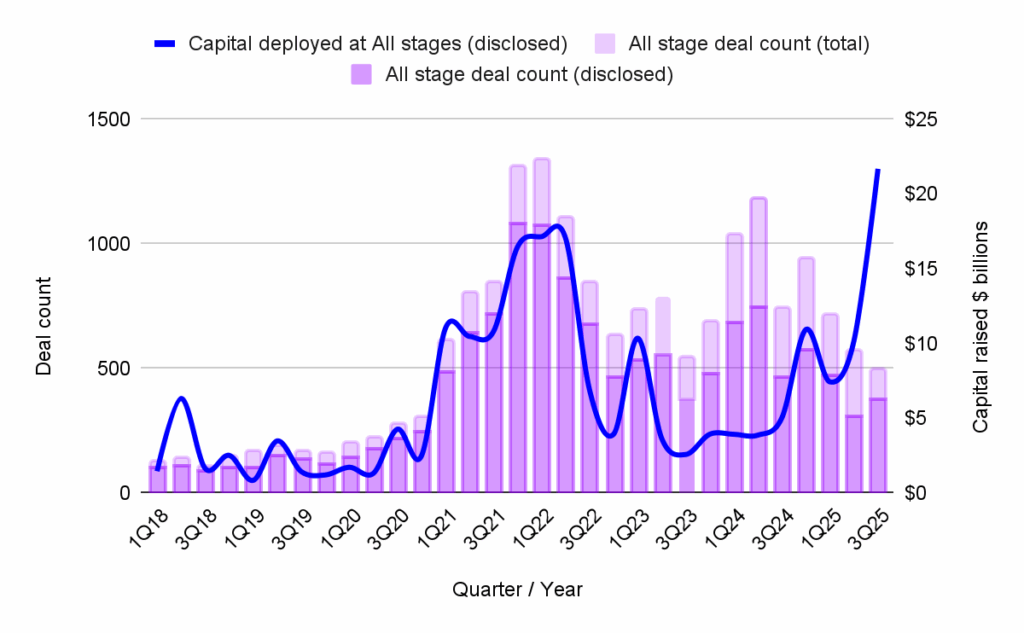
Global Web3 fundraising experienced a dramatic resurgence in the third quarter of 2025, pulling in nearly $22 billion across 376 disclosed deals. According to comprehensive market data compiled by Outlier Ventures and Messari, total capital deployed surged by 113% compared to the previous quarter, leaping from $10.2 billion in 2Q25 to $21.7 billion in 3Q25. This performance eclipses even the peak figures recorded during the historic 2021 and 2022 bull runs, establishing a new cycle high for the blockchain and digital asset sector.
However, a granular examination of the data reveals that this capital influx was not accompanied by a proportional broadening of early-stage market activity. While capital outpaced deal volume significantly—with the total number of disclosed deals rising by only 22% from 309 to 376—the quarter was fundamentally propelled by larger, concentrated cheques rather than a broad-based surge in startup creation. Analysts attribute this phenomenon to an institutional maturation across the industry, wherein traditional financial frameworks and crypto-native infrastructure have successfully transitioned from experimental pilots to operational scale.

Chronology and Market Evolution: From 1H25 Caution to 3Q25 Institutional Scale
The trajectory of 2025 fundraising has been characterized by a persistent theme of "conviction over coverage." Throughout the first half of the year (1H25), venture capitalists and institutional allocators demonstrated extreme selectivity, favoring compliance-ready infrastructure over speculative consumer applications.
In the first quarter of 2025 (1Q25), the market stabilized following regulatory shifts, yet investors remained cautious, directing capital primarily toward foundational layers. By the second quarter of 2025 (2Q25), strategic and selective deployment became the industry standard, keeping total capital constrained near $10.2 billion while deal counts fluctuated.
The third quarter broke this plateau not through a widespread revival of venture appetite, but through massive capital concentration. The ten largest funding rounds of 3Q25 accounted for roughly half of the total quarterly fundraising volume. Furthermore, 3Q25 stands out as the only recent period where the number of disclosed deals increased even as overall deal activity remained tightly constrained. Larger, later-stage rounds are far more likely to be publicly announced, reinforcing the narrative that visibility in 3Q25 was a direct product of capital concentration among mature enterprises.
The Institutional Architecture of Web3 Capital
The structural foundation underpinning 3Q25’s record-breaking figures lies in the deep integration of crypto with traditional finance (TradFi). Institutional rails that were once viewed as speculative promises became fully operational utilities during the quarter.
Data from Messari’s Crypto x TradFi review highlights that Ethereum-focused exchange-traded funds (ETFs) absorbed approximately $8.7 billion in 3Q25, surpassing Bitcoin-focused funds for the period. Total Assets Under Management (AUM) for ETH ETFs expanded by roughly 170% quarter-on-quarter to reach $27.4 billion. Simultaneously, Digital Asset Treasuries (DATs) secured approximately 3.8% of the total ETH supply, demonstrating a permanent shift in corporate treasury management.
Enterprise adoption mirrored these financial inflows. Major global institutions moved tokenization and settlement use-cases from testing environments into live production. JPMorgan’s Kinexys network went live for tokenized repurchase agreement (repo) settlement. Concurrently, SWIFT expanded its tokenization trials with major global custodians—including BNY Mellon, Citi, Clearstream, Euroclear, and Northern Trust—to test cross-network settlement of bonds and fund shares on-chain. Visa Direct also initiated the processing of cross-border payments utilizing USDC.
Policy developments acted as a vital catalyst for this institutional pivot. Reports from DBS Bank indicate that 2025 marked a definitive transition from regulatory consultation to execution. Legislative milestones, such as the GENIUS Act and concurrent international regulatory frameworks, lowered compliance barriers for banking and payments integration.
Venture Capital Dynamics and New Fund Formation
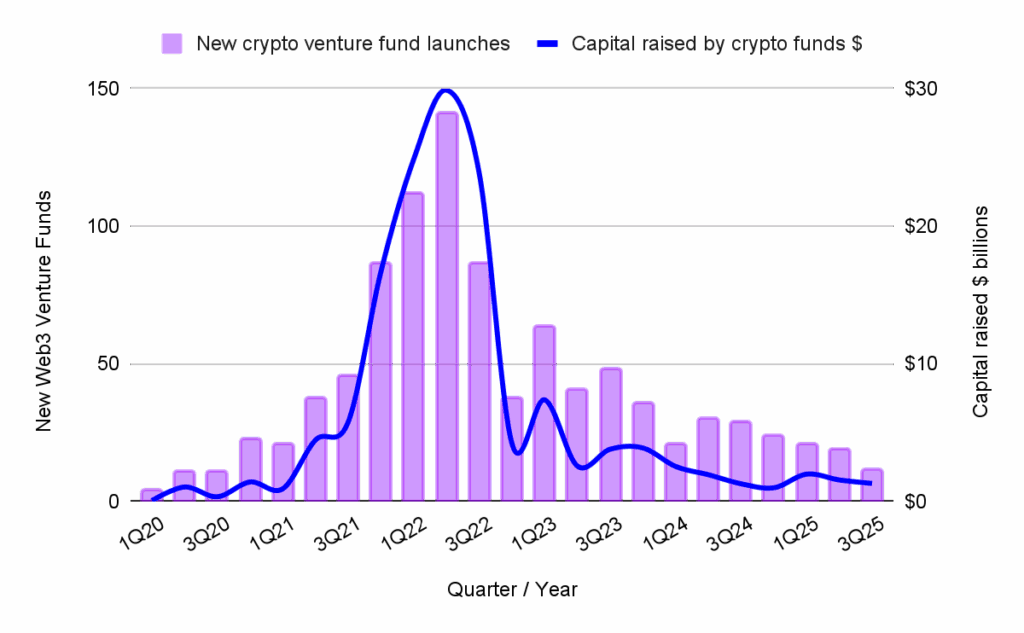
Despite the headline-grabbing capital figures, the creation of new crypto-focused venture capital funds remained subdued. Only 11 new crypto venture funds were launched globally in 3Q25, raising a combined total of $1.3 billion. This continues a downward trend observed throughout the year, mirroring the cautious fund-raising environment of mid-2020. General partners increasingly relied on existing dry powder rather than raising fresh mandates, while limited partners remained highly selective. Market analysts at PM Insights categorized this environment as a "recycling phase," where capital circulates through secondary trades and strategic exits rather than fueling new venture formation.
Early-stage fundraising reflected this cautious environment, displaying stark divergence across tiers:
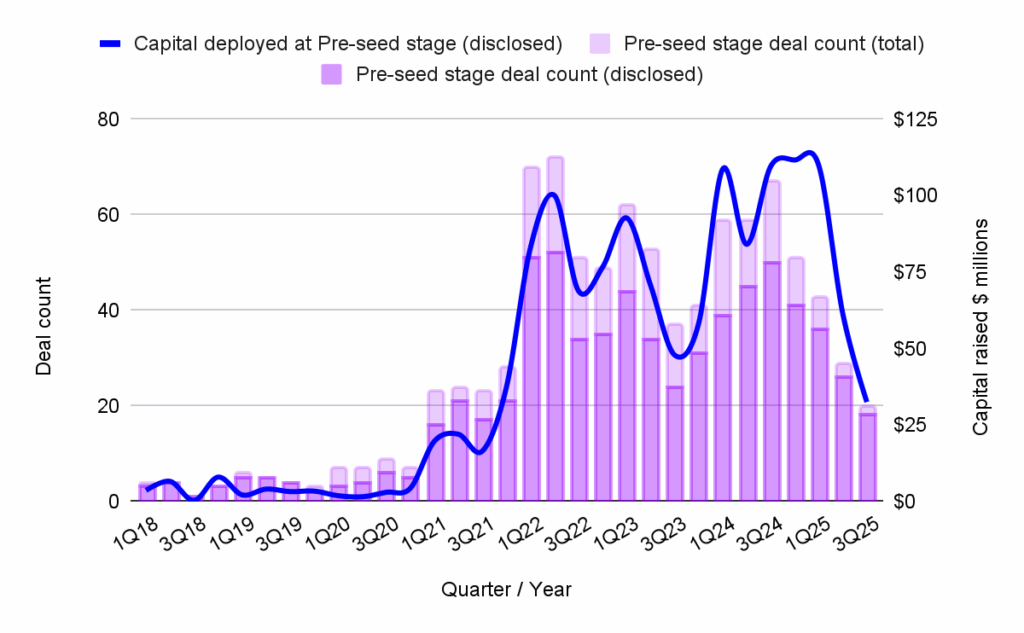
- Pre-Seed Stage: Recorded a multi-year low with only 18 disclosed rounds totaling $32.5 million. The 12-month running median slipped to just under $2.5 million, compounded by a noticeable contraction in accelerator activity.
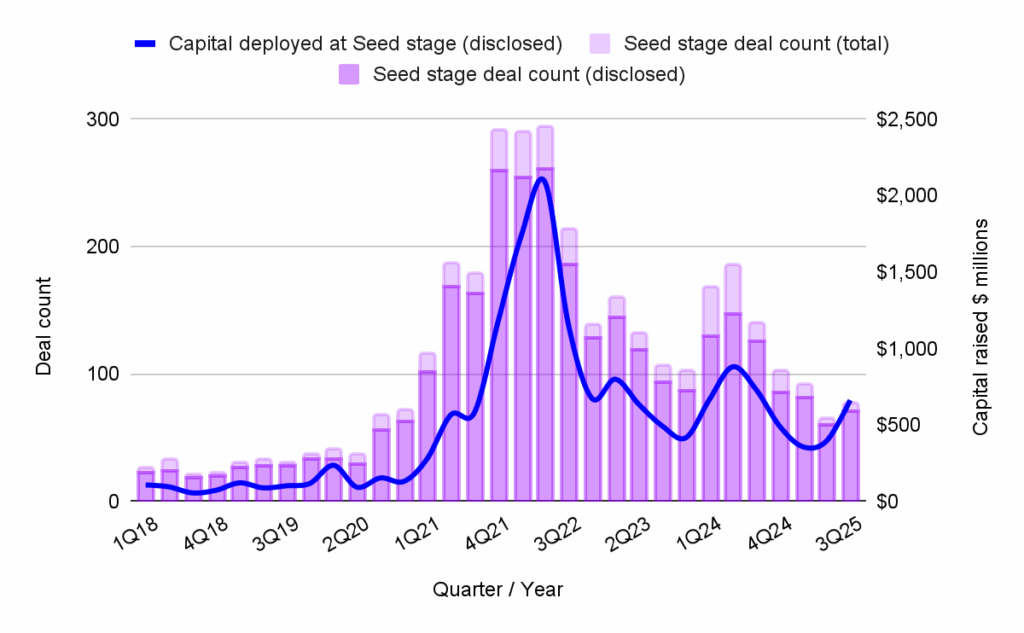
- Seed Stage: Reached 71 disclosed rounds totaling nearly $663 million. However, this metric was heavily skewed by Flying Tulip’s $200 million raise, which accounted for roughly a third of the category’s total capital. Crucially, Flying Tulip utilized an unconventional structure granting investors on-chain redemption rights and yield exposure, signaling a growing investor preference for liquid, capital-efficient financial instruments over traditional illiquid SAFEs and SAFTs.
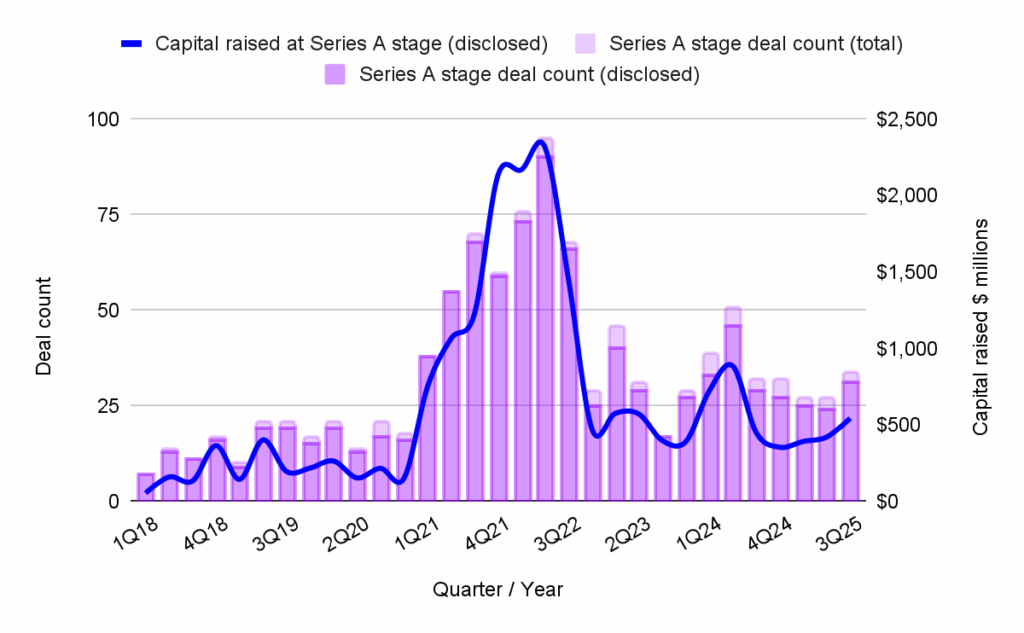
- Series A Stage: Logged 31 disclosed rounds totaling almost $545 million, with the 12-month running median stabilizing around $16 million. Projects with direct alignment to institutional rails—such as payments, tokenization, data, and infrastructure—secured the vast majority of these allocations.
Category Breakdown and Sector Concentration
Capital investment across all stages demonstrated a clear institutional bias. Investment Management, Marketplaces, Data, Financial Services, and Mining & Validation collectively absorbed approximately 70% of all deployed dollars in 3Q25.
Investment Management rounds were dominated by vehicles tied to ETFs, DATs, and regulated access products. Data infrastructure projects commanded high median valuations, driven by strategic investments into indexing, analytics, and AI-adjacent blockchain stacks—a sector formalized by Grayscale Research as a distinct investable segment in 2025. Conversely, consumer-facing sectors such as Metaverse & Gaming and Wallet/Security remained peripheral, as investors prioritized compliance-ready infrastructure over retail-facing experiments.
Private Versus Public Token Fundraising
Token issuance experienced a notable shift back toward public distribution channels during the quarter. Public token sales climbed to 47 events totaling $819 million, while private token sales receded to 7 events totaling $331 million.
According to CoinGecko’s 3Q25 industry report, rising market capitalizations and expanding trading volumes fostered an environment where project teams favored public distribution for price discovery and community alignment. Furthermore, Tiger Research noted that initial public offerings (IPOs) and public listings functioned as a "regulatory-compliance certification mark," enabling compliant firms to ease access to institutional capital pools.
This public rebound contrasts sharply with early 2025, when regulatory uncertainty in the United States and Europe temporarily suppressed public token launches, driving capital temporarily into stablecoins and yield-bearing assets.
Implications and Outlook for Upcoming Quarters
The third quarter of 2025 demonstrated that the convergence of cryptocurrency and traditional finance is no longer a speculative hypothesis but an operational reality. As highlighted in a16z crypto’s State of Crypto report, mainstreaming has successfully occurred at the infrastructure layer. Financial institutions are actively embedding stablecoin rails and tokenized settlement layers into the global financial architecture, even if the end-user experience remains largely unchanged.
For Web3 founders, the primary challenge moving forward is bridging the narrow pre-seed funnel into scalable Series A rounds. Investors have made it clear that future allocations will require demonstrable utility, regulatory alignment, and active enterprise integration. For venture capitalists and institutional allocators, the task ahead involves designing hybrid capital structures that reconcile liquidity preferences with long-term ecosystem growth.
Whether the liquidity observed in 3Q25 broadens across the wider startup ecosystem or remains strictly concentrated in institutional infrastructure will depend heavily on regulatory continuity and market performance heading into the final quarter of 2025 and the first half of 2026.

