
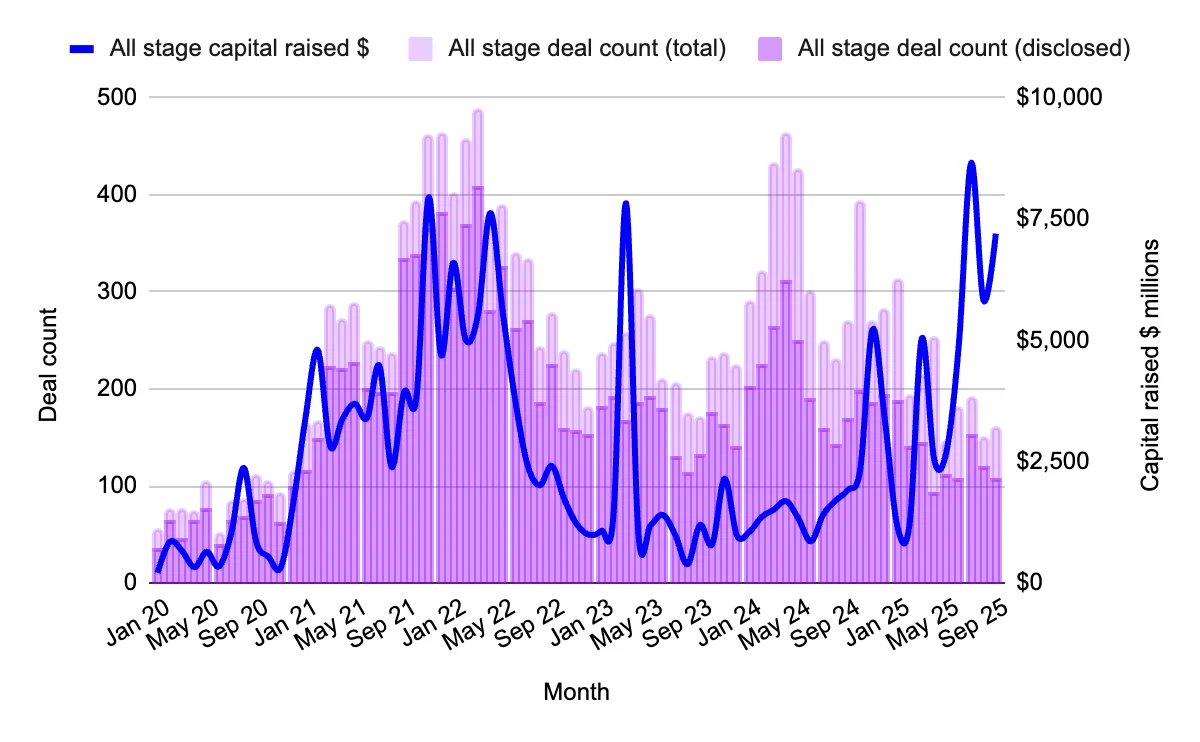
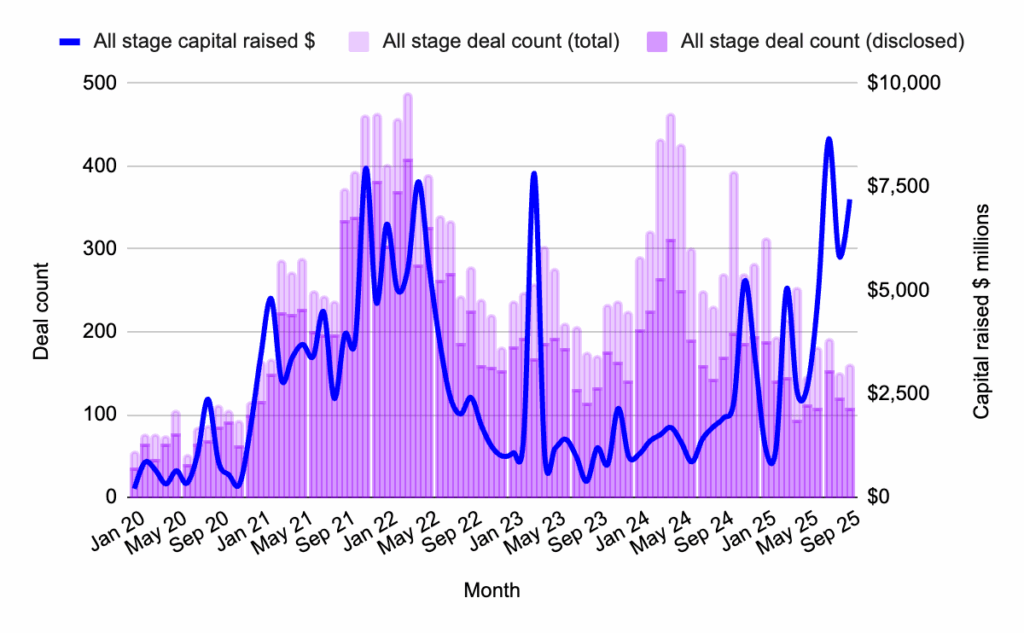
The global Web3 fundraising ecosystem experienced a notable recovery during September 2025, generating $7.2 billion across 160 distinct funding deals. According to market data compiled by Messari and Outlier Ventures, this performance marked the highest aggregate capital deployment since the broad market surge observed in the spring of 2025. Despite the strong headline figure, a granular examination of the month’s activity reveals a highly bifurcated market. While late-stage enterprises and prominent token sales successfully commanded massive financial allocations, early-stage venture creation—particularly at the pre-seed level—continued a nine-month downward trajectory, reflecting a broader risk-off sentiment among institutional investors and venture capitalists.
Market Overview and Structural Shifts
The overarching narrative of September 2025 is defined by a distinct preference for maturity and liquidity. At first glance, the $7.2 billion capital injection signals a robust return of risk appetite within the digital asset sector. However, market analysts emphasize that the month’s totals were heavily top-heavy, dominated by outsized rounds directed toward established protocols, mature platforms, and massive private token sales.
This trend aligns closely with venture capital insights gathered earlier in the autumn at major industry gatherings, including Token2049 in Singapore. Investors are increasingly prioritizing assets with clear paths to liquidity and proven market traction, steering away from prolonged holding periods typically associated with early-stage SAFEs (Simple Agreements for Future Equity) and SAFTs (Simple Agreements for Future Tokens). Consequently, while aggregate capital deployment metrics appear healthy, the underlying distribution highlights a widening chasm between mature sector leaders and nascent startups.
Seed Stage Dynamics and the Flying Tulip Anomaly
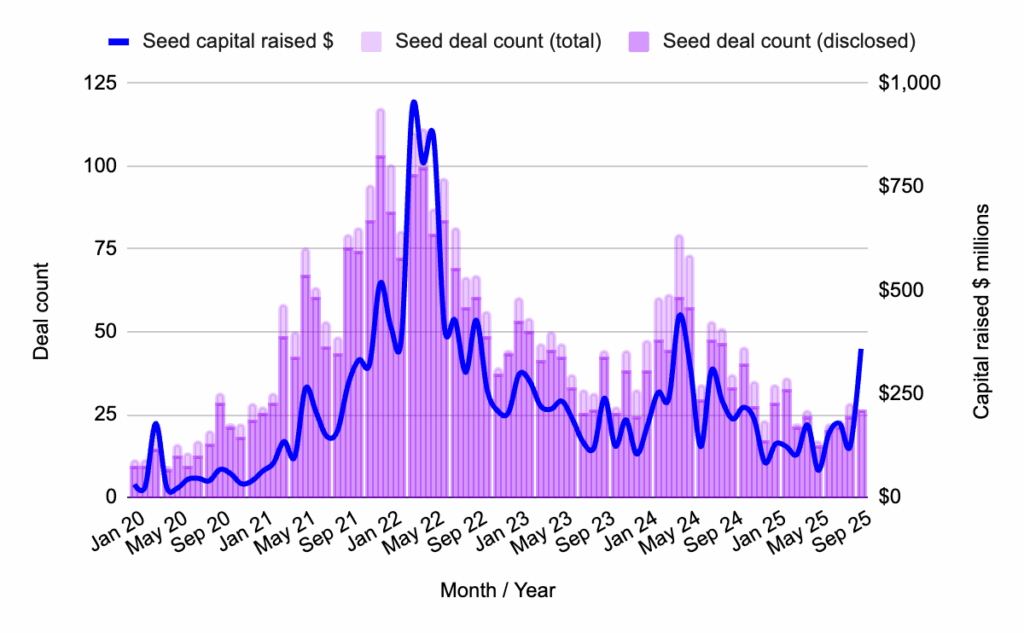
The seed stage of September 2025 presented a statistical anomaly entirely driven by a single, monumental transaction: the $200 million seed round secured by Flying Tulip at a unicorn valuation of $1 billion. Without this extraordinary capital infusion, seed-stage metrics would have remained closely aligned with the subdued figures recorded throughout the summer months.
Flying Tulip’s financing structure departed significantly from conventional venture funding models. The platform, designed to unify spot trading, perpetual swaps, lending, and structured yield into a single on-chain exchange with a hybrid automated market maker (AMM) and order book model, introduced a novel approach to capital management. Featuring cross-chain deposits and volatility-adjusted lending, the project incorporated on-chain redemption rights that afford investors capital security and continuous yield exposure without forfeiting upside potential. Rather than rapidly depleting the raised capital, Flying Tulip reportedly utilizes DeFi yield generation to fund operational growth, ecosystem incentives, and token buybacks.
Industry observers note that while investors retain the right to withdraw funds, this mechanism represents a sophisticated, DeFi-native evolution of capital efficiency. By offering liquid asset exposure within a seed-stage vehicle, Flying Tulip provided Web3 venture capitalists with an alternative to traditional illiquid instruments, though it remains to be seen whether this structure will become a widespread industry standard or remain an isolated experiment.
Contraction in New Fund Formations and Pre-Seed Struggles
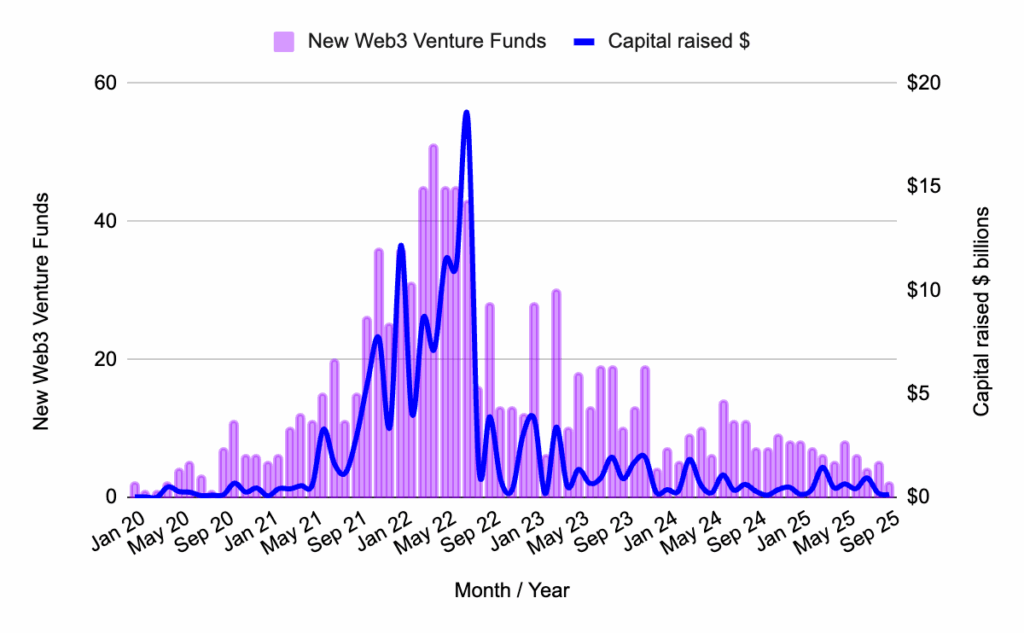
Contrasting sharply with the activity at the top end of the market, the formation of new crypto and Web3 venture funds cooled significantly in September 2025. Only two new venture vehicles were launched during the month. Both funds were characterized by smaller target sizes and highly thematic mandates, underscoring an industry-wide pivot toward selectivity. Rather than raising sprawling, general-purpose treasuries, emerging fund managers are opting for sharper, thesis-driven capital deployment aimed at specific infrastructural or application layers.
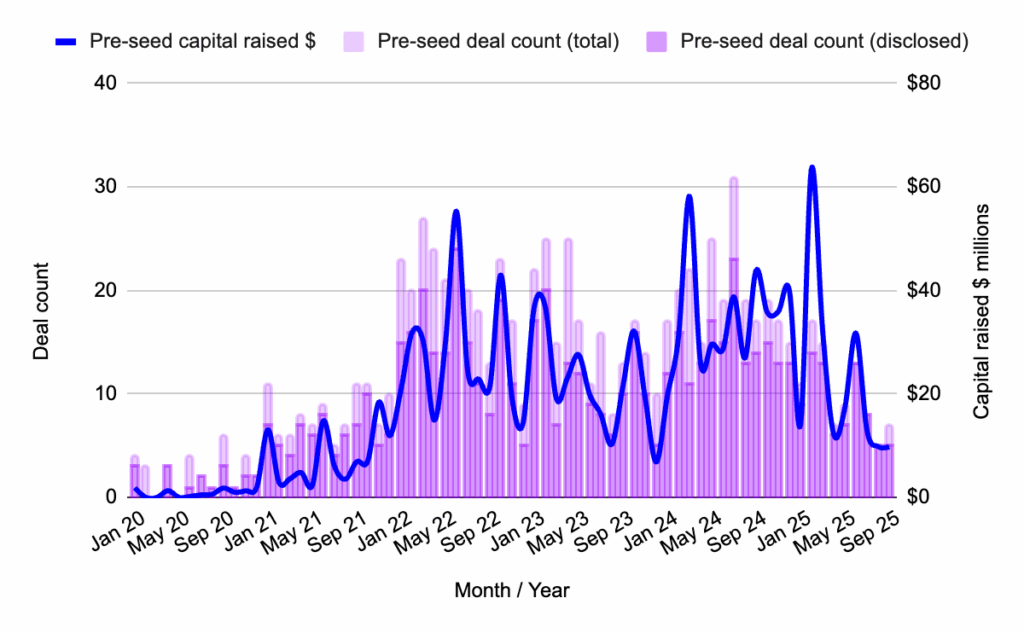
This conservative approach was similarly evident in the pre-seed sector, which extended a nine-month slump in both aggregate capital raised and total deal count. Pre-seed funding remains sluggish, with few tier-one institutional investors willing to commit early capital. Founders operating at this foundational level face a severely constrained funding environment, forcing them to rely on exceptionally tight narratives, demonstrated technical conviction, and lean operational models to secure backing.
A notable exception within the pre-seed landscape was Melee Markets, a Solana-based platform that successfully closed a $3.5 million funding round with backing from prominent funds such as Variant and DBA. Functioning as a hybrid between prediction markets and social trading, Melee Markets enables users to speculate on influencers, current events, and trending cultural topics, exemplifying the type of targeted, attention-driven asset class capable of cutting through current market hesitation.
Series A Stabilization and Regional Divergence
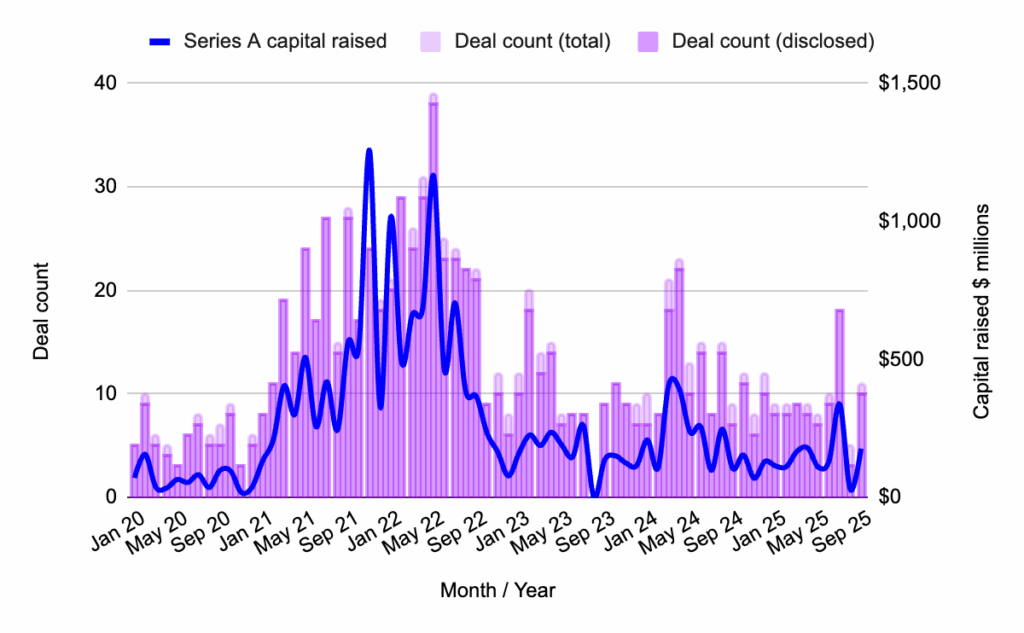
Series A funding exhibited signs of stabilization in September 2025, recovering modestly from a sharp contraction recorded in August. Deal volume and total capital deployed at this stage landed near the average baseline for the year, confirming that investors remain methodical and selective, preferring to underwrite proven operational traction over speculative potential.
A prime illustration of this trend was the $38 million Series A round secured by Digital Entertainment Asset (DEA), a Singapore-based firm developing Web3 gaming, environmental, social, and governance (ESG), and advertising platforms featuring real-world economic payouts. Backed by strategic heavyweights including SBI Holdings and ASICS Ventures, DEA’s successful raise highlighted Asia’s enduring appetite for bridging blockchain technology with mainstream consumer industries and corporate enterprise applications.
Private and Public Token Markets: Megarounds and BTCFi
Private token sales during September 2025 followed the established pattern of recent quarters: reduced overall round counts offset by outsized check sizes directed toward exchange-driven plays and major infrastructural projects. The most prominent transaction in this category was Crypto.com’s $178 million raise, executed in partnership with Trump Media. This substantial capital injection underscores the ongoing race among centralized exchanges to secure global accessibility, expand regulatory compliance frameworks, and deploy mass-market consumer spending tools.
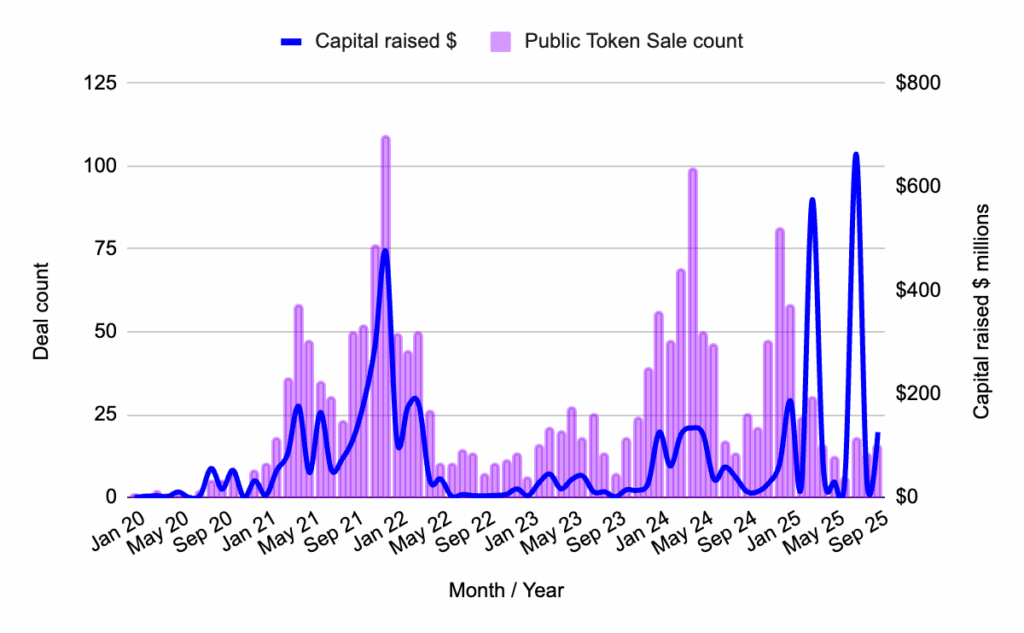
Meanwhile, public token sales remained active, propelled primarily by two dominant market narratives: artificial intelligence (AI) agents and Bitcoin yield generation, commonly referred to as BTCFi. Public markets continued to reward projects offering innovative solutions to unlock liquidity within historically dormant asset classes.
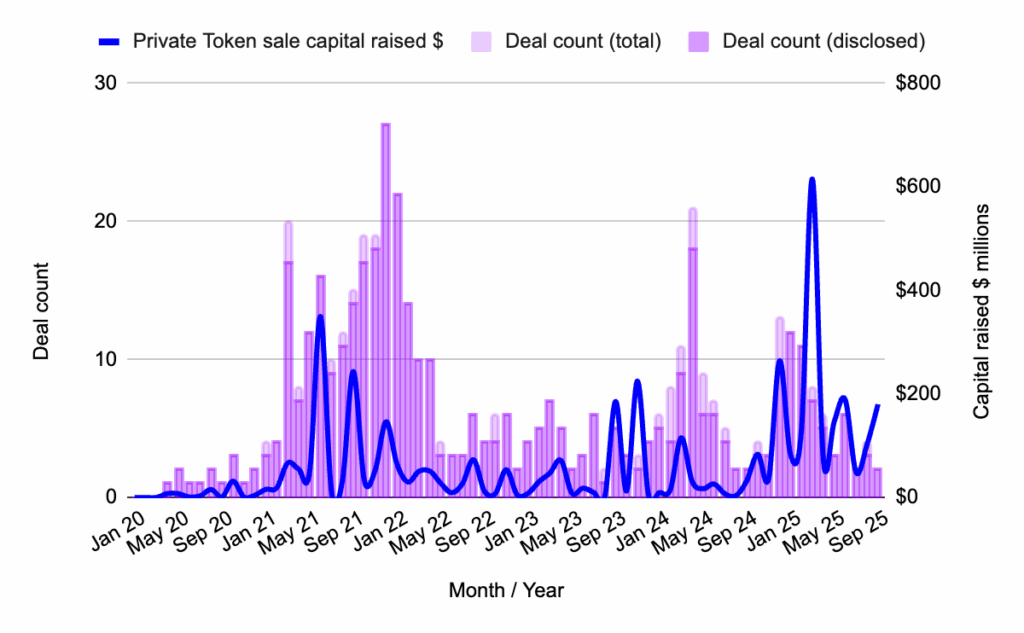
A standout development in this sector was Lombard, which successfully raised $94.7 million through its public token sale initiatives. Lombard is advancing the BTCFi narrative by introducing LBTC—a yield-bearing, cross-chain, liquid Bitcoin asset engineered to unify fragmented Bitcoin liquidity across disparate decentralized finance ecosystems. By enabling native Bitcoin to generate yield, projects like Lombard are addressing a fundamental capital inefficiency within the broader cryptocurrency economy.
Broader Economic Implications and Outlook
The fundraising landscape of September 2025 underscores a maturing Web3 industry characterized by institutional pragmatism. As venture capitalists increasingly demand liquid asset exposure, yield-bearing structures, and proven late-stage traction, early-stage founders must adapt to a more rigorous capital-raising environment.
While mega-deals and innovative token models like those observed in September demonstrate that substantial capital remains available for high-conviction projects, the broader recovery is uneven. The contraction in new fund formations and pre-seed activity suggests that the era of speculative, broad-market capital deployment has been decisively replaced by targeted, thesis-driven investment strategies focused on sustainable utility and long-term liquidity.

