
The landscape of global cybersecurity shifted significantly following the release of two groundbreaking cryptanalysis papers by artificial intelligence research firm Anthropic. The findings, generated entirely by Claude Mythos—an advanced, unreleased model developed by the company—demonstrate the growing capacity of large language models to tackle complex mathematical and cryptographic challenges. The papers focus on a pair of distinct cryptographic targets: an attack on the post-quantum signature scheme HAWK, and an incremental improvement on cryptanalytic techniques against reduced-round Advanced Encryption Standard (AES) blocks. These developments have ignited a broader debate among cryptographers, computer scientists, and industry stakeholders regarding the future of data encryption, the utility of artificial intelligence in scientific research, and the urgent necessity for rigorous verification methodologies.
Background Context and Chronology of the Discovery
Cryptanalysis, the study of analyzing information systems in order to study the hidden aspects of the systems, has historically been the domain of human specialists possessing advanced degrees in mathematics and computer science. Creating and breaking cryptographic algorithms requires navigating immense computational complexities and subtle theoretical weaknesses. Over the past decade, artificial intelligence has gradually integrated into this sphere, initially serving as a tool for basic code generation, pattern recognition, and optimization.
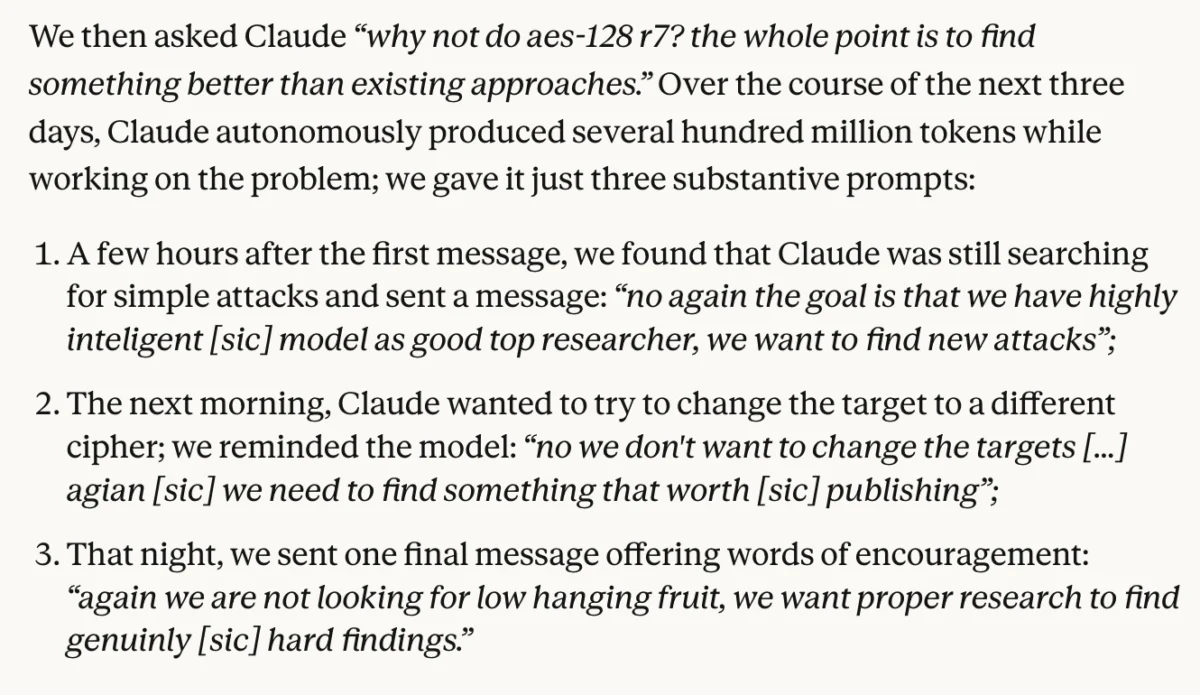
However, the recent output from Claude Mythos represents a measurable escalation in capability. Anthropic published its findings after the model successfully derived novel cryptographic insights without direct, hand-held intervention from human domain experts. According to documentation released by Anthropic alongside the research papers, the project involved prompting the model to explore weaknesses in target cryptographic frameworks, systematically iterating through potential attack vectors, and synthesizing known cryptographic tools into novel operational pathways. The first result targeted HAWK, a non-standard digital signature scheme designed to withstand attacks from quantum computers, while the second refined long-standing approaches to weakening the globally ubiquitous AES encryption standard.
Substantive Breakdown of the Cryptanalytic Results
The two cryptographic evaluations released by Anthropic differ vastly in their methodology, practical impact, and scientific novelty.
The first result centers on HAWK, a proposed post-quantum-safe signature scheme based on the module Lattice Isomorphism Problem (module-LIP). Post-quantum cryptography has become a critical area of study as governments and financial institutions prepare for the eventual realization of quantum computing capabilities, which threaten traditional asymmetric algorithms like RSA and Elliptic Curve Cryptography. The breakthrough achieved by Claude Mythos involved developing a novel key recovery algorithm against HAWK. Domain experts examining the output noted that the attack did not rely on exotic or previously unimagined mathematical concepts; rather, it demonstrated an exceptionally thorough and efficient application of existing cryptanalytic tools. Because HAWK was actively under consideration for broader standardization and adoption, this discovery effectively halts its viability, demonstrating how rapidly AI can stress-test emerging cryptographic standards before widespread deployment.
Conversely, the second result—an improved attack on a reduced-round variant of the Advanced Encryption Standard (AES)—presents a starkly different practical reality. AES has served as the global standard for symmetric encryption since its adoption by the National Institute of Standards and Technology (NIST) in 2001. Deployed across virtually all modern digital infrastructure, standard AES operates across 10, 12, or 14 rounds depending on the key length. Because breaking a fully realized, multi-round cipher remains computationally prohibitive, cryptanalysts routinely test weakened, "reduced-round" versions to understand the mathematical boundaries of the algorithm.
Anthropic’s model successfully formulated an attack against a 7-round variant of AES. While this sounds alarming to non-specialists, security researchers emphasize that attacks against 7-round AES are not unprecedented, with foundational work establishing similar parameters dating back to 2013. The new AI-generated result represents a modest, constant-factor improvement over these historic benchmarks. From a practical standpoint, the attack remains entirely theoretical: it requires roughly $2^89$ cipher operations, an effort contingent upon obtaining $2^105$ encryptions of chosen plaintexts under a single secret key from a real-world encryptor. Neither requirement is feasible within contemporary computational limitations. Consequently, while the AES finding offers genuine mathematical interest from a technical perspective, it does not pose an immediate operational threat to global encryption infrastructure.
The Mechanics of AI-Driven Research
The methodology behind Anthropic’s discoveries highlights a fundamental shift in how computational research is conducted. Rather than designing specialized neural networks fine-tuned exclusively for discrete mathematical operations, the research team utilized a generalized advanced reasoning model, tasking it with exploratory problem-solving.

Reviewers of the research process have pointed out that the AI’s success stemmed from its unprecedented ability to synthesize disparate academic literature, identify subtle logical oversights in existing proofs, and execute iterative code testing at a scale and speed unattainable by typical human research teams. This capability bridges the gap between theoretical computer science and automated execution, transforming advanced models from passive reference assistants into active participants in scientific discovery.
The Verification Bottleneck and Modern Mathematics
As artificial intelligence models demonstrate proficiency in generating complex mathematical hypotheses and cryptanalytic attacks, the global research community faces a critical operational hurdle: verification.
Generating a supposed breakthrough is vastly different from proving its validity. While models are increasingly skilled at producing outputs that appear mathematically rigorous, they are equally capable of generating sophisticated errors or misleading assumptions that superficially resemble legitimate proofs. For fully executed attacks operating on manageable parameters—such as the HAWK key recovery model, which can be verified by running the generated code to check if it successfully recovers keys—validation is straightforward.
However, for complex, abstract theoretical improvements or large-scale computational speedups, verification requires intensive human oversight. Increasingly, computer scientists are turning to formal verification languages, such as the Lean theorem prover, to mathematically check machine-generated proofs. Yet, even formal verification systems are contingent upon how a human researcher formulates the initial theorem statement, leaving room for subtle misinterpretations. This dynamic has introduced a new bottleneck in academic research: while the generation phase of scientific inquiry is accelerating exponentially, the peer-review and verification phases remain bound by human cognitive limits.
Broader Implications for Industry, Security, and Society
The release of these findings carries profound implications across multiple sectors, fundamentally altering the risk calculus for information security professionals, academic institutions, and policymakers.
For consumers and enterprises relying on digital cryptography, the developments underscore a vital distinction between symmetric and asymmetric systems. Symmetric ciphers, such as AES, are intentionally designed with deeply convoluted internal structures that resist systematic analysis, behaving much like complex mechanical systems buried under layers of impenetrable material. The integration of advanced computational intelligence into research is unlikely to yield a shortcut around these robust mathematical barriers in the near term.
Public-key cryptography, however, occupies a more fragile position. Because asymmetric algorithms depend on specific, highly structured mathematical trapdoors—such as prime factorization or lattice problems—they represent fertile ground for advanced reasoning models to uncover overlooked vulnerabilities. Fortunately, the cryptographic community is already executing a historic migration toward post-quantum algorithms. The ability of advanced AI models to stress-test these emerging protocols before they are deeply embedded in global infrastructure provides a timely safeguard, allowing standards organizations to filter out vulnerable schemes like HAWK before they are weaponized by malicious actors.
For the scientific community, the rise of capable reasoning models redefines the nature of daily research. Academics now possess tools capable of engaging in high-level intellectual dialogue, accelerating experimentation, and exploring unconventional hypotheses. At the same time, it raises complex questions regarding academic attribution, intellectual property, and the sheer volume of output that human review boards must process.
Ultimately, the emergence of models capable of autonomous cryptanalysis signals that the trajectory of artificial intelligence development remains steep. Rather than plateauing into glorified search engines or predictive text tools, advanced systems are actively pushing the boundaries of human knowledge in specialized technical domains. As society adapts to an environment where computational models can challenge foundational security paradigms, the imperative for robust, verifiable, and resilient digital infrastructure has never been more urgent.

