The Ethereum Foundation, as part of its ambitious Trillion Dollar Security initiative, has identified two critical vulnerabilities currently plaguing the user experience of the Ethereum blockchain: blind signing and the inherent unpredictability of transaction outcomes. As decentralized finance (DeFi) continues to evolve, the gap between what a user authorizes and what the Ethereum Virtual Machine (EVM) actually executes has become a vector for substantial financial loss. To bridge this gap, the Foundation is researching the implementation of native transaction assertions, a mechanism designed to enforce specific post-transaction outcomes, working in tandem with the previously announced Clear Signing standard.
The Fundamental Flaw: Intent vs. Execution
At the core of the issue lies the design philosophy of the Ethereum network. Ethereum is an execution-agnostic engine; it processes the instructions provided in a transaction based on the state of the network at the exact moment of inclusion. It does not interpret the user’s subjective intent, nor does it verify that the final state matches the user’s expectations. A digital signature serves as a cryptographic commitment to a specific sequence of data, but that data interacts with complex smart contracts whose behavior can be influenced by external factors—such as front-running, sandwich attacks, or proxy contract upgrades—that were not accounted for when the signature was initially generated.
The disconnect between user intent and on-chain reality has been highlighted by several high-profile security incidents. In the Bybit incident, for example, attackers exploited a compromised frontend to manipulate signing requests, leading users to unwittingly authorize the replacement of Safe wallet implementation contracts. Similarly, the BadgerDAO attack saw users granting excessive token spending permissions under the guise of legitimate protocol interactions. In both instances, the signature was valid, yet the outcome was malicious.
These cases underscore a systemic failure: there is currently no robust, trustless mechanism for a user to attach a "rulebook" to their transaction that the network itself must verify before committing state changes.
Chronology of Security Challenges
The evolution of these threats has forced the Ethereum developer community to re-evaluate the transaction lifecycle. Historically, the focus was on protocol-level security and smart contract audits. However, the rise of sophisticated frontend-based attacks and complex multi-step DeFi interactions has shifted the focus toward user-centric defense.

- The Early Era (2015–2020): Security was largely focused on preventing re-entrancy and arithmetic overflows. Users primarily interacted with simple token transfers.
- The DeFi Summer and Beyond (2020–2023): As protocols grew in complexity, the "blind signing" problem emerged. Wallets began showing raw hex data to users, making it impossible for the average participant to understand the implications of their signatures.
- The Rise of Advanced Exploits (2023–2025): Attackers shifted tactics toward social engineering and frontend manipulation, as seen in the Radiant Capital post-mortem, where malicious payloads were substituted at the moment of signing.
- The Current Initiative (2025–2026): The Ethereum Foundation’s Trillion Dollar Security initiative, launched in May 2025, represents a formal effort to standardize protections like Clear Signing and explore long-term architectural shifts, including EIP-7906.
The Aave and CoW Swap Case Study
The necessity for outcome-based assertions was perhaps most starkly demonstrated by the Aave and CoW Swap collateral swap incident. A user attempted to execute a massive $50.4 million swap, but the market lacked the liquidity to accommodate a trade of that magnitude at the expected price. While the interface provided warnings, the lack of an on-chain, enforced price-impact constraint—independent of the frontend’s estimation—resulted in a catastrophic loss of value. The trade executed, but the resulting token receipt was worth only a fraction of the original collateral. This event proved that even when users are warned, the lack of an automated, "hard" guardrail at the protocol level leaves capital exposed to extreme slippage and market volatility.
Limitations of Current Defenses
Current security measures, while helpful, suffer from significant architectural limitations. Simulation services, which are widely used by modern crypto wallets, attempt to predict the outcome of a transaction before it is sent to the mempool. However, these simulations are snapshots of a specific state. Because Ethereum is a dynamic environment, the state can shift in the milliseconds between the simulation and the actual block inclusion.
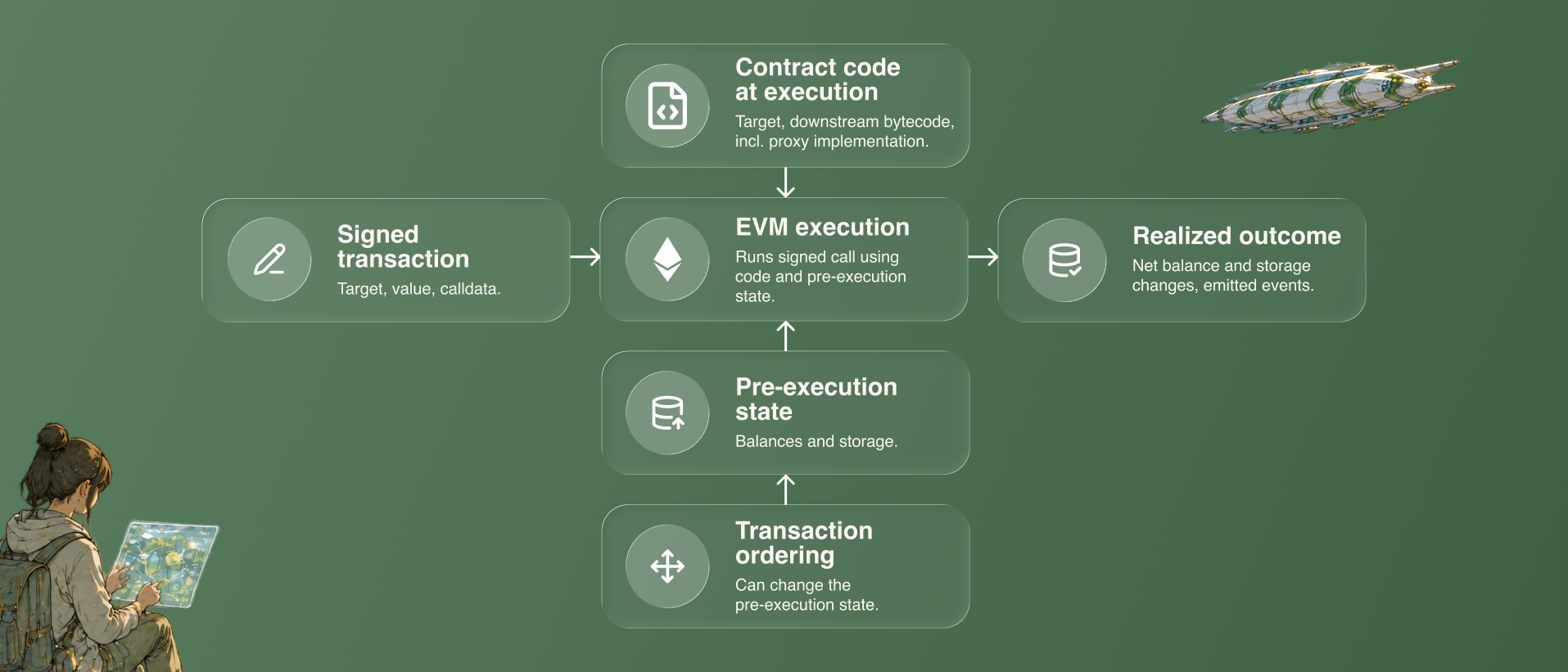
Furthermore, existing guardrails like amountOutMinimum in Uniswap or checkAfterExecution in Gnosis Safe are specific to individual protocols. They are not universal. A truly secure ecosystem requires a standardized, protocol-agnostic way to define "success." As it stands, there is no native way for a user or a smart contract to query the total net change of a transaction—such as every balance shift, storage modification, and emitted event—before the transaction is finalized.
EIP-7906 and the Path Forward
The proposed solution, outlined in EIP-7906, seeks to introduce "Transaction Assertions via State Diff Opcode." This EIP is heavily influenced by the "frame transactions" concept found in EIP-8141. By adding a read-only POST_TX frame, the network would allow for a final validation step after the execution of the transaction’s primary logic.
If the POST_TX step determines that the final state violates the user-signed rules (such as a minimum asset balance or an forbidden contract interaction), the entire transaction reverts. This would effectively act as a circuit breaker for individual transactions. The inclusion of new opcodes—TXTRACE, TXDIFF, and EVENTDATACOPY—would provide the necessary visibility into the net changes of the state.
Crucially, this mechanism introduces a cost-mitigation strategy. By requiring the gas payer to cover the cost of the POST_TX frame, the network ensures that malicious actors cannot spam the chain with failing assertions, as they would still be penalized for the computational resources consumed during the transaction’s execution phase.
Implications for Protocols and Delegation
The introduction of native transaction assertions would have profound implications for the future of delegation. As users increasingly rely on smart agents and account abstraction to manage their assets, the ability to enforce "intent-based" security becomes paramount. An agent could be authorized to manage a portfolio, but only under the strict condition that its actions never drop the account’s total value below a certain threshold or authorize specific, untrusted contracts.
From a protocol perspective, developers could enforce that all interactions occur within a frame transaction, thereby ensuring that every participant is protected by a predefined safety rule. This would fundamentally change the trust dynamic in DeFi, moving from "trust the interface" to "trust the code that verifies the outcome."
Industry Reaction and Next Steps
The proposal has been met with cautious optimism by the developer community. While some raise concerns regarding the complexity of implementing new opcodes and the potential for increased block-processing time, the consensus is that the status quo is unsustainable. Security researchers have long argued that as long as the user’s signature is "dumb"—meaning it only signs instructions rather than outcomes—the ecosystem will remain vulnerable to sophisticated exploitation.
The Ethereum Foundation is currently soliciting feedback from wallet providers, auditors, and DeFi protocol teams to refine the design of EIP-7906. The focus is on finding a balance between robust security and the flexibility required for a vibrant, innovative ecosystem. As the industry moves closer to the Hegot upgrade, the integration of these security standards will be a critical topic of debate.
The Foundation’s message to stakeholders is clear: to secure the next trillion dollars of value, the network must evolve to understand not just what the user is doing, but what the user intends to achieve. By embedding these assertions directly into the protocol, Ethereum may be taking its most significant step yet toward becoming a secure, institutional-grade financial layer. Those interested in the technical specifications or wishing to contribute to the research are encouraged to engage through the EIP-7906 discussion threads on Ethereum Magicians or by contacting the Trillion Dollar Security initiative directly.