

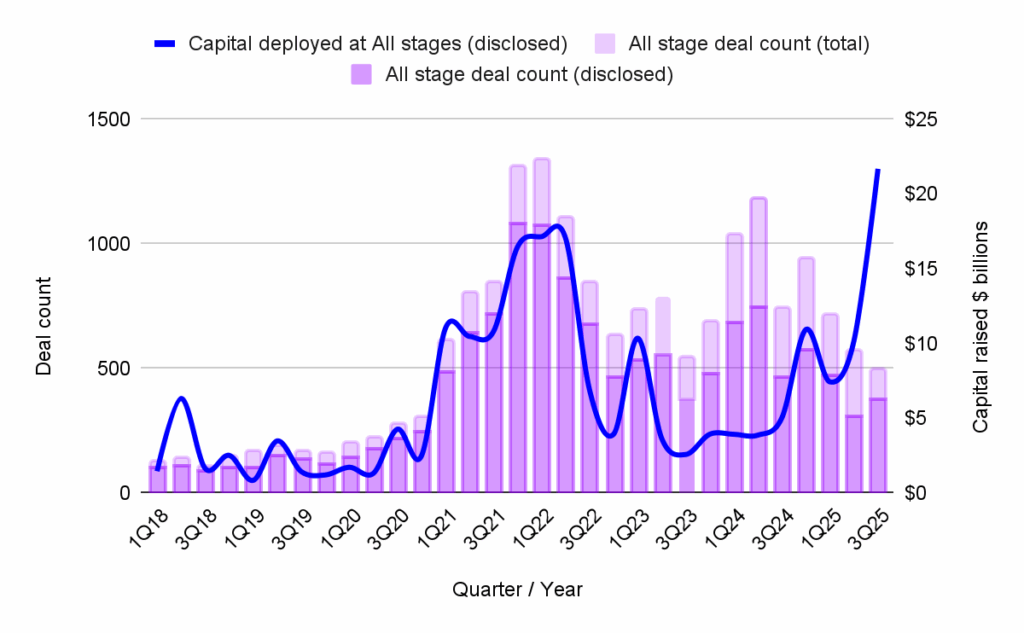
The global Web3 fundraising landscape experienced a dramatic resurgence in the third quarter of 2025, deploying nearly $22 billion across 376 disclosed deals. According to comprehensive market data compiled by Outlier Ventures and Messari, total capital deployed soared by 113% quarter-on-quarter, jumping from $10.2 billion in the second quarter to $21.7 billion. While this influx of capital eclipsed the figures seen during portions of the historic 2021 and 2022 bull markets, the expansion was characterized by a distinct structural dynamic: capital outpaced deal volume. The number of disclosed transactions increased by a modest 22%, indicating that the quarter’s record-breaking performance was propelled by significantly larger ticket sizes rather than a broad-based surge in early-stage entrepreneurial activity.
This trend underscores a continuation of the "conviction over coverage" paradigm that defined the first half of 2025. However, the third quarter introduced a critical evolutionary step. The institutional channels that underpin modern cryptocurrency markets—including exchange-traded funds (ETFs), digital asset treasuries (DATs), tokenization initiatives, and enterprise settlement rails—transitioned from theoretical promises to operational realities. Consequently, the venture funding mix aligned closely with these established financial arteries, concentrating capital where traditional institutions could deploy resources at scale.

Market Overview and Institutional Capital Concentration
A granular examination of the third-quarter metrics reveals an unprecedented level of capital concentration. Data from Messari indicates that the ten largest fundraising rounds of the quarter accounted for approximately half of all venture capital deployed. This dynamic highlights that the recovery in macro liquidity has yet to trigger a widespread revival in traditional venture capital appetite for early-stage speculative ventures.
Furthermore, third-quarter data marked a unique statistical divergence: it was the only recent period in which the number of disclosed deals increased even as the aggregate number of transactions declined across several categories. Market analysts point out that disclosure rates naturally correlate with round size and maturity. Later-stage, highly capitalized rounds are routinely publicized to signal market traction, whereas smaller pre-seed and seed-stage rounds frequently remain private. This visibility bias further emphasizes a market where capital became more pronounced primarily because it became heavily concentrated in mature, compliant enterprises.
The institutional architecture supporting this capital shift deepened considerably throughout the quarter. Ethereum-focused exchange-traded funds attracted approximately $8.7 billion in inflows during the third quarter, outstripping their Bitcoin-focused counterparts and driving total Ethereum ETF assets under management up by roughly 170% quarter-on-quarter to $27.4 billion. Concurrently, digital asset treasuries captured approximately 3.8% of the circulating Ethereum supply, signaling a structural transformation in corporate balance sheet management.
Enterprise adoption moved rapidly from pilot phases into production. JPMorgan expanded its institutional footprint by launching its Kinexys network for tokenized repurchase agreement settlements. Concurrently, SWIFT advanced its multi-party tokenization trials in collaboration with major global custodians—including BNY Mellon, Citi, Clearstream, Euroclear, and Northern Trust—to test cross-network settlement of bonds and fund shares on-chain. Additionally, payment giants like Visa integrated USDC into Visa Direct for cross-border settlement rails. This massive institutional demand explains why infrastructure and later-stage projects secured outsized funding rounds.
Regulatory Evolution and Strategic Partnerships
Regulatory developments throughout 2025 provided the legal clarity necessary to accelerate institutional execution. Industry reports from financial institutions such as DBS highlighted that 2025 marked a pivotal pivot from regulatory consultation to active implementation. Legislative milestones, including the proposed GENIUS Act and concurrent international regulatory frameworks, served as catalysts for stablecoin deployment and asset tokenization within traditional banking and payment sectors. These policy adjustments effectively lowered regulatory barriers for institutional market participants.
However, regulatory clarity alone does not fully account for the extreme concentration of capital in later-stage ventures. Large financial institutions operate under strict governance mandates, fiduciary duties, and return targets. Deploying numerous small tickets into early-stage ventures is operationally inefficient and clashes with traditional investment profiles. Institutional allocators also face strict career risk constraints, discouraging decision-makers from backing unproven startups with extended time horizons.
To bridge this operational divide, the market increasingly turned to hybrid investment models. Strategic partnerships between traditional asset managers and specialist Web3 venture firms—such as Outlier Ventures’ collaboration with Morgan Creek—exemplified this trend. By leveraging specialized due diligence, deep sector expertise, and robust portfolio support infrastructure, these partnerships enable traditional institutional capital to gain structured exposure to early-stage digital assets while effectively mitigating systemic risks.
Fund Formation and Secondary Market Dynamics
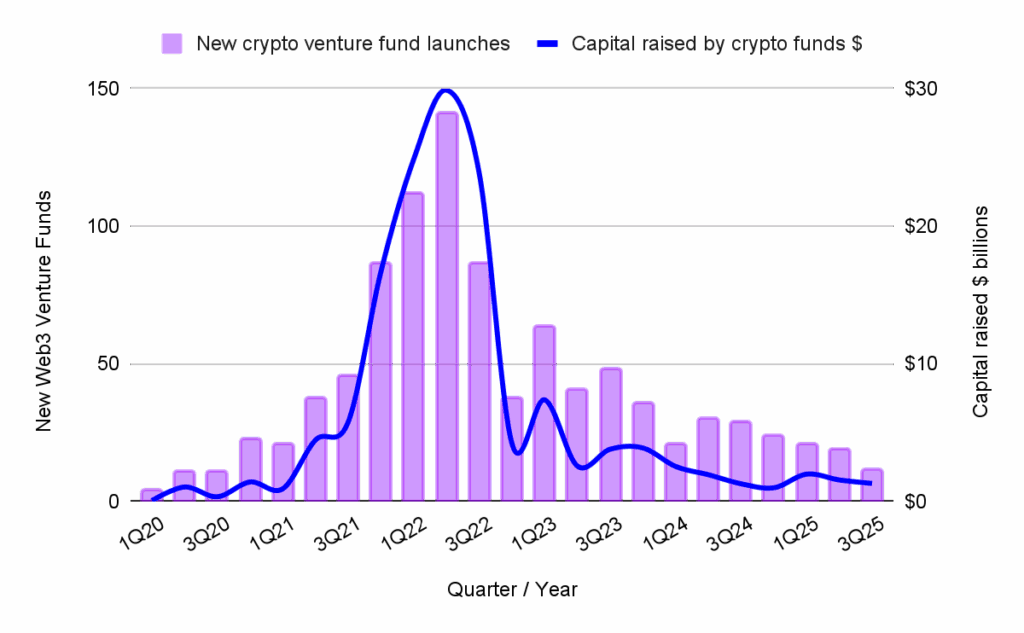
Despite the record-breaking deployment of capital, the formation of new crypto-focused venture funds remained remarkably subdued. Only 11 new venture funds were launched during the third quarter, securing a combined $1.3 billion. This figure extends a persistent downward trend observed throughout the year, mirroring the cautious fundraising environment of mid-2020.
Rather than signaling a systemic crisis, this caution reflects a strategic reliance on existing dry powder by general partners and continued selectivity from limited partners. Industry data from PM Insights characterized the period as a "recycling phase," wherein existing capital circulated through secondary market transactions and strategic exits rather than fueling a wave of net-new venture fund creation.
Stage-by-Stage Breakdown of Venture Funding
Early-stage fundraising performance varied significantly across development tiers, consistently rewarding proven traction over speculative promise.
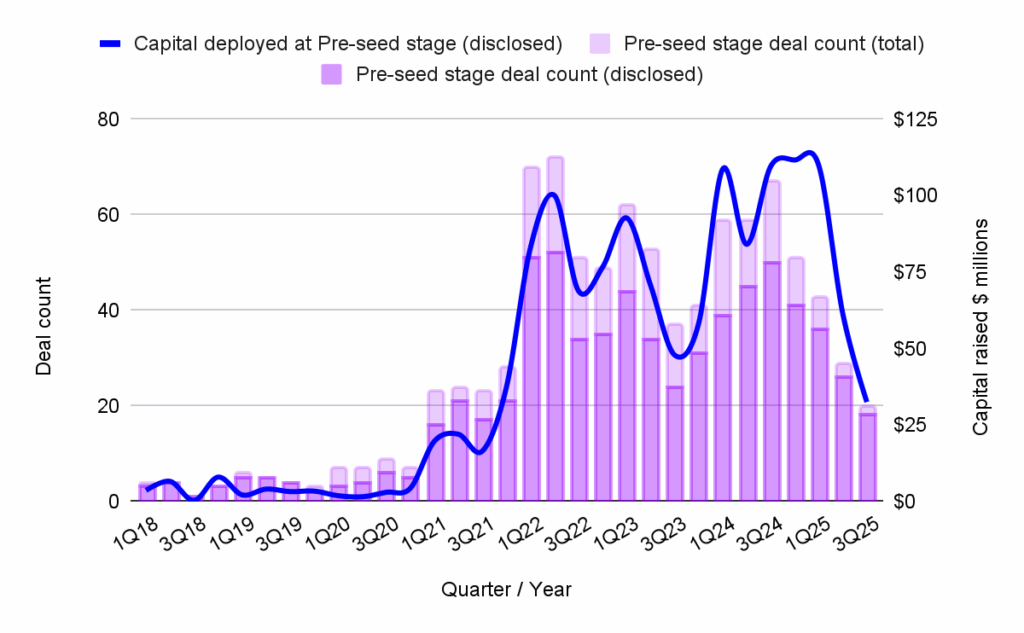
Pre-seed fundraising endured its weakest quarter in recent history, recording just 18 disclosed rounds totaling $32.5 million. The 12-month running median for pre-seed rounds dipped below $2.5 million, a contraction exacerbated by a measurable decline in global accelerator activity that narrowed the top of the entrepreneurial funnel.
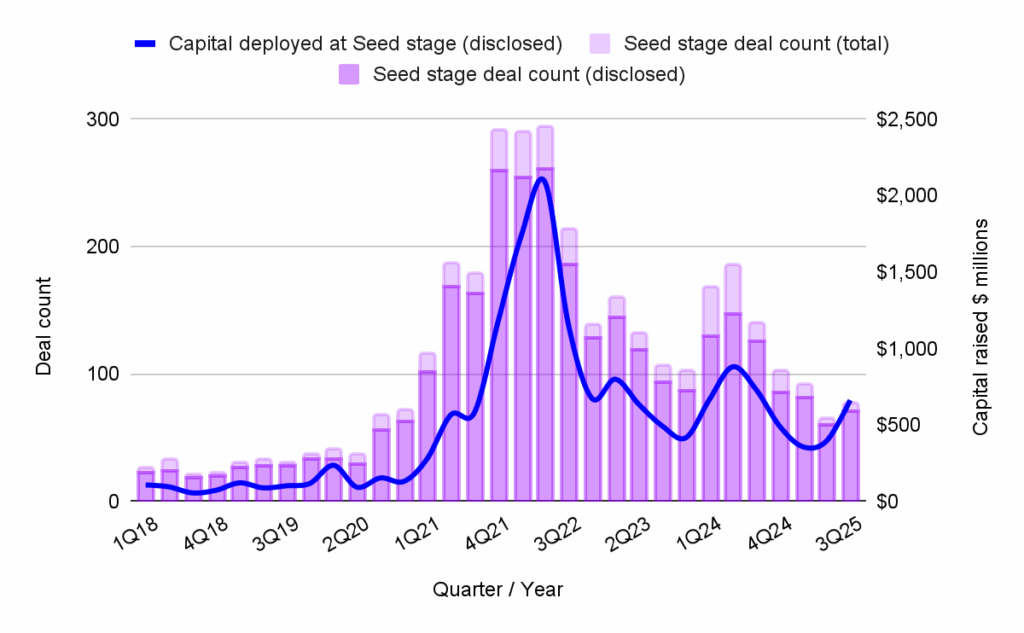
Conversely, seed-stage financing posted a headline recovery, registering 71 disclosed rounds totaling nearly $663 million. However, this figure was heavily skewed by a single transaction: Flying Tulip’s $200 million raise, which accounted for approximately one-third of all seed capital for the quarter. Structured unconventionally, the financing granted investors on-chain redemption rights that provided yield and capital exposure without forfeiting upside, illustrating a growing preference among Web3 investors for liquid, capital-efficient instruments over traditional, illiquid SAFEs (Simple Agreements for Future Equity).
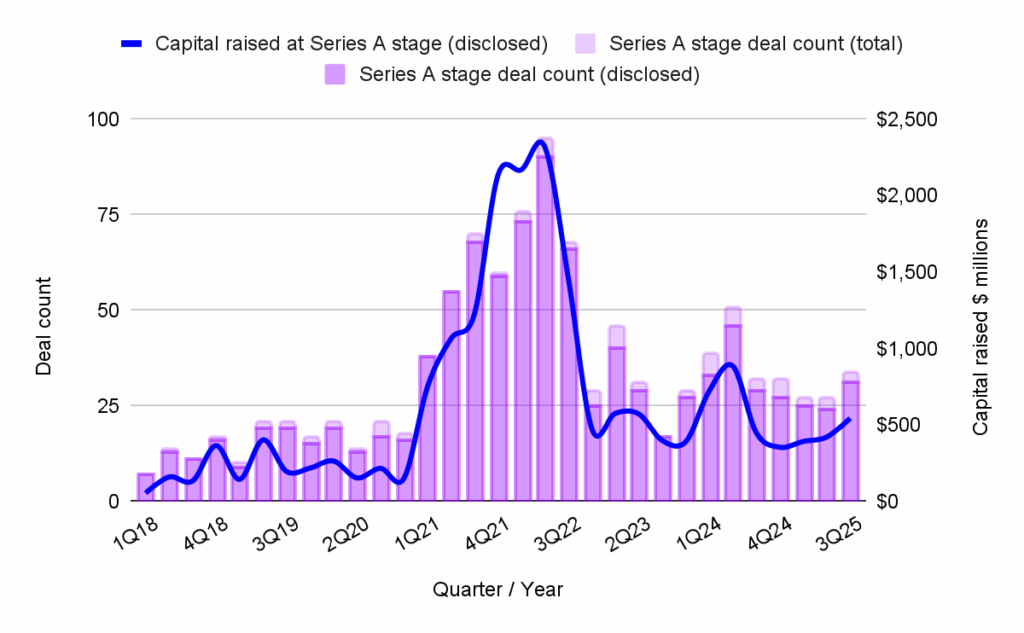
Series A fundraising demonstrated relative stability, logging 31 disclosed rounds totaling approximately $545 million, with a steady 12-month running median of roughly $16 million. Investor interest at this stage remained strictly focused on projects with clear alignment to institutional infrastructure, such as enterprise payments, tokenization platforms, and developer tooling.
Category Concentration and Token Sales
An analysis of capital deployment across market categories confirms an unmistakable institutional preference. Investment management platforms, financial services, data infrastructure, and mining operations absorbed roughly 70% of all venture dollars in the third quarter. These sectors benefit directly from ETF inflows, corporate treasury accumulation, and enterprise tokenization pilots. Conversely, consumer-facing categories such as gaming, the metaverse, and wallet security remained largely peripheral as investors prioritized regulatory compliance and clear revenue visibility.
Token fundraising exhibited a parallel shift toward public distribution models. Public token sales rebounded sharply, recording 47 events that raised a combined $819 million. Private token sales, by contrast, continued a multi-quarter decline, dropping to just 7 events totaling $331 million. As market capitalization and trading volumes improved across public exchanges, project teams increasingly favored public token launches for efficient price discovery and community alignment. Market observers note that the reopening of public listings and initial public offerings served primarily as a vital sentiment marker, signaling renewed public market appetite for digital asset exposure.
Implications and Outlook for Upcoming Quarters
The third quarter of 2025 crystallized a permanent evolution in the Web3 sector. The convergence of decentralized technology and traditional finance is no longer an abstract hypothesis; it is the foundational assumption guiding modern capital allocation. While mainstream adoption has materialized primarily at the infrastructure and settlement layers rather than the consumer interface, this integration ensures that blockchain technology is sustainably embedded within the global financial architecture.
As the industry looks toward the final quarter of 2025 and into 2026, the central challenge for early-stage founders will be demonstrating measurable product-market fit, enterprise utility, and regulatory compliance to secure institutional-grade Series A funding. For venture capitalists and institutional allocators alike, bridging the gap between macro liquidity and early-stage innovation will determine whether the current cycle’s capital concentration broadens into a fully recovered entrepreneurial ecosystem.

