
The landscape of large language model (LLM) deployment has undergone a radical transformation over the past eighteen months, shifting from a binary choice between experimental open-weight projects and polished proprietary APIs to a sophisticated engineering decision matrix. As of early 2026, the performance gap between open-weight models and frontier proprietary systems—such as those from OpenAI, Anthropic, and Google—has narrowed significantly, with many open-weight contenders reaching parity on standard industry benchmarks for coding, classification, and retrieval-augmented generation (RAG) tasks.
For data scientists and machine learning engineers, the selection process is no longer driven by raw capability alone. Instead, it has evolved into a strategic evaluation of data sovereignty, operational overhead, and long-term cost predictability. With proprietary API costs falling by approximately 80% since 2023, the economic incentives are fluid, requiring a structured approach to ensure that technical architecture remains aligned with both regulatory requirements and business objectives.
A Chronology of the LLM Divide
The history of this divide began in earnest during the 2023 "Gold Rush," when proprietary models like GPT-4 established an early, unassailable lead in reasoning and general intelligence. During this period, open-weight models were widely viewed as academic curiosities or lightweight alternatives suitable only for minor tasks.
The pivot point occurred throughout 2024 and 2025. Meta’s release of the Llama 3 and subsequently the Llama 4 series fundamentally altered the market, providing the industry with a "gold standard" for open-weight performance. Simultaneously, competitors like Mistral AI and the DeepSeek research group demonstrated that smaller, highly optimized models could outperform much larger predecessors. By the start of 2026, the market entered a phase of maturity where open-weight models are no longer just "good enough"—they are frequently the preferred choice for enterprise-grade production environments that demand data control and cost-efficiency.
The Modern Landscape of Model Families
The current ecosystem is divided into two primary camps, each serving distinct operational needs.
The Open-Weight Ecosystem
In 2026, the term "open source" in the context of LLMs typically refers to open-weight models. While the underlying training data and proprietary methodologies remain undisclosed, the accessibility of the model weights allows organizations to host, fine-tune, and deploy these systems within their own secure environments.
- Meta Llama 4: This series has cemented its status as the industry benchmark for general-purpose open-weight models. The introduction of Llama 4 Scout, featuring a 10-million-token context window, has opened new frontiers for document analysis, allowing for the ingestion of entire legal libraries or codebase repositories in a single inference call.
- DeepSeek V3 and R1: These models have disrupted the leaderboard by offering elite-level reasoning and mathematical capabilities. DeepSeek R1, specifically optimized for logical inference, has become a staple for organizations handling complex, multi-step agentic workflows where output accuracy is paramount.
- Qwen 3.5: Developed by Alibaba, this series has emerged as a leader in multilingual performance. With an Apache 2.0 license, it provides a robust, commercially viable alternative for global organizations requiring high proficiency in languages such as Chinese, Arabic, and French, often outperforming frontier models in these specific domains.
- Mistral AI: Known for high efficiency, Mistral’s architecture is particularly favored by European firms. Its models, such as Mistral Small 4, are engineered to comply with the stringent requirements of the EU’s GDPR, making them a default choice for organizations operating under complex regulatory frameworks.
The Proprietary API Landscape
Proprietary models remain the gold standard for organizations that prioritize ease of integration over total control. Leaders like OpenAI’s GPT-5, Anthropic’s Claude, and Google’s Gemini offer managed infrastructure, significantly reducing the burden on internal DevOps teams.
The economic shift here is notable: while frontier-tier models still command a premium, mid-tier models (such as GPT-4o or Claude Sonnet) have seen their pricing stabilize at a fraction of 2023 costs. This "democratization of intelligence" allows startups and enterprises alike to leverage state-of-the-art models for pennies on the million tokens, effectively commoditizing the inference layer of the AI stack.
Four Pillars of the Decision Framework
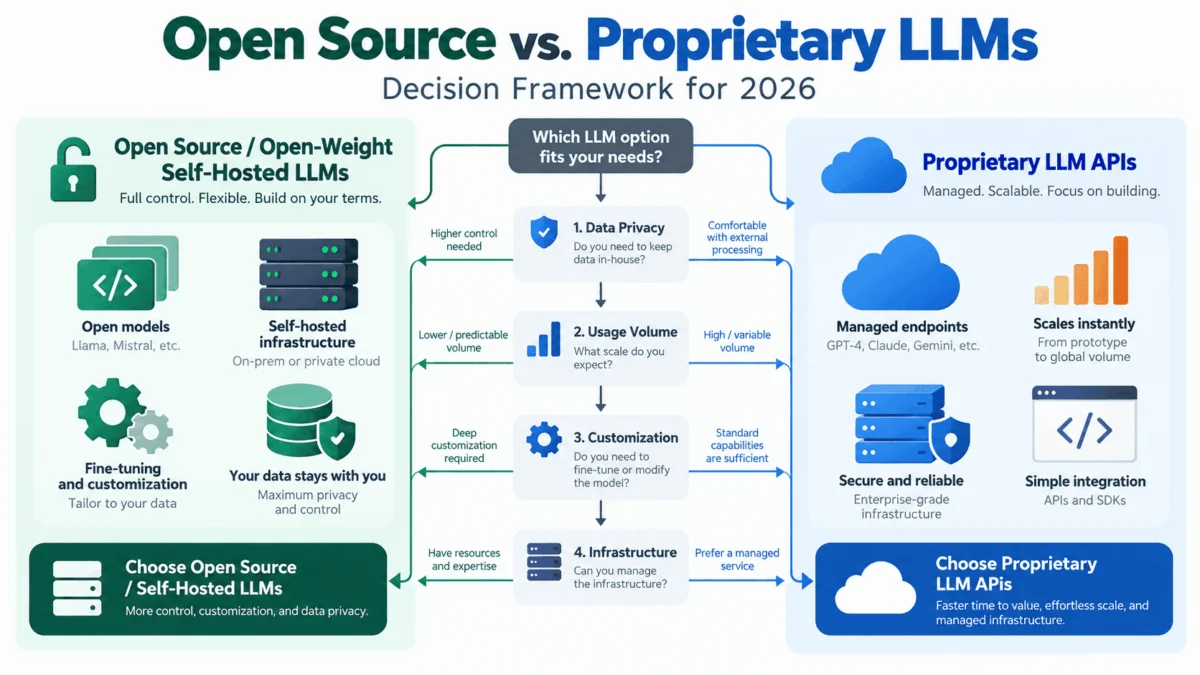
To navigate this landscape, organizations should evaluate their deployment strategy against four core technical and business requirements.
1. Data Sensitivity and Compliance
The most critical factor is the nature of the input data. For sectors like healthcare (HIPAA), finance (PII/transactional data), and national defense, the "air-gapped" security provided by self-hosted open-weight models is not merely a preference—it is a non-negotiable requirement. When data cannot leave the corporate firewall, proprietary APIs are effectively disqualified, regardless of their performance advantages.
2. Usage Volume and Economic Scaling
The cost-benefit analysis of LLMs follows a non-linear curve. At low volumes—typically under one million tokens per month—the engineering cost of maintaining a private GPU cluster exceeds the marginal cost of a proprietary API. However, at high volumes exceeding ten million tokens per month, the economies of scale shift dramatically in favor of self-hosted open-weight models. By leveraging hosted inference providers like Together AI or Groq, organizations can access open-weight models at 4x to 10x lower costs than proprietary counterparts, even before factoring in the elimination of long-term vendor dependency.
3. Customization and Domain Specificity
Proprietary models are often "black boxes," providing limited ability to perform deep, persistent fine-tuning on proprietary data. In contrast, open-weight models allow teams to perform domain-specific fine-tuning on highly niche datasets—such as clinical terminology or specific legal contract structures. Owning the weights provides a permanent, reusable asset that can be further distilled or optimized, a strategic advantage that proprietary APIs cannot replicate.
4. Infrastructure and Operational Capacity
The "hidden" cost of open-weight models is the requirement for MLOps expertise. Deploying a production-ready model requires a robust serving stack (such as vLLM or Ollama), ongoing monitoring, and hardware management. For teams without a dedicated infrastructure department, the complexity of managing GPU clusters may lead to "technical debt." In such cases, the middle ground—using hosted open-model APIs—provides the benefits of open-weight pricing while offloading the infrastructure burden to third-party providers.
Strategic Implications and Future Outlook
The industry is currently witnessing a transition toward hybrid architectures. Many mature organizations are now adopting a "routing" strategy: simple, high-frequency tasks—such as standard text summarization or basic classification—are directed to lightweight, cost-effective open-weight models, while complex, high-reasoning tasks are sent to frontier proprietary APIs.
This approach mitigates the risk of vendor lock-in, which has become a significant concern as proprietary providers iterate on their APIs. By keeping prompt templates model-agnostic and treating the LLM as a pluggable component, firms can pivot their underlying model strategy as performance benchmarks evolve or pricing structures shift.
Ultimately, the choice between open-weight and proprietary models is a functional one. The maturity of the open-weight ecosystem means that for roughly 80% of enterprise use cases, the performance gap is negligible. The remaining 20%—reserved for highly complex, multi-step agentic chains—remains the stronghold of proprietary frontier models.
As we look toward the remainder of 2026, the competitive pressure from open-weight models will continue to drive down the cost of proprietary APIs, further narrowing the gap. The winners in this market will not be those who cling to one ideology, but those who build flexible, data-driven systems capable of adapting to the rapid pace of artificial intelligence development. Organizations must move beyond public leaderboard scores and commit to rigorous internal testing on their specific, production-bound data to determine the optimal path forward. By focusing on data sovereignty, operational capacity, and scalability, companies can build AI infrastructures that are resilient, compliant, and economically sustainable.

