

The rise of Large Language Models (LLMs) has fundamentally shifted how software is built, yet a critical chasm remains between the capabilities of a chatbot and the requirements of an autonomous AI agent. While LLMs excel at generating static text based on a single prompt, enterprise-grade agents require the ability to maintain long-term context, reliably invoke external tools, and navigate multi-step workflows without succumbing to "hallucinations" or logical drift. Addressing this gap, Abacus.AI has introduced the Smaug family of models, a suite of three open-weight, fine-tuned models specifically optimized for the rigors of agentic, multi-step environments.
The Smaug initiative represents a departure from traditional prompt engineering or superficial weight adjustments. Instead, the team at Abacus.AI focused on a deep-training methodology designed to instill behavioral reliability directly into the model’s core. By applying a consistent training "recipe" across three distinct base models—DeepSeek V4 Flash, Qwen3.8-27B, and Kimi K3—Abacus.AI has demonstrated that while performance gains vary based on the underlying architecture, the methodology effectively closes capability gaps where base models are historically weakest.

The Problem of Agentic Drift
For developers, the transition from building a standard chatbot to an autonomous agent is fraught with technical hurdles. A standard LLM operates on a request-response paradigm. An agent, however, must perform a sequence of actions—such as querying a database, parsing the output, and deciding on the next logical step—while remembering the intent of the initial user prompt.
Abacus.AI observed that in many production environments, standard models begin to falter as the workflow extends. Factors such as prompt caching degradation, excessive context window bloat, and the propensity for models to "lose the thread" of the original task during complex tool use often lead to failure. In many cases, these operations crash or result in incorrect outputs after several hours of continuous, multi-stage interaction. Abacus.AI posits that this is a training issue, not a prompting one, and that the only solution is to reinforce the model’s ability to remain "on task" through intensive fine-tuning.
The Smaug Lineup: Architecture and Specialization
The Smaug series consists of three distinct models, each calibrated for a different point on the efficiency-capability spectrum. This allows developers to select a model based on hardware constraints and the complexity of the intended workload.
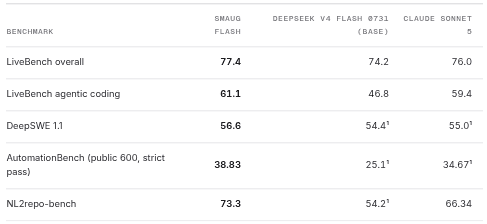
- Smaug Flash (304B): Built upon the DeepSeek V4 Flash base, this model is designed as the enterprise workhorse. It prioritizes speed and cost-efficiency for agents that must remain "always-on" and perform repetitive, long-context tasks.
- Smaug Mini (27B): Derived from the Qwen3.8-27B architecture, this is the compact, multimodal option. It is optimized for one-off tasks and scenarios where inference must run on more constrained hardware without sacrificing accuracy.
- Smaug Agentic (2.8T MoE): Leveraging the Kimi K3 Mixture-of-Experts (MoE) architecture, this is the flagship, frontier-scale model. It is built specifically for long-horizon coding tasks and highly complex reasoning workflows where stability is paramount.
Methodology: Beyond Benchmark Optimization
A recurring criticism of modern model training is that developers often over-optimize for specific benchmark scores, leading to models that perform well on standardized tests but fail in real-world application. Abacus.AI’s approach aims to bypass this "format compliance" trap.
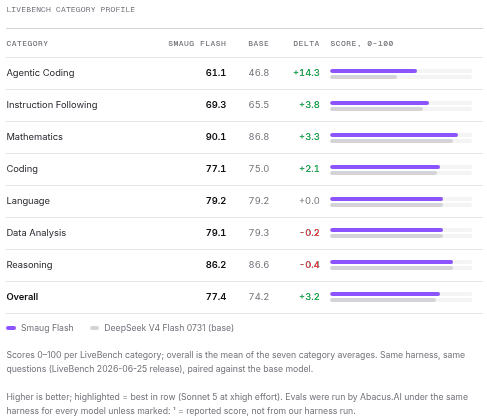
The training methodology combines human-curated, real-world agentic traces with synthetic data derived from notoriously difficult edge cases. By filtering out data that simply exploits scoring criteria, the team prioritized genuine problem-solving. This is most evident in the performance of Smaug Flash. Because its base model—DeepSeek V4 Flash—was historically prone to "spinning" or becoming confused during long-context tool use, the fine-tuning specifically targeted these failure modes. The result was a 14.3-point jump in LiveBench agentic coding, a significant improvement that validates the decision to focus on structural weaknesses rather than superficial metrics.
Analyzing the Data: Gains and Trade-offs
The performance data released by Abacus.AI reveals a nuanced picture of how fine-tuning alters a model. In the case of Smaug Flash, the improvements are dramatic. Beyond the 14.3-point gain in agentic coding, the model saw a 13.7-point increase in AutomationBench scores and a 19-point surge in NL2Repo-Bench. These are not incremental tweaks; they represent a fundamental shift in the model’s ability to handle the specific workflows for which it was designed.
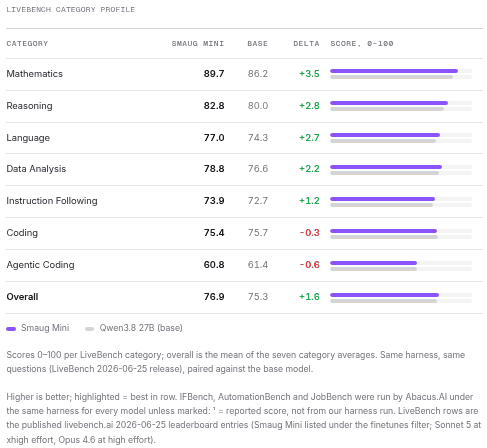
In contrast, Smaug Mini offers a different profile. Because its base model (Qwen3.8-27B) was already highly proficient at coding, the Smaug training regimen shifted the gains toward mathematics (+3.5) and general reasoning (+2.8). Interestingly, Smaug Mini slightly trailed its base in agentic coding (-0.6), yet it outperformed significantly larger, closed-source models like Claude Sonnet 5 and GPT-5.6 on benchmarks like IFBench and JobBench. This underscores a critical lesson for developers: benchmark categories are specialized, and a minor dip in one area is often a strategic trade-off for higher efficiency in another.
Perhaps the most compelling case is Smaug Agentic. When compared to the Kimi K3 base, the benchmark deltas appear modest, and in some areas, such as Terminal-Bench 2.1, the base model actually retains a slight edge. However, the true value of Smaug Agentic lies in behavioral endurance. During testing, the model successfully completed 113 complex coding tasks, averaging 78 agent steps per task over seven hours, with zero infrastructure errors or timeouts. In a production environment, the ability to run for hours without a catastrophic failure is vastly more valuable than a marginal increase in a static benchmark score.
Implications for the AI Development Ecosystem
The launch of the Smaug series arrives at a pivotal time for the AI industry. As businesses move from experimental chatbots to integrated, autonomous agents, the demand for models that can "behave" predictably over long durations is surging.

The transparency provided by Abacus.AI—specifically the inclusion of performance data where the model did not improve—sets a high standard for academic and industrial reporting. By acknowledging that Smaug Agentic is not superior in every single category, the researchers provide a more honest assessment of what developers can expect. This level of granular detail allows for better "model selection" workflows.
Furthermore, the Smaug models highlight the potential of open-weight models to compete with proprietary "frontier" models. By providing the public with models that are trained for specific behavioral outcomes, Abacus.AI is enabling smaller teams to build highly sophisticated agentic applications that were previously the domain of companies with the resources to train proprietary models from scratch.
Conclusion and Future Outlook
The Smaug family of models offers a clear, data-driven framework for understanding how fine-tuning impacts agentic capabilities. The divergence in results—where one model gains in coding, another in reasoning, and the third in operational endurance—demonstrates that there is no "one size fits all" solution in AI.
For developers, the takeaway is clear: benchmark scores provide a starting point, but they are not a substitute for rigorous, workload-specific testing. As the industry moves toward more autonomous agents, the focus will likely shift further away from raw, general-purpose intelligence toward the specialized "behavioral stability" that the Smaug series exemplifies. Abacus.AI’s methodology confirms that while base models provide the raw engine, it is the deliberate, targeted refinement of that engine that determines whether an agent succeeds in the chaotic, high-stakes environment of real-world enterprise operations.

