
The landscape of artificial intelligence is shifting from generative, open-ended creative tasks toward high-efficiency, precision-based decision-making. Google DeepMind has officially launched the Gemini Decisions API, a specialized endpoint powered by the newly unveiled Gemini Decision 1 model. This development represents a strategic departure from traditional token-heavy generative models, focusing instead on high-speed, closed-set analytical tasks such as policy enforcement, agent routing, and complex classification. By streamlining the way models process and output information, Google aims to provide developers with a robust infrastructure for building enterprise-grade AI agents that require both reliability and extreme low latency.
Redefining the AI Interaction Paradigm
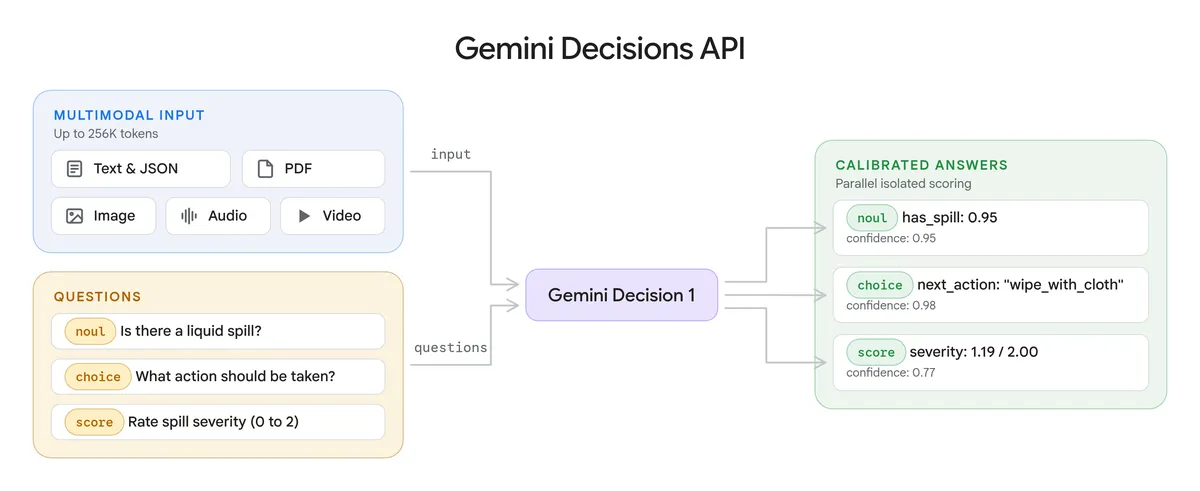
Historically, Large Language Models (LLMs) have functioned as generative engines, predicting the next token in a sequence to construct paragraphs of text. While effective for chat and content creation, this approach is often inefficient for binary or categorical decision-making. The Gemini Decisions API introduces a purpose-built primitive for "bounded choices." Rather than generating prose, the Gemini Decision 1 model performs a single forward pass over multimodal inputs—ranging from text and PDFs to high-fidelity audio and video—and returns probability and confidence scores for a series of pre-defined questions.
This methodology eliminates the need for token-by-token decoding, which is the primary source of latency in traditional LLM architectures. By bypassing the generation phase, the API achieves end-to-end latency in the 150-250 millisecond range. This efficiency is critical for real-time applications where a "thinking" time of several seconds would be prohibitive, such as industrial robotics, automated customer support routing, or real-time safety monitoring.
Technical Architecture and Efficiency Gains
The technical architecture of the Gemini Decision 1 model is designed to optimize both cost and speed. Under the new pricing structure, the service is billed at $0.10 per one million input tokens, with zero fees for output tokens. This creates a predictable economic model for businesses, as developers are no longer penalized for the length of the model’s internal reasoning process.

The API supports up to 1,000 independent questions per request. Because the model processes these in a single pass, the latency remains remarkably stable whether a developer asks one question or one hundred. This represents a significant optimization over standard generative APIs, where adding more questions would typically require recursive or extended generation cycles, driving up both cost and latency. Furthermore, the model’s ability to handle contexts up to 256,000 tokens ensures that it can ingest vast amounts of data—such as technical manuals, entire legal documents, or hours of meeting recordings—without losing track of the specific criteria required for the decision.
Strategic Background and Development Timeline
The release of the Gemini Decisions API follows an intensive period of research by the Google DeepMind team, led by Product Manager Min Choi and Principal Scientist Felix Yu. The project was born out of a recurring challenge observed across Google’s internal product teams: the need for a "control plane" for AI agents.
Throughout the development cycle, the team focused on "calibration," a metric that measures how accurately a model’s confidence score reflects its actual likelihood of being correct. In internal benchmarks, Gemini Decision 1 demonstrated superior calibration compared to existing alternatives, meaning that when the model assigns a 90% confidence score, it is statistically more likely to be correct than other models currently on the market. This reliability is the cornerstone of the API’s utility; it allows developers to implement automated "fallback" triggers. If the model returns a low confidence score on a critical decision, the system can automatically flag the input for human review, ensuring a "human-in-the-loop" safety mechanism.
Industry Implications and Practical Applications
The implications for enterprise software are significant. Companies that previously relied on custom-trained classifiers or heavy LLM chains to handle routine tasks can now consolidate these functions into a single API call.
For instance, in the logistics and retail sectors, a company might use the Decisions API to monitor a video feed of a warehouse or a retail counter. The model can simultaneously answer: "Is the floor wet?" (Yes/No), "Is the display stocked according to guidelines?" (Rubric score), and "What is the primary reason for the shelf vacancy?" (Multiple choice). Because the model processes these inputs natively—without needing separate OCR for text or transcription for audio—the entire analysis happens in milliseconds.
Early adopters and internal Google teams have already begun utilizing this for product design flows. One such example involves "Stitch Rapid," a tool that designs installation sequences for hardware products by analyzing visual inputs and providing real-time instructions. By automating the decision-making process, these teams have effectively bypassed the need for building fragile, hard-coded rulesets that often fail when confronted with edge cases in real-world environments.
Ecosystem Integration and Future Outlook
Google is ensuring broad compatibility by rolling out support for the Decisions API across major developer platforms, including LangChain, Vercel’s AI SDK, Pydantic AI, and LiteLLM. By integrating with these popular frameworks, Google is positioning the Decisions API as a foundational layer for the next generation of "agentic" AI.
The transition to an agent-based web—where AI systems perform tasks on behalf of users rather than just answering questions—requires this kind of specialized infrastructure. The ability to perform fast, accurate, and low-cost decisions is the "connective tissue" that allows multiple AI models to communicate and act upon the world.
While the API is currently available via Google AI Studio and the Gemini API, plans are already in place to integrate it into the wider Google Cloud ecosystem. This will likely open the door for large-scale enterprise deployments, where security, compliance, and integration with existing cloud storage and database services are paramount.
A Measured Analysis of the Competitive Landscape
The shift toward specialized API endpoints marks a maturing phase in the generative AI market. While foundational models (like the core Gemini or GPT series) will continue to dominate in creative and complex reasoning tasks, the market is bifurcating. There is a clear, growing demand for "narrow but deep" models that excel at high-frequency, low-latency operational tasks.
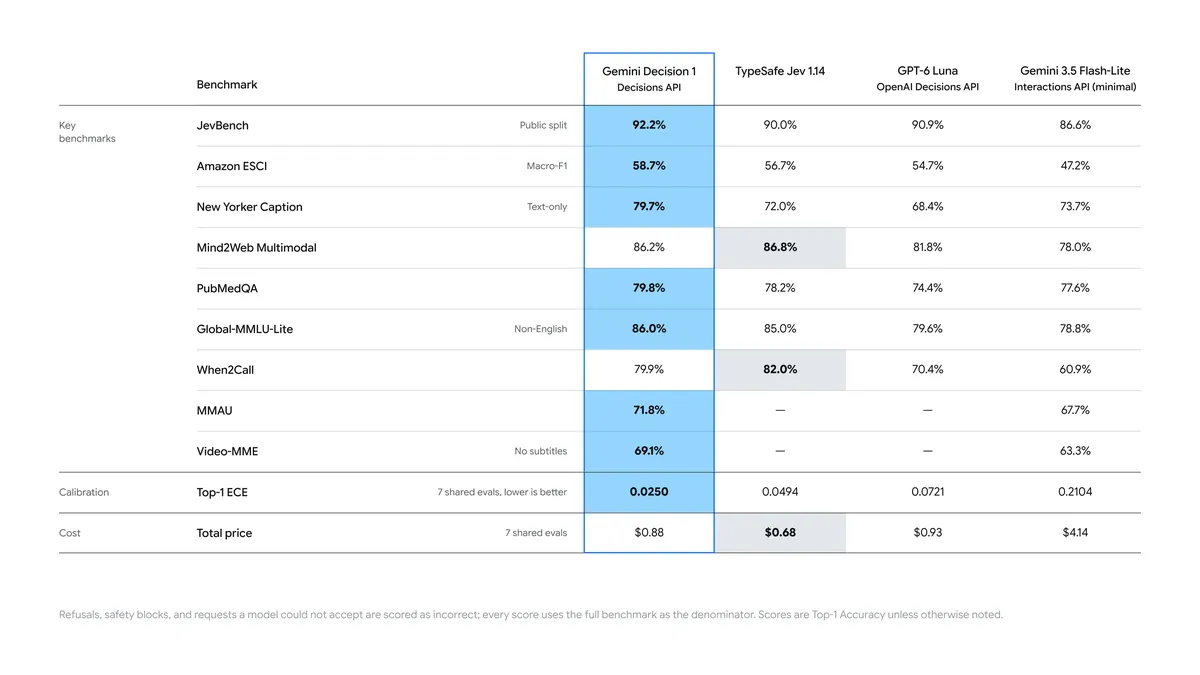
By pricing the Decisions API at a fraction of the cost of traditional interaction-based APIs, Google is aggressively targeting the high-volume, automated decision-making segment. Competitors in the space, such as those providing specialized classification or routing models, will face increased pressure to match not just the accuracy of the Gemini Decision 1 model, but also the seamless integration of its multimodal capabilities.
As developers begin to integrate this tool into production environments, the industry will likely see a surge in AI agents that are more responsive and less prone to the "hallucinations" associated with generative models. Because the Decisions API forces the model to choose from pre-defined criteria, it inherently constrains the output space, significantly reducing the risk of erratic behavior. This makes the technology particularly attractive for industries with strict regulatory requirements, such as finance, healthcare, and manufacturing, where the ability to audit and trust an AI’s decision is as important as the decision itself.
In summary, the Gemini Decisions API is a calculated move to provide the "engine room" for the next generation of software. By focusing on speed, calibration, and multimodal efficiency, Google is providing the tools necessary to move AI from the realm of curiosity and experimentation into the core of global industrial and operational infrastructure.

