
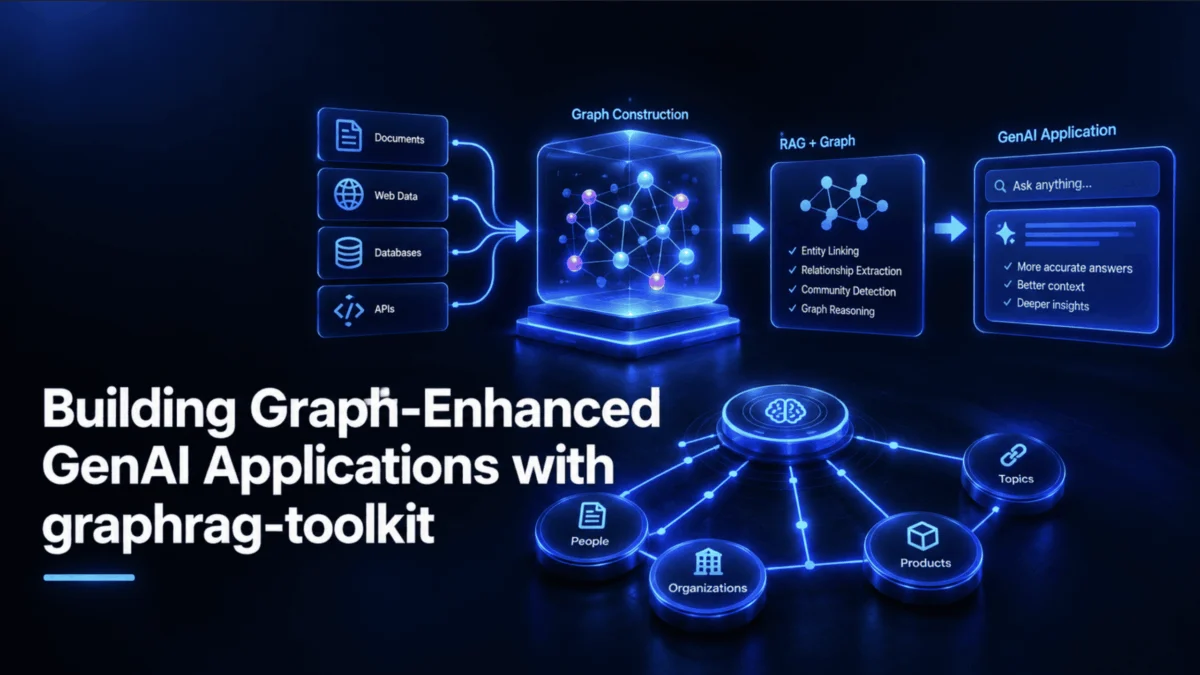
The landscape of Generative AI is currently undergoing a structural shift as developers move beyond the initial excitement of basic Retrieval-Augmented Generation (RAG) toward more robust, reasoning-capable architectures. While standard vector-based RAG has served as the industry standard for connecting Large Language Models (LLMs) to private data, it frequently falters when faced with complex, multi-hop queries. These are questions that require the synthesis of disparate pieces of information scattered across a document corpus—information that lacks explicit semantic proximity but shares a logical or relational connection. To bridge this gap, AWS Labs has introduced the graphrag-toolkit, an open-source framework designed to integrate knowledge graphs with generative AI, allowing models to reason over connected facts rather than isolated text fragments.
The Structural Limitation of Vector Search
To understand the necessity of GraphRAG, one must first recognize the inherent limitations of standard vector databases. In a traditional RAG pipeline, documents are chunked and converted into high-dimensional vector embeddings. When a user poses a question, the system retrieves the most "similar" chunks based on cosine similarity or Euclidean distance. This mechanism excels at answering straightforward inquiries, such as identifying a specific policy detail within a singular paragraph.
However, the architecture fails when a query demands cross-referencing. If a user asks, "How does the return policy interact with warranty terms for international orders," and those two subjects reside in separate sections of a manual, a vector search engine will likely retrieve only the chunk most similar to the query, missing the crucial context required to provide a comprehensive answer. The system treats every chunk as an independent island. It possesses no awareness of the underlying entities, causal relationships, or thematic hierarchies that define the document structure. This is not a failure of the LLM’s reasoning capabilities, but a failure of the retrieval mechanism to surface the necessary, connected facts.
The Rise of Knowledge-Graph Enhanced Retrieval
Graph-enhanced retrieval, or GraphRAG, shifts the focus from semantic similarity to relational structure. By querying a knowledge graph—a network of nodes representing entities and edges representing the relationships between them—an application can traverse a web of information to identify context that spans across an entire corpus.
This approach has gained significant traction across the database industry. Both Neo4j and Oracle have published extensive documentation supporting the transition toward graph-based RAG, arguing that the future of enterprise AI lies in combining the precise, structured data of knowledge graphs with the linguistic fluidity of LLMs. This consensus among major database providers suggests that the industry has hit a ceiling with plain vector search and is actively seeking a standardized methodology to incorporate structural metadata into the retrieval process.
Understanding the AWS graphrag-toolkit
The graphrag-toolkit, released by AWS Labs under an Apache 2.0 license, provides a structured path for developers to implement these concepts. The toolkit consists of two primary pillars: lexical-graph and BYOKG-RAG.
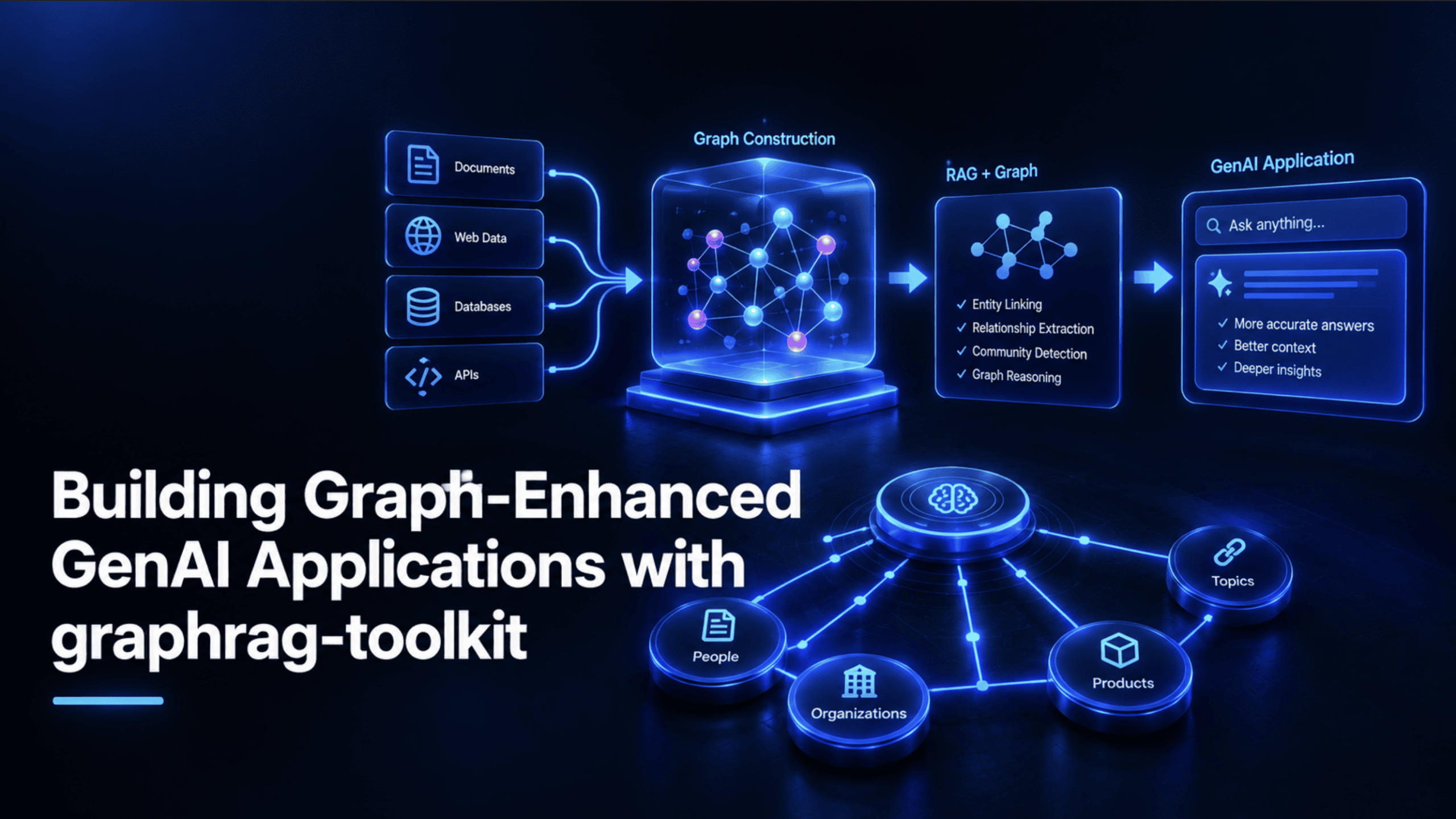
The lexical-graph framework is the flagship component, designed to automatically ingest unstructured documents and transform them into a hierarchical knowledge graph. It operates on a sophisticated six-level hierarchy: source, chunk, topic, statement, fact, and entity. By organizing data in this way, the system enables "multi-hop" retrieval, where the engine can navigate from a query to an entity, then to a related statement, and finally to the relevant chunk, ensuring the LLM receives the full context of a concept rather than just a keyword-matched paragraph.
The second component, BYOKG-RAG (Bring Your Own Knowledge Graph), serves organizations that have already invested in building custom knowledge graphs. It provides a modular layer that allows these teams to overlay a sophisticated question-answering system onto their existing graph infrastructure without undergoing a time-consuming re-extraction process.
Technical Architecture and Data Extraction
The extraction process within the toolkit is intentionally rigorous. To ensure high-quality output, the toolkit employs a two-step LLM extraction pipeline. In the first phase, raw text chunks are processed to generate well-formed, self-contained propositions. In the second phase, these propositions are analyzed to extract topics, statements, facts, and entities.
This methodology is grounded in research outlined in the paper "Hierarchical Lexical Graph for Enhanced Multi-Hop Retrieval." By cleaning the text before performing entity extraction, the system significantly reduces the noise that typically plagues automated graph construction. This dual-pass approach has already been battle-tested in enterprise environments; notably, Deloitte has integrated the lexical-graph framework into its Amazon Neptune-based GenAI Security Intelligence Center, showcasing the toolkit’s viability for production-grade deployments.
Implementation: Building a Multi-Hop Research Assistant
To demonstrate the capabilities of the graphrag-toolkit, one can build a research assistant focused on complex topics such as human spaceflight. By utilizing local instances of Neo4j and Postgres (with the pgvector extension), developers can create a high-performance environment at zero infrastructure cost.
Chronology of Deployment:
- Containerization: Establishing a Docker environment to host Neo4j and Postgres instances ensures that the graph and vector stores are ready for data ingestion.
- Library Integration: Utilizing Python packages such as
graphrag-lexical-graphandllama-index-readers-web, developers can construct a pipeline that converts raw web data into a searchable, hierarchical knowledge structure. - Extraction and Indexing: The
extract_and_buildprocess triggers the LLM-driven ingestion, populating the graph with nodes and edges that represent the conceptual relationships between articles on the Artemis program, the International Space Station, and the Commercial Crew Program. - Query Execution: Using the
LexicalGraphQueryEngine, the assistant is able to perform traversal-based searches. Unlike standard search, this engine anchors on the most relevant statements and then follows the graph’s structural links to aggregate information from across all three source documents.
Supporting Data and Industry Implications
The effectiveness of this approach can be quantified through connectivity metrics. When the graph is built, the toolkit provides statistics such as "localConnectivity" and "globalConnectivity," which measure the density of the information network. High connectivity in a lexical graph directly correlates with the system’s ability to handle complex, multi-step queries.
From a business perspective, the implications are profound. Companies that rely on vast internal documentation—such as legal firms, engineering consultancies, or medical research organizations—can now deploy AI assistants that actually understand the "map" of their knowledge base. Rather than providing generic summaries, these systems provide precise, cited answers that account for the nuanced relationships between projects, policies, and historical data.
Strategic Roadmap and Future Developments
The toolkit is currently in a state of rapid evolution. While it currently relies heavily on Amazon Bedrock for its LLM operations, the design is modular enough that future iterations will likely expand support for a broader range of model providers. Furthermore, the introduction of the Model Context Protocol (MCP) suggests that these lexical graphs will soon function as "tools" for autonomous agents, allowing them to browse and select the most relevant domain-specific graph for any given task.
For organizations looking to move beyond the RAG "toy demo" phase, the combination of graph-based traversal and vector similarity represents the most viable path forward. The industry is effectively moving away from treating AI as a simple text-matching utility and toward treating it as a relational reasoning engine. As the adoption of the graphrag-toolkit grows, we can expect a new generation of enterprise AI applications that are characterized by their accuracy, structural transparency, and ability to navigate the complex interdependencies of modern institutional knowledge.
In conclusion, the shift toward graph-enhanced generative AI marks a turning point in how organizations interact with their data. By moving the focus from "what sounds similar" to "how things are connected," developers are equipping LLMs with the logical framework necessary to perform high-level synthesis. The AWS graphrag-toolkit offers a robust, open-source entry point for this transition, providing the infrastructure to turn chaotic document collections into structured, actionable intelligence. As these systems scale, the divide between basic RAG implementations and true enterprise-grade knowledge assistants will continue to widen, placing a premium on architectures that prioritize relational depth over surface-level semantic matching.

