
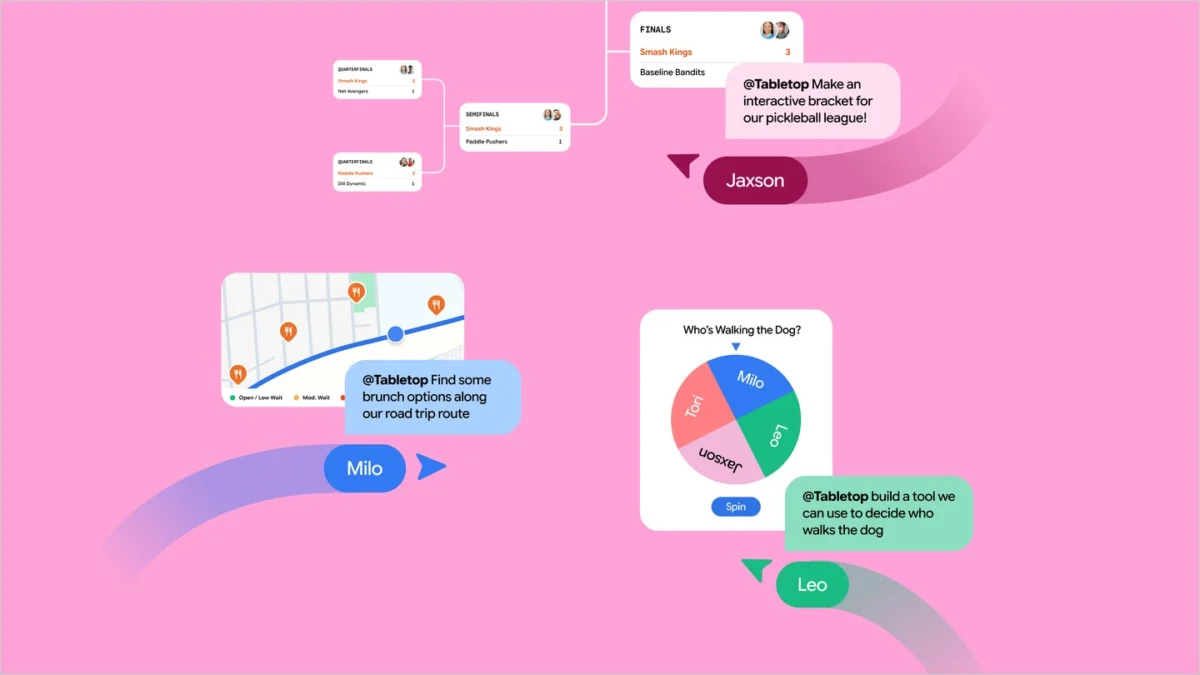
Group coordination often devolves into a fragmented mess of scattered text messages, disparate email chains, and disconnected shared documents. Whether a group is attempting to organize a complex family vacation, manage the logistics of a local recreational sports league, or simply coordinate a community potluck dinner, the administrative burden of consensus-building frequently outweighs the enjoyment of the activity itself. Recognizing this persistent friction in digital social interaction, Google has officially unveiled Tabletop, a new experiment under the Google Labs umbrella designed to centralize collaborative planning into a singular, real-time interface.
The platform, which launched today in the United States for users aged 18 and older, seeks to bridge the gap between static planning tools and high-functioning project management software. By leveraging generative AI capabilities and a shared workspace architecture, Tabletop allows participants to aggregate links, documents, and creative concepts in a unified environment. Once the groundwork is laid, users can engage with the platform’s AI assistant—invoked via the @tabletop command—or select from a variety of pre-configured starter templates to generate functional assets such as interactive trip itineraries, automated dinner polls, complex expense-splitting calculators, and tournament brackets.
The Evolution of Google Labs and Collaborative Tooling
The emergence of Tabletop is the latest in a long series of initiatives from Google Labs, the company’s internal incubator for experimental technology. Historically, Google Labs has served as a testing ground for concepts that eventually become cornerstones of the company’s ecosystem, such as the early iterations of Google Maps and Gmail. In recent years, the focus of these experiments has shifted heavily toward generative AI and large language model (LLM) integration.
The development of Tabletop arrives at a time when Google is aggressively integrating its Gemini AI models across its suite of productivity applications, including Docs, Sheets, and Slides. However, unlike these enterprise-focused tools, Tabletop is positioned as a consumer-facing utility. It targets the "middle-ground" of organization: tasks that are too casual for professional project management software like Jira or Asana, yet too cumbersome for standard messaging apps like WhatsApp or Signal.
Market analysis indicates that the demand for "collaborative social utilities" has grown as digital-first populations seek more structured ways to manage non-professional lives. According to recent data from productivity research firms, the average individual spends approximately 30% of their digital downtime engaged in some form of group logistics. As these tasks grow in complexity, the industry has seen a pivot toward "co-creation" interfaces—digital whiteboards or workspaces where multiple users can manipulate data simultaneously, mirroring the functionality of Google Docs, but applied to specific life-management tasks.
Functionality and User Experience
At its core, Tabletop functions as a shared canvas. When a user creates a new space, they are invited to populate it with raw data. The platform’s strength lies in its ability to parse this unstructured information into actionable formats. For example, a user could paste a series of restaurant links and flight numbers into the chat; Tabletop can then synthesize this data into a visual itinerary or a collaborative budget tracker.
The collaborative aspect of the tool is designed to feel instantaneous. Once a workspace is generated, the creator provides an invite link. Upon joining, participants see a live-updating interface where every edit is visible to the entire group in real-time. This "multiplayer" approach to planning is intended to reduce the "bottleneck effect," where one individual is forced to act as the sole secretary for a group. By democratizing the ability to edit and contribute, Google aims to minimize the communication lag that often leads to planning failures.
Strategic Implications for Digital Coordination
Industry experts view the launch of Tabletop as a strategic move to lock users into the Google ecosystem through utility-based stickiness. By providing a tool that solves specific, recurring pain points—such as splitting expenses or managing tournament schedules—Google creates a high-retention environment.
"The challenge with most planning tools is the ‘onboarding tax,’" notes a digital strategy analyst. "Users are often unwilling to learn a complex new piece of software just to plan a weekend trip. If Google can make this as intuitive as a group text but as powerful as a spreadsheet, they solve a massive consumer friction point."
However, the experiment faces competition from a crowded landscape of niche applications. Dedicated expense-splitting apps like Splitwise, travel planning tools like TripIt, and general-purpose collaboration tools like Notion have already captured significant market share. Tabletop’s success will likely hinge on its ability to integrate these disparate functions into one seamless experience without becoming overly complex. The use of generative AI to act as a "facilitator" is the key differentiator; by prompting the AI to handle the heavy lifting of data organization, the user is spared the tedious work of formatting and calculating.
Chronology of Development and Public Access
The trajectory of Tabletop reflects a rapid development cycle characteristic of Google’s current AI-first mandate.
- Q1 2024: Internal prototyping of collaborative workspace agents within Google Labs.
- Q2 2024: Alpha testing phase involving select groups to determine the most common "pain points" in social planning.
- Q3 2024: Refinement of the AI prompt interface to ensure compatibility with varied data inputs (URLs, PDFs, text).
- Today: Official public beta launch for U.S. users (18+) via a waitlist model at labs.google/tabletop.
The waitlist approach is a standard procedure for Google Labs, serving both to manage server load during the initial rollout and to gather granular user feedback to refine the product’s UI/UX. Google has not yet specified a timeline for a global rollout, noting that the experiment is subject to iterative updates based on participant engagement.
Addressing Privacy and Data Concerns
As with any tool that aggregates personal data—such as flight details, financial information, and social itineraries—privacy remains a central concern. Google has indicated that the data used within Tabletop will adhere to its broader consumer privacy policies. However, because the tool relies on generative AI to synthesize user input, questions regarding the extent to which that data might be used for model training remain a point of interest for privacy advocates.
Google’s standard practice for Labs experiments usually involves clear disclosure that user interaction data may be processed to improve AI performance. Users are encouraged to review the specific Terms of Service provided during the sign-up process. Given the sensitive nature of group planning (which often involves personal financial data and location history), the transparency of these policies will be a critical factor in public adoption.
The Broader Impact on Collaborative Software
If successful, Tabletop could represent a shift toward "agentic" software—applications that do not just store information but actively organize and execute tasks on behalf of the user. In this model, the software acts less like a repository and more like a participant.
The broader implications for the tech sector are significant. Should Google successfully integrate this level of planning intelligence into its broader suite of products, it could fundamentally alter how social groups interact online. For years, the internet has been divided between platforms for communication (messaging) and platforms for storage (cloud drives). Tabletop attempts to merge these functions into a single "workspace" layer.
For the recreational league organizer, this means no more manual score-keeping in a notebook. For the family vacation planner, it means no more arguing over who booked the rental car. By centralizing these tasks, Tabletop aims to return the focus of group activity to the experience itself, rather than the logistics required to facilitate it.
As the waitlist opens and the first wave of users begins to populate their digital tables, the technology community will be watching closely. The success of the experiment will ultimately be measured not by the complexity of the AI, but by the simplicity of the outcome: does it make the group’s job easier? If the answer is yes, Google may have found the next essential utility for the digital-first social experience. Those interested in participating in the pilot program can register their interest at labs.google/tabletop.

