
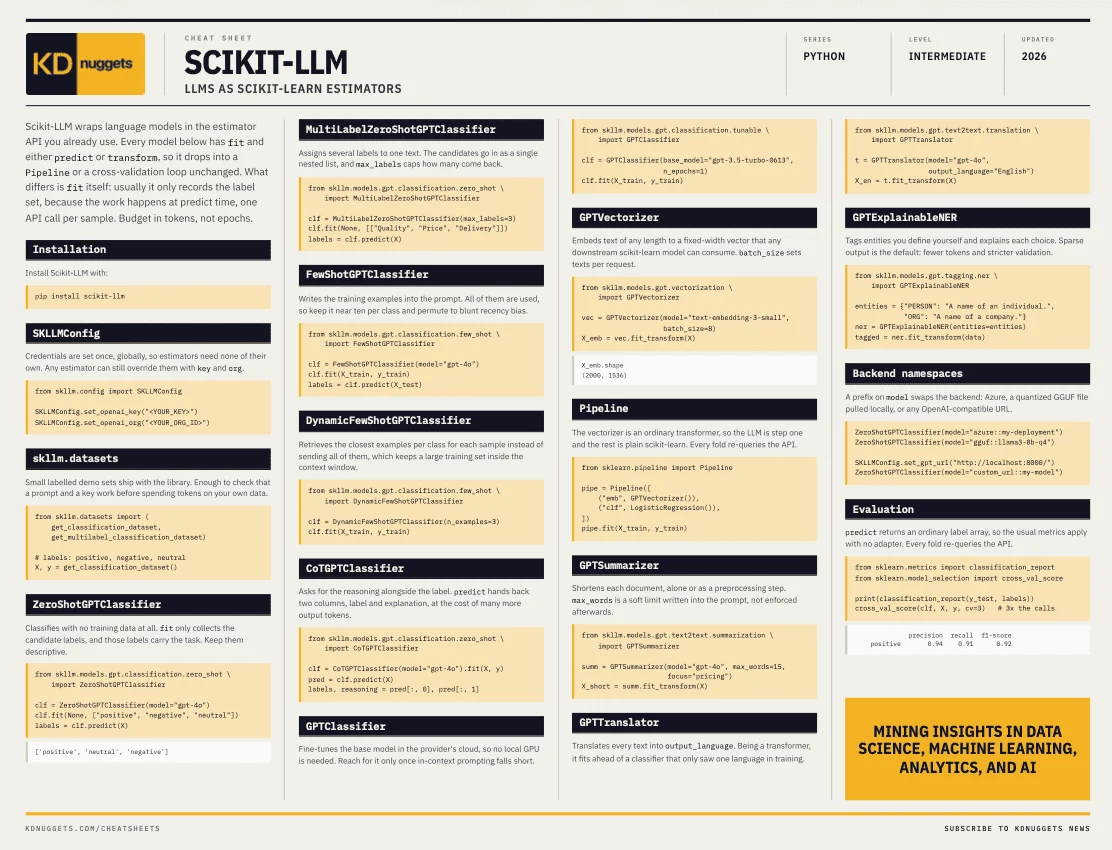
Integrating Large Language Models (LLMs) into production-grade machine learning pipelines has historically presented a significant architectural challenge. Data scientists and machine learning engineers often find themselves choosing between two suboptimal paths: adopting the structured, rigorous framework of scikit-learn, which is traditionally designed for static datasets, or building custom, brittle scripts that rely on iterative API calls, complex error handling, and unpredictable response formats. The latter approach frequently results in codebases characterized by nested loops, fragile string parsing, and extensive try-except blocks that fail to account for the stochastic nature of generative AI outputs.
To bridge this divide, the open-source community has introduced Scikit-LLM, a library designed to encapsulate language models within the familiar scikit-learn estimator API. By standardizing the interface through which LLMs are invoked, Scikit-LLM allows developers to leverage existing tools—such as pipelines, cross-validation, and automated metrics reporting—without reinventing the infrastructure for every new project.
The Evolution of Model Integration
The rise of LLMs has created a paradigm shift in how classification tasks are executed. In traditional machine learning, models are trained on large, labeled datasets where the underlying weights are updated to reflect patterns. In the LLM era, the model weights are typically frozen, and the task specification is moved into the prompt.
Scikit-LLM addresses the operational disconnect between these two worlds. By adhering to the scikit-learn standard, where every model possesses a consistent fit, predict, and transform method, Scikit-LLM enables LLMs to function as drop-in components. While a standard scikit-learn model uses the fit method to learn parameters from training data, Scikit-LLM estimators often utilize the fit method to establish the label space or define context, deferring the primary execution to the predict or transform stages. This architectural choice aligns with the reality of API-based model usage, where the computational cost is incurred during inference.
Key Components of the Scikit-LLM Framework
The utility of Scikit-LLM is centered on a specific suite of estimators designed for distinct NLP workflows. Understanding these components is essential for optimizing LLM integration.
ZeroShotGPTClassifier
The ZeroShotGPTClassifier is perhaps the most widely utilized component in the library. Unlike traditional classifiers that require extensive training data, this estimator relies on the intrinsic capabilities of LLMs to perform classification tasks based on descriptive labels. In this context, the labels themselves serve as the task specification. When a developer provides candidate labels during the fit process, they are effectively priming the model to categorize incoming text based on the semantic weight of those descriptors. Research indicates that the precision of these models is heavily dependent on the quality and specificity of the labels provided, transforming the role of the data scientist from a model trainer to a prompt engineer.
DynamicFewShotGPTClassifier
For complex tasks where zero-shot performance is insufficient, the DynamicFewShotGPTClassifier offers a more sophisticated approach. Rather than injecting the entire training dataset into the prompt—which would quickly exceed token limits and degrade performance—this estimator retrieves the most relevant examples per class for every individual sample. This dynamic retrieval mechanism mimics human learning, where specific contextual examples are used to guide judgment, thereby significantly increasing the accuracy of the classification output compared to static few-shot prompting.
GPTVectorizer and GPTTranslator
Beyond classification, Scikit-LLM expands the utility of language models through the GPTVectorizer and the GPTTranslator. The GPTVectorizer converts unstructured text into fixed-width numerical embeddings. These vectors can then be passed to traditional machine learning algorithms, such as logistic regression or support vector machines, allowing for the integration of state-of-the-art semantic representations with proven, high-speed classical models. Meanwhile, the GPTTranslator serves as a preprocessing transformer, normalizing multilingual inputs into a target language before they reach a classifier. This eliminates the need for maintaining multiple language-specific models or retraining existing classifiers on massive multilingual datasets.
The Economics of Token-Based Computing
While the integration of LLMs into scikit-learn pipelines provides significant convenience, it introduces a critical economic variable: the cost of inference. Unlike classical machine learning models that run locally on CPU or GPU cycles, LLM-based estimators typically rely on remote API calls.
This introduces a multiplier effect on project costs. For instance, executing a cross-validation process with a cv=3 parameter requires running the entire dataset through the LLM three times. When combined with grid searches—a standard practice for hyperparameter tuning in traditional machine learning—these operations can lead to an exponential increase in API consumption. Organizations must therefore treat token usage as a first-class metric, balancing the robustness of a Scikit-LLM pipeline against the budgetary implications of repeated API calls. Engineers are advised to implement caching strategies and optimize prompt sizes to mitigate these costs without sacrificing performance.
Broader Implications for AI Engineering
The development of Scikit-LLM is emblematic of a broader trend in the machine learning ecosystem: the professionalization of AI workflows. By wrapping LLMs in the well-understood, standard interfaces of scikit-learn, developers can maintain the modularity of their systems. This interoperability is vital for the reproducibility of research and the scalability of production applications.
The accessibility offered by this approach allows teams to experiment with LLMs within their existing comfort zones. Developers who are already proficient with scikit-learn’s API can now explore the capabilities of large models without learning the intricacies of proprietary model-specific SDKs. This lowers the barrier to entry for incorporating advanced AI into standard data pipelines, potentially accelerating the adoption of LLMs in industries ranging from finance and legal services to healthcare and retail.
Practical Implementation and Future Outlook
As the library matures, the focus is shifting toward optimizing the interface for large-scale, high-throughput environments. The recent release of specialized cheat sheets for Scikit-LLM estimators suggests a growing need for clear, actionable documentation that bridges the gap between theoretical understanding and practical deployment.
For the data scientist, the roadmap is clear: utilize the Scikit-LLM framework to standardize the integration of language models into existing workflows, treat labels as descriptive specifications rather than static categories, and maintain strict monitoring of token consumption. By adhering to these principles, practitioners can create systems that are not only robust and reusable but also economically sustainable. As the field progresses, the integration of these tools into standard CI/CD pipelines and MLOps workflows will likely become the industry standard for managing the next generation of AI-augmented applications.
In conclusion, Scikit-LLM serves as a critical bridge between traditional statistical modeling and modern generative AI. By providing a consistent, predictable, and modular interface, it empowers engineers to focus on the business logic and performance of their models, rather than the underlying infrastructure required to maintain them. As the reliance on LLMs in enterprise environments continues to grow, tools that promote standard practices and interoperability will remain essential for the long-term success of AI-driven projects.

