

The recent sellout of Spritehood, a fantasy-themed NFT project, has served as a litmus test for the current state of the digital asset market. With 44,444 "Wisp" tokens minted and claimed, the project has drawn significant attention not only for its creative mechanics but for its deployment on the Robinhood Chain—a newly launched Ethereum Layer 2 network. As the digital art space continues to navigate the aftermath of the 2021-2022 market volatility, the success of this launch invites a critical examination of whether large-scale collectible projects can foster a healthier, more durable ecosystem for digital creators and collectors alike.
The Genesis of Spritehood and its Creator
At the center of the project is Cole Villemain, known in digital circles as ColeThereum. His involvement has triggered a polarized response within the Web3 community, largely stemming from his history as a co-founder of the Pudgy Penguins collection. The original Pudgy Penguins project, while iconic for its early character designs and cultural footprint, suffered from significant leadership disputes that led to a complete acquisition of the intellectual property by Luca Netz in 2022. Under Netz, the brand underwent a dramatic professionalization, evolving into a successful retail and media powerhouse.
For observers, Villemain’s transition to Spritehood represents a "second act" that is being scrutinized under a microscope. Critics argue that historical performance is a key indicator of future reliability, while supporters suggest that the maturation of the market requires an acceptance of evolving leadership. The launch of Spritehood is, in many ways, an attempt to translate the lessons of the past into a more robust, interactive framework.
Technical Mechanics: Beyond the Static Image
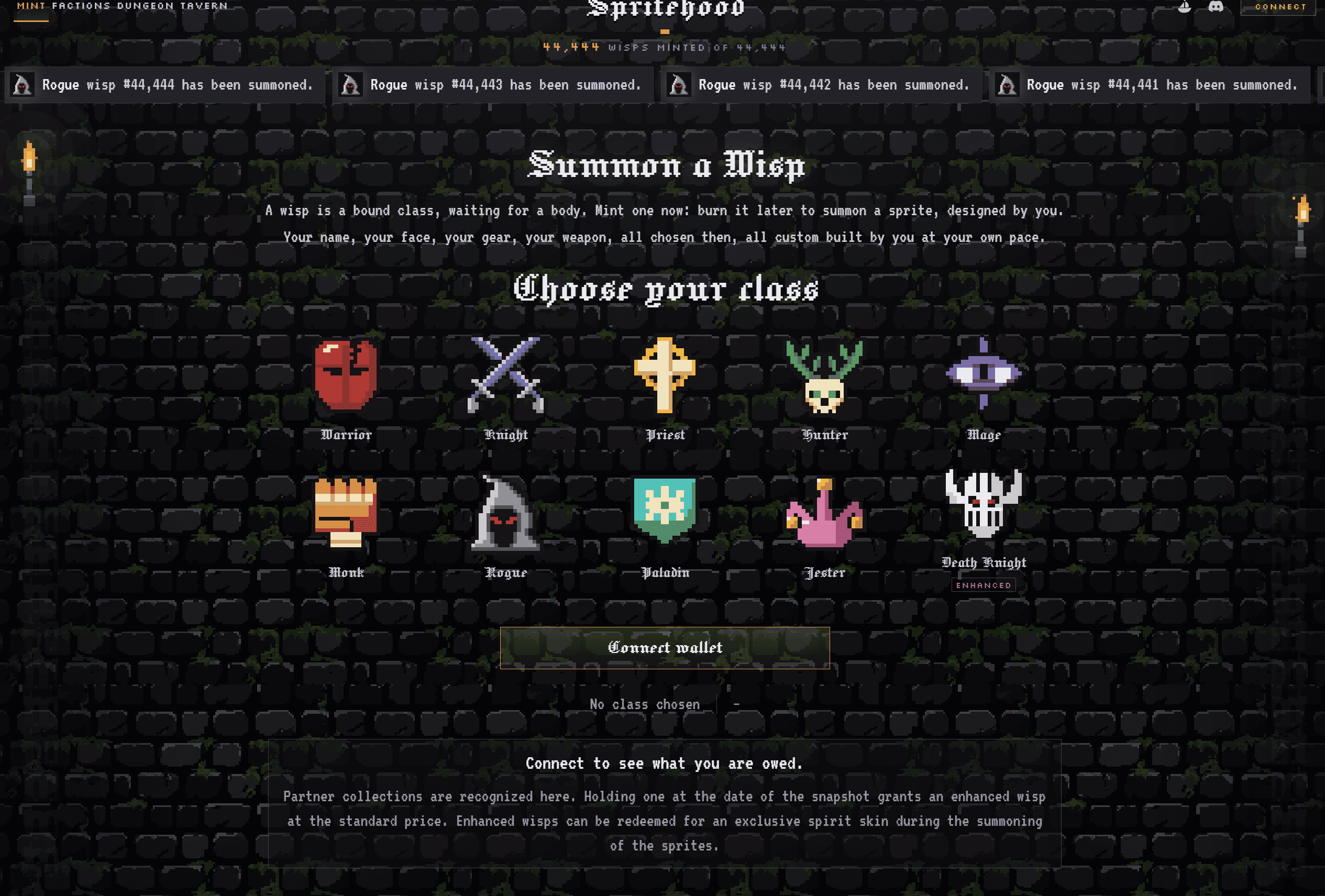
Unlike the conventional "Profile Picture" (PFP) projects that defined the 2021 market—where users purchased a fixed image—Spritehood utilizes a staged evolution model. The initial minting phase allowed users to acquire Wisps, which serve as foundational character classes. These include Warrior, Knight, Priest, Hunter, Mage, Monk, Rogue, Paladin, Jester, and Death Knight.
The innovation lies in the "burning" and "summoning" phase. Rather than being assigned a randomized, immutable asset upon minting, holders retain the agency to customize their sprite’s visual identity, gear, and weapon. This shift toward user-driven customization reflects a broader trend in Web3 gaming and digital identity, where the value proposition is tied to long-term engagement and personal creative input rather than speculative secondary market flipping.
The Role of Robinhood Chain
Perhaps the most significant development surrounding Spritehood is its choice of infrastructure. The project launched on the Robinhood Chain, an Ethereum Layer 2 network developed using Arbitrum technology. The network, which went live in July 2026, was initially positioned as a venue for financial services and the tokenization of real-world assets.
By hosting a 44,444-item NFT mint, the Robinhood Chain is effectively testing its capacity for consumer-grade, high-volume traffic. For the broader NFT market, this integration is vital. Historically, the barrier to entry for digital collectibles has been high, involving complex wallet management, high gas fees, and fragmented marketplaces. By operating on a chain associated with a mainstream financial platform, Spritehood is positioning itself within an infrastructure designed to make onchain participation more intuitive for a retail audience. While an endorsement from Robinhood itself is not implied by the project’s deployment, the synergy between a major financial brand’s infrastructure and a creative project creates a bridge that could potentially onboard a new demographic of collectors.
Market Context and the "Flywheel" Effect
The argument against large-scale NFT collections has often been that they "cannibalize" the market, siphoning liquidity away from individual, independent digital artists. However, data from previous market cycles suggests a more complex dynamic. Many successful collectors began their journeys by interacting with larger, community-driven projects. Through these experiences, they gained the technical proficiency and market familiarity required to discover and support niche generative artists.
This "collector flywheel" operates on three levels:
- Onboarding: Large projects act as a low-friction entry point, teaching new users how to manage digital wallets and navigate marketplaces.
- Capital Formation: Successful participation in these projects generates capital, which users frequently reinvest into more specialized, high-art segments of the NFT market.
- Cultural Networking: Community-led projects foster connections between creators and patrons, facilitating a network effect that benefits the wider art ecosystem.
When these large projects disappear or fail to gain traction, the capital does not automatically flow to independent artists. Instead, it often exits the NFT space entirely, moving into traditional finance or speculative altcoins. Therefore, the presence of well-executed, high-visibility projects like Spritehood is essential for keeping the "onchain funnel" active.
A Call for Professional Accountability
The industry’s recovery cannot be a mirror image of the 2021 boom. That era was marred by opaque tokenomics, abandoned roadmaps, and a reliance on manufactured hype. For the NFT market to mature, the standard for project management must shift toward transparency and utility.
Professional analysts emphasize that the next phase of Web3 growth requires:
- Clear Communication: Founders must move away from cryptic "teasers" and provide tangible, realistic project milestones.
- Economic Sustainability: Projects must demonstrate how their internal economies are designed to last beyond the initial minting hype.
- Accountability: With the rise of onchain transparency, projects are increasingly being held to their promises through public discourse and community governance.
The Spritehood project has, thus far, attempted to align with these expectations by documenting its rollout publicly and focusing on a multi-stage, participatory experience rather than a one-time liquidity event.

Implications for the Digital Art Market
While it is premature to declare Spritehood a "savior" of the NFT market, it serves as a meaningful signal of renewed interest. The sellout suggests that there is still a robust appetite for projects that offer more than just aesthetic value—specifically, those that provide a sense of belonging and ongoing interaction.
Furthermore, the project’s success on the Robinhood Chain highlights the importance of Layer 2 solutions in lowering the cost and complexity of participating in digital art. As Ethereum continues to scale, the ability for NFT projects to exist on user-friendly, high-performance chains will be the deciding factor in whether digital collectibles can transition from a niche speculative asset to a mainstream form of creative expression.
Looking Ahead
The path forward for NFTs involves reconciling the speculative energy of the past with the practical, utility-driven reality of the future. Projects that prioritize the "participatory" aspect—such as the custom-built identities in Spritehood—are likely to have greater longevity than those that rely solely on the rarity of an image.
As the industry continues to stabilize, the focus will remain on whether these projects can successfully convert "traders" into "collectors." If Spritehood can sustain its momentum and deliver on its promised roadmap, it may provide a blueprint for other creators looking to launch in a more skeptical, mature market environment. The goal, ultimately, is not to recreate the volatile cycles of the past, but to build a durable infrastructure where artists and collectors can interact with confidence, supported by scalable technology and a renewed sense of shared cultural value.
In summary, the Spritehood project represents an intersection of past lessons and future possibilities. Whether it achieves long-term success remains to be seen, but its arrival on the Robinhood Chain marks a pivotal moment for a sector that has spent years searching for a path back to sustainable growth. The industry is watching to see if this project can transform from a viral mint into a lasting pillar of the digital art landscape.

