
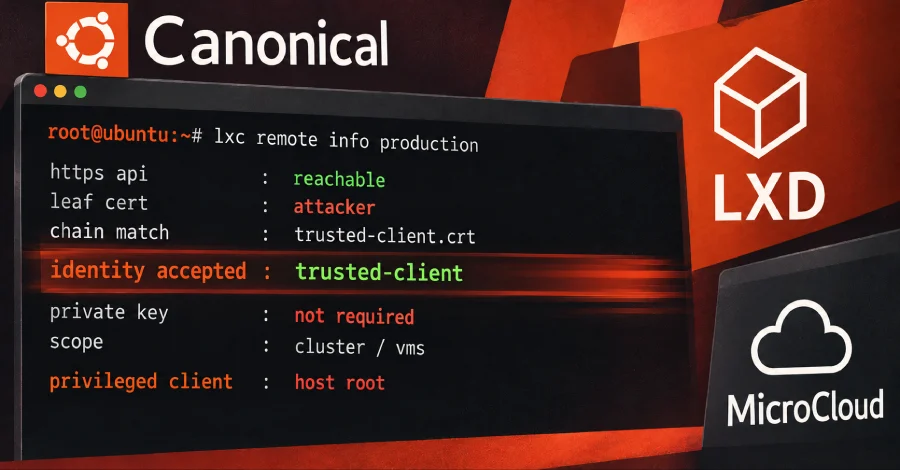
A critical security flaw, designated CVE-2026-112816, has been identified within Canonical’s LXD and MicroCloud platforms, exposing virtualized infrastructure to unauthorized remote access. This vulnerability, which carries a maximum Common Vulnerability Scoring System (CVSS) rating of 10.0, represents a significant risk to cloud environments by allowing an attacker to impersonate trusted clients without possessing the necessary private cryptographic keys. By exploiting the way the software validates mutual TLS (mTLS) certificate chains, unauthorized actors can potentially achieve full root-level control over host machines, compromising the entire cluster.
Understanding the Technical Mechanism of the Vulnerability
At the heart of this security failure is an improper validation process during the mutual TLS handshake. LXD and MicroCloud rely on mTLS to authenticate remote API calls. Under normal circumstances, a client must present a certificate that the server recognizes within its internal trust store. The security protocol is intended to ensure that only the holder of the corresponding private key can successfully initiate a connection.
However, the flaw exists in how the server parses the presented certificate chain. When a client initiates a connection, it sends a certificate chain to the server. The server, in its vulnerable state, performed a comparison of every certificate in the provided chain against its internal trust store. This logic is fundamentally flawed because, in standard TLS implementations, the client is only required to prove ownership of the "leaf" or the primary certificate in the chain. The additional certificates in the chain are provided by the client and are not independently verified for ownership.
By manipulating the certificate chain, an attacker who possesses a publicly available—and non-secret—trusted client certificate can append that certificate to their own connection request. The server, seeing a trusted certificate present within the chain, incorrectly validates the entire connection as legitimate. Once the handshake is completed, the attacker is granted the same level of access as the impersonated, trusted entity. If the compromised identity holds administrative privileges, the attacker can move laterally across the cluster, execute arbitrary commands, and gain host-level root access.
Chronology and Disclosure
The discovery of CVE-2026-112816 did not originate within Canonical’s own internal audit, but rather through the Incus project. Incus, which functions as an open-source community fork of LXD, identified the flaw during a rigorous security review. Upon confirming the existence of the vulnerability, the Incus team alerted the wider containerization community and coordinated the disclosure.

Canonical subsequently verified that its proprietary LXD and MicroCloud implementations were susceptible to the same logic error. Following the notification, Canonical worked rapidly to develop patches. The vulnerability was formally documented and assigned a tracking number on October 30, 2026. Shortly thereafter, on November 1, 2026, Canonical released a series of security advisories urging administrators to update their software immediately.
While the flaw is severe, there is currently no evidence of active exploitation in the wild. The U.S. Cybersecurity and Infrastructure Security Agency (CISA) has acknowledged the vulnerability but has not placed it on its Known Exploited Vulnerabilities (KEV) list. This suggests that while the potential for damage is catastrophic, the window for remediation remains open before widespread exploitation occurs.
Scope of Impact and Affected Systems
The impact of this vulnerability is widespread, particularly for organizations relying on MicroCloud for cluster management. MicroCloud, which orchestrates multiple LXD nodes into a unified environment, is especially sensitive to this flaw because it involves the exchange of credentials between cluster members. An attacker capable of intercepting or acquiring the public certificate of a cluster member during a join operation could effectively inject themselves into the cluster’s trust domain.
Standalone LXD installations are only vulnerable if the network API has been explicitly enabled. By default, LXD operates via a local Unix socket, which is immune to this specific network-based attack vector. However, many enterprise deployments leverage the core.https_address setting to allow remote management, thereby exposing the HTTPS API and creating the necessary conditions for an exploit.
The versions affected by this flaw are extensive, spanning several release branches:
- LXD 4.0.14 and earlier
- LXD 5.0.10 and earlier
- LXD 5.21.8 and earlier
- LXD 6.9 and earlier
- MicroCloud versions prior to 3.4.1 and 2.1.5
Canonical has issued specific patches for these versions via its snap packaging system. Administrators are advised to perform a sudo snap refresh to pull the latest versions, which include 6.10.1 for the 6/stable channel, 5.21.9 for 5.21/stable, 5.0.11 for 5.0/stable, and 4.0.15 for 4.0/stable.

Broader Implications for Cloud Security
The emergence of CVE-2026-112816 highlights the ongoing risks associated with complex identity verification in distributed systems. As organizations move toward highly automated, containerized environments, the reliance on mTLS as a "gold standard" for security often masks subtle implementation errors. When software projects deviate from standard library behaviors—in this case, by attempting to validate entire certificate chains rather than just the leaf—the results can be devastating.
This event also serves as a critical case study in the importance of community-led security audits. The fact that the Incus project, a fork, provided the initial warning demonstrates the value of an open ecosystem in identifying deep-seated vulnerabilities that might otherwise remain dormant in proprietary or downstream implementations. It underscores a shift in cloud-native security, where the "upstream-first" approach to patching and disclosure is becoming a necessity rather than a best practice.
Recommended Mitigation Strategies
For administrators, the primary directive is immediate patching. Because this vulnerability exists at the protocol level, there is no configuration-based workaround that maintains full functionality while ensuring safety.
- Prioritize Updates: All instances of LXD and MicroCloud that have the remote HTTPS API enabled must be updated to the versions specified by Canonical.
- Restrict Network Access: Until an update can be applied, security teams should implement strict firewall rules to limit access to the LXD API port (typically 8443) to known, trusted IP addresses. While this does not remove the flaw, it significantly narrows the attack surface by preventing unauthorized remote actors from initiating the handshake.
- Audit Trust Stores: Organizations should conduct an audit of their current trust stores to identify any unauthorized or unexpected public certificates that may have been added, though this is secondary to the necessity of applying the patch.
- Monitor for Anomalies: Because this attack involves impersonation, traditional signature-based detection may fail. Security Information and Event Management (SIEM) systems should be configured to flag unusual API activity, such as sudden administrative commands originating from unexpected client certificates.
As the industry continues to integrate LXD and MicroCloud into large-scale cloud architectures, the lessons from this event will likely influence future development practices. Canonical’s swift reaction and the coordinated efforts with the Incus project provide a blueprint for how future critical vulnerabilities should be handled. However, the onus remains on the infrastructure administrators to maintain vigilance and ensure that their systems are not only up to date but also architected with the principle of least privilege in mind. As of early November 2026, the situation remains stable, but the high CVSS score of 10.0 serves as a stark reminder that even trusted, mature infrastructure components are subject to critical failures.

