A significant security vulnerability within Cloudflare’s containerization infrastructure has been identified, allowing a paying customer to inadvertently access residual data left behind by other tenants on shared servers. The flaw, which originated from the way Cloudflare managed disk space allocation, affected the company’s "Containers" and "Sandboxes" services, potentially exposing sensitive information ranging from database structures to environment variables and user credentials. While the vulnerability has since been fully mitigated, the incident highlights the complex security challenges inherent in multi-tenant cloud environments where resource isolation is paramount.
The Mechanism of the Flaw
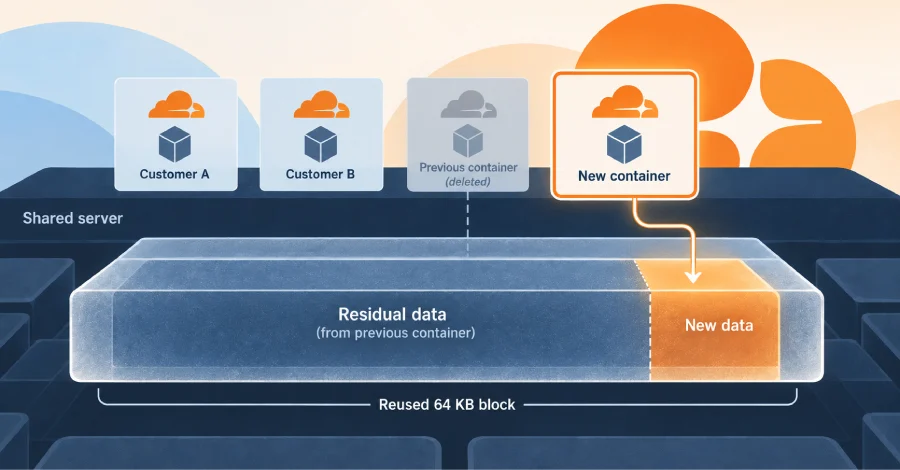
The vulnerability centered on the implementation of "thin provisioning," a storage optimization technique used by Cloudflare to manage disk space across its global fleet of servers. In this architecture, storage is allocated to containers in discrete, 64-kilobyte blocks. When a customer’s container is terminated, these blocks are returned to a global pool, theoretically to be reallocated to future workloads.
Under normal circumstances, the Linux kernel’s device-mapper thin provisioning module is configured to "zero out" or wipe these blocks before they are assigned to a new user. However, a misconfiguration in Cloudflare’s infrastructure caused the system to skip this critical security step. Consequently, when a new container was provisioned, it would occasionally inherit a block that still contained data fragments from a previous tenant.
Because the system did not perform a secure wipe, an attacker could write a small amount of data to a block and then read the remainder of that block at a raw disk level. By doing so, they could recover up to 60 kilobytes of residual information from the preceding user. This data included sensitive directory structures, SQLite database pages, and configuration files, such as .env files and browser profiles, which often house highly sensitive credentials.
Timeline of Discovery and Remediation
The flaw was discovered by Oren Yomtov of the cybersecurity firm Accomplish. On September 4, 2024, the researchers utilized Cloudflare’s bug bounty program to formally report the vulnerability. The discovery process involved systematic testing across various servers, revealing that the issue was not isolated to a single machine but was systemic across Cloudflare’s global infrastructure.
The chronology of the incident and the subsequent cleanup are as follows:

- September 4, 2024: Accomplish researchers report the vulnerability through the official bug bounty channel, providing a proof-of-concept that demonstrated the ability to read residual data.
- September 14, 2024: Cloudflare implements a fix by re-enabling the block-wiping mechanism. The researchers verify that their proof-of-concept is no longer functional.
- September 19, 2024: Recognizing that the initial fix did not address data already cached in active memory or existing image layers, Cloudflare completes a comprehensive, multi-day purge of all running container disks and clears associated caches. This process required draining and restarting servers during low-traffic periods to ensure zero downtime for clients.
- September 24, 2024: Cloudflare officially discloses the vulnerability, detailing the scope and the steps taken to resolve it.
Empirical Scope and Data Analysis
The researchers conducted extensive testing to determine the prevalence of the issue. Across 24 production-level tests on servers selected by Cloudflare, they successfully recovered data on 18 occasions. Furthermore, the issue was validated across 22 underlying machines spanning four continents, suggesting that the misconfiguration was deeply embedded in the company’s global server provisioning scripts.
The recovered data was not merely fragmented noise; the researchers reported successfully capturing structurally complete SQLite databases and directory listings. Despite the sensitivity of the information, the researchers emphasized that their analysis scripts were strictly designed to perform format checks and count data snippets. They explicitly confirmed that no third-party names, credentials, or proprietary content were stored or transmitted beyond the verification required by Cloudflare’s security team.
In its official response, Cloudflare confirmed that the researchers handled the findings with high ethical standards. The company stated that the recovered data was kept private during the testing phase and subsequently destroyed in a secure manner.
Cloudflare’s Investigation and Forensic Audit
Following the report, Cloudflare initiated an internal forensic audit to determine whether the vulnerability had been exploited by malicious actors prior to the report. The company leveraged the researchers’ proof-of-concept to develop detection signatures, which were then applied to historical disk-activity logs.
According to Cloudflare, the audit uncovered no evidence of unauthorized access. The only recorded instances of the exploit were those generated by the Accomplish research team and Cloudflare’s own engineers during the verification phase. However, the company has not provided a definitive window for how long the unsafe "skip-wipe" configuration was in place, making it impossible to fully quantify the duration of the potential exposure.
Broader Implications for Cloud Security
This incident serves as a stark reminder of the "noisy neighbor" and data leakage risks inherent in shared infrastructure. As cloud providers move toward increasingly granular isolation—such as sandboxes designed specifically for AI agents and untrusted code—the complexity of managing storage and memory at the kernel level grows exponentially.
For enterprises relying on containerized environments, the reliance on the cloud provider’s "thin provisioning" security measures is a critical point of trust. The fact that a single flag in a configuration file could compromise the confidentiality of thousands of customers underscores the necessity for robust defense-in-depth strategies.

Furthermore, the Accomplish team noted that this was their sixth successful "sandbox escape" since July 2024. Their track record includes similar findings in platforms such as Anthropic’s Claude, Cursor, Docker, and OpenAI’s Codex. This trend indicates that as AI-integrated development environments become more prevalent, the sandboxes protecting these environments are becoming prime targets for security researchers and potential attackers alike.
The Role of Bug Bounty Programs
The successful resolution of this issue highlights the efficacy of bug bounty programs in modern cybersecurity. By incentivizing independent researchers to report vulnerabilities, companies can identify systemic flaws before they are weaponized by threat actors. Cloudflare’s decision to quickly validate the report, implement a global fix, and perform an extensive audit of their infrastructure demonstrates the standard operating procedure for major cloud service providers when dealing with high-severity disclosures.
However, the incident also raises questions about internal auditing processes. While the bug bounty program caught the issue, the fact that the vulnerability existed in a production environment suggests a gap in automated security regression testing. As providers scale their services globally, ensuring that infrastructure-as-code deployments strictly adhere to security defaults remains a significant operational challenge.
Moving Forward
For Cloudflare customers, no action was required, as the company performed the necessary remediation on the backend. Nevertheless, the incident serves as a catalyst for organizations to review their data handling practices in the cloud. Experts suggest that for highly sensitive data, customers should continue to rely on encryption-at-rest and strict access controls, as these measures provide a second layer of defense even if the underlying container infrastructure is compromised.
As for the industry at large, this case will likely prompt a re-evaluation of disk-provisioning standards. The trade-off between the performance gains of thin provisioning and the security requirements of multi-tenancy is now at the forefront of cloud engineering discussions. Cloudflare’s transparency in disclosing the nature of the "skip-wipe" configuration provides a valuable case study for other providers to audit their own storage allocation mechanisms.
The incident is now officially closed, with Cloudflare maintaining that no customer data was compromised beyond the controlled tests performed by the researchers. The company has moved to strengthen its monitoring tools, ensuring that any future deviation from standard security configurations is identified and mitigated in real-time.