
At 14:06:10 UTC on Sunday, September 6, 2026, the Liquid Network experienced a significant security failure that resulted in the unauthorized transfer of 3,996.01834922 BTC from the Liquid Federation’s Bitcoin reserve. The event, triggered by a sophisticated exploitation of the Elements software—the open-source framework upon which the Liquid sidechain is built—has raised profound questions regarding the security architecture of custodial sidechains and the inherent trade-offs between privacy-focused transaction obfuscation and auditability. The stolen funds, valued at approximately $320 million based on the prevailing market rate of $80,000 per BTC, remain in the possession of an entity that has publicly identified itself as a "whitehat" actor.
The Mechanism of the Breach
The Liquid Network operates as a Bitcoin sidechain secured by a "Strong Federation" of fifteen functionaries. These entities, comprised of prominent blockchain companies, maintain the network’s integrity through an 11-of-15 multisig configuration. The system is designed to facilitate the movement of Bitcoin into and out of the Liquid ecosystem through a "peg-in" and "peg-out" process. Under normal conditions, users transfer BTC to a federation-controlled address, receive an equivalent amount of Liquid Bitcoin (L-BTC), and may later initiate a peg-out to reclaim their native Bitcoin.
The vulnerability exploited on September 6 did not stem from a compromised signing key or a failure of the federation’s hardware security modules (HSMs). Instead, the exploit occurred at the consensus layer. An attacker successfully injected invalid L-BTC into the network by triggering a bug within the Elements software. Because all fifteen functionaries utilize the same validation codebase, the consensus rules accepted the fraudulent L-BTC as legitimate. Once the L-BTC was "minted" via this consensus error, the attacker utilized the SideSwap peg-out service to convert the fraudulent L-BTC into native Bitcoin. Because the SideSwap service and the federation’s automated protocols only verify that the requested peg-out corresponds to a legitimate burning of L-BTC, the system processed the withdrawal without triggering any security alarms.
Chronology of the September 6 Incident
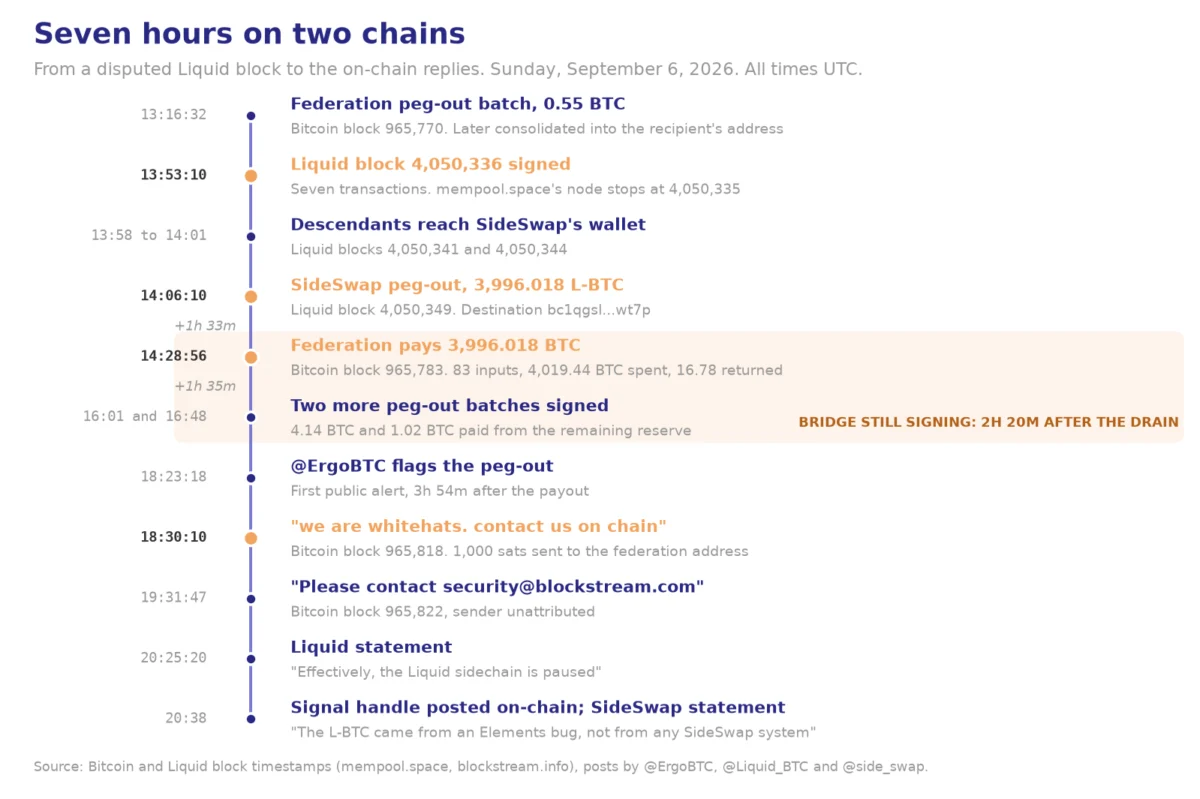
The sequence of events unfolded rapidly, exposing the divergence between the internal state of the Liquid sidechain and the external reality of the Bitcoin reserve.
- 13:16 UTC: A smaller, unrelated peg-out of 0.55 BTC occurred, which served as a precursor to the larger movement of funds.
- 13:53 UTC: Liquid block 4,050,336 was generated. This block contained the fraudulent transaction that minted the illicit L-BTC. Notably, this block was accepted by Blockstream’s infrastructure but rejected by third-party observers, including the Mempool.space node, signaling a consensus split.
- 14:05 UTC: An order for 4,000 L-BTC was submitted to the SideSwap peg-out service.
- 14:06 UTC: The official peg-out transaction (ce4caece…) was recorded in Liquid block 4,050,349, formally requesting the release of 3,996.01834922 BTC.
- 14:28 UTC: The federation’s Bitcoin wallet executed the payout in Bitcoin block 965,783, transferring the funds to an address controlled by the attacker.
- 18:30 UTC: The attacker, utilizing an OP_RETURN transaction, broadcast a message stating, "we are whitehats. contact us on chain," while sending a nominal amount of 1,000 satoshis back to the federation as a gesture of communication.
- 20:25 UTC: The Liquid Federation issued an official statement confirming the incident and announcing a pause on bridge operations.
Analysis of the Consensus Failure
The crux of the incident lies in the reliance on Confidential Transactions, a privacy feature that masks the amounts and asset types of transactions. While this provides a high degree of privacy for users, it creates an "auditability vacuum." In a transparent ledger, the creation of 4,000 unbacked L-BTC would be immediately visible as an increase in the total circulating supply. On Liquid, the supply is verified through complex cryptographic commitments that were, in this instance, bypassed by the underlying software bug.
The disagreement between public explorers—Blockstream’s explorer and Mempool.space—highlighted the severity of the situation. Blockstream’s explorer continued to show a balanced peg, as its node had accepted the malformed block. In contrast, the Mempool.space node, having rejected the block, displayed a clear discrepancy between the circulating L-BTC supply and the physical BTC reserves held by the federation. This divergence underscores a fundamental challenge: when the consensus software is flawed, the node operators themselves become the primary point of failure.
Official Responses and Remediation
In the aftermath of the breach, the Liquid Federation moved to suspend the bridge, effectively halting peg-ins and peg-outs to prevent further capital flight. Blockstream and SideSwap have both confirmed that no private keys were compromised. SideSwap’s statement emphasized that their service was a conduit for the exploit rather than the source, noting that their systems were unable to distinguish the fraudulent L-BTC from legitimate assets.
As of this writing, the stolen 3,998.5 BTC remains stationary in a consolidation address. The federation is attempting to establish contact with the purported whitehats through signed on-chain messages, and various community members have sent messages to the attacker’s address urging them to contact [email protected].
Broader Implications for Sidechain Architecture
The September 6 incident represents a "black swan" event for federated sidechains. While multisig thresholds and HSMs are effective at preventing unauthorized access to funds by malicious actors, they are impotent against systemic bugs that trick the signers into verifying a falsehood.
- Uniformity vs. Diversity: The fact that all fifteen functionaries run identical code creates a single point of failure. Future iterations of federated networks may need to consider "multi-client" strategies, where different federation members run different, independent implementations of the consensus software to detect anomalies before they are finalized.
- Reserve Transparency: The incident demonstrates that relying on an explorer to report the health of a peg is insufficient when the underlying asset is obfuscated. Real-time, automated monitoring systems that verify the reserve-to-supply ratio at the block-production level—independent of the consensus rules—may become a necessary standard for bridge security.
- The "Whitehat" Dilemma: The emergence of the "whitehat" narrative presents a recurring challenge for decentralized finance (DeFi). Without a formal legal or technical framework to resolve these incidents, the recovery of funds remains at the mercy of the attacker’s intent. The lack of a decentralized governance or treasury mechanism in the Liquid Network leaves the burden of restitution currently undefined, placing significant pressure on the federation members.
Technical Debt and Future Outlook
Questions regarding the specific bug in the Elements software remain, though observers have pointed to a recent patch related to range-proof verification caches. The timing of a pull request on September 4, aimed at addressing a vulnerability in how the cache binds to asset and scriptpubkey data, has drawn scrutiny. Whether this specific patch was a proactive fix or a response to the unfolding incident is a matter of ongoing technical investigation.
For holders of L-BTC, the immediate future is characterized by uncertainty. While the federation has stated that issued assets like USDT remain technically intact, the lack of a functioning bridge renders them effectively illiquid. The resolution of this incident will likely hinge on the negotiations between the federation and the party currently holding the $320 million in Bitcoin, as well as a comprehensive audit and potential architectural overhaul of the Elements software to ensure that consensus verification is sufficiently robust to prevent a recurrence of this magnitude.
As the industry reflects on this event, the incident serves as a stark reminder that even the most carefully constructed bridges are only as secure as the fundamental code upon which they are built. The Liquid Network now faces the dual challenge of recovering its assets and rebuilding the trust of its user base in an ecosystem where privacy and auditability must find a new, more resilient equilibrium.

