
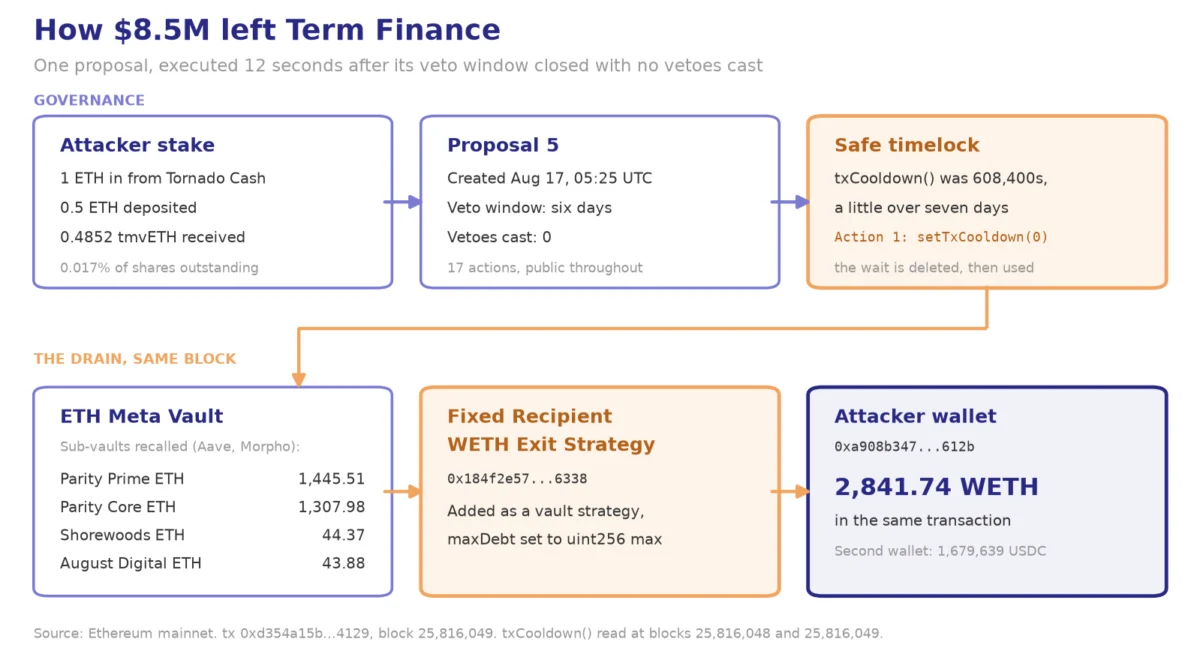
On Sunday, August 23, 2026, at 06:25:47 UTC, a critical failure in the governance architecture of the decentralized lending protocol Term Finance resulted in the unauthorized withdrawal of approximately 2,841.74 WETH from its ETH Meta Vault. This event was followed shortly thereafter by a second exploit targeting five USDC vaults, leading to the drainage of an additional 1,679,639 USDC. The total loss, estimated at $8.5 million, was not the result of a traditional technical exploit such as a reentrancy attack, oracle manipulation, or flash loan. Instead, it was a systemic failure of the protocol’s opt-out governance mechanism, which allowed an unprivileged actor to pass a malicious proposal that dismantled the protocol’s own internal security safeguards.
The incident underscores a growing trend in decentralized finance (DeFi) where the "curator model"—designed to simplify yield generation for passive depositors—creates a dangerous concentration of authority that, if left unmonitored, becomes a primary attack vector.
The Mechanism of Failure
Term Finance operates as a fixed-rate lending protocol, distinguishing itself from floating-rate competitors like Aave or Compound by matching borrowers and lenders for fixed maturities. The protocol’s "Strategy Vaults" rely on external risk curators to allocate capital into various sub-vaults across the DeFi ecosystem. To manage these allocations, Term utilizes a governance module where parameter changes are proposed by curators.
Under the protocol’s design, these governance actions are governed by an "opt-out" mechanism. When a proposal is submitted, a voting window opens, and liquidity provider (LP) token holders are given the opportunity to veto the change. If no veto is cast by the end of the period, the proposal is considered approved and becomes executable. Crucially, Term implemented a seven-day timelock as a "second line of defense" to allow for emergency intervention.
However, the exploit revealed that this timelock was not isolated from the governance module itself. The attacker successfully submitted a proposal that included an instruction to set the timelock cooldown period to zero. By doing so, the attacker effectively disarmed the protocol’s final safety mechanism, allowing the malicious transaction to execute immediately upon the expiration of the voting window.

Chronology of the Exploit
The timeline of the breach suggests a high level of preparation and patience on the part of the attacker.
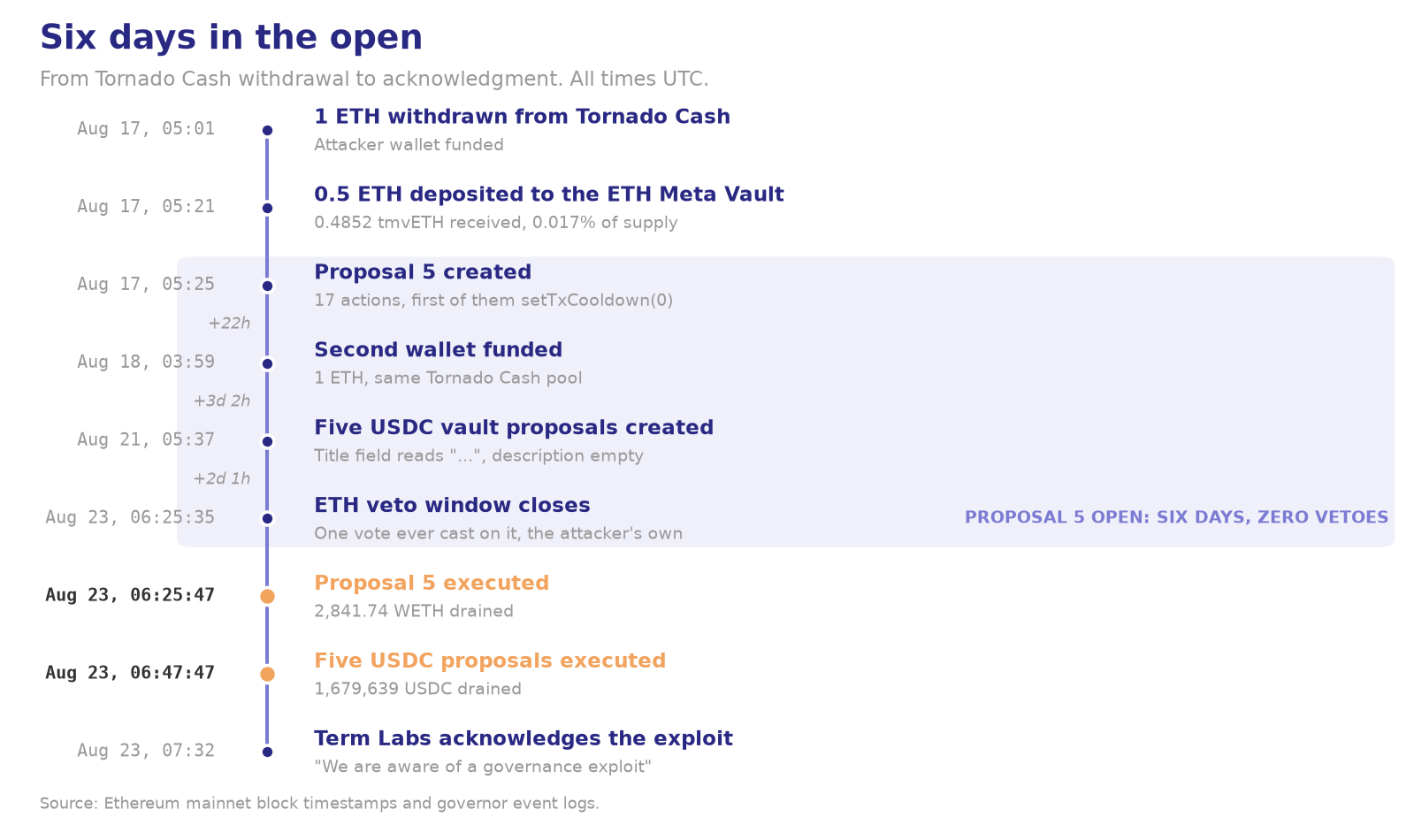
- August 17, 2026: A wallet address, 0xa908b3472d76e7744bab0a5911768a4a6300612b, receives 1 ETH from a Tornado Cash pool.
- August 17, 2026 (05:21 UTC): The attacker deposits 0.5 ETH into the ETH Meta Vault, acquiring a 0.017% share of the vault.
- August 17, 2026 (05:25 UTC): The attacker deploys a contract that submits "Proposal 5" to the ETH Meta Vault’s governor. The proposal, disguised as a standard parameter update, contains 17 instructions, including the command to delete the seven-day timelock.
- August 17–23, 2026: The proposal remains active and publicly viewable on-chain for six days. During this time, not a single veto is cast by the curators or the vault’s LP token holders.
- August 23, 2026 (06:25 UTC): The voting window closes.
- August 23, 2026 (06:25:47 UTC): The attacker executes the proposal. The contract successfully resets the timelock to zero and triggers a series of actions that move 2,841.74 WETH to the attacker’s address.
- August 23, 2026 (06:47 UTC): A second wallet executes a similar, more aggressive exploit against five USDC vaults, draining over 1.67 million USDC.
Data Analysis and Financial Impact
The breach was executed with surgical precision, utilizing a relatively small capital stake to gain the required status to initiate governance proposals. On the ETH side, the attacker held only 0.017% of the total vault supply. For the USDC vaults, the attacker’s stake was even smaller, effectively a rounding error compared to the total assets under management.
Despite the removal of the funds, the vault’s accounting software initially continued to reflect the presence of the assets. The vault recorded the stolen funds as a "loan" to a strategy contract, which meant that for a period following the exploit, the share price reported by the vault remained artificially high. This "fictional" valuation poses a secondary risk to users and integrators who rely on automated dashboards to monitor their holdings, as they may be unaware that the underlying collateral has been removed.
Total losses are estimated by third-party security firms, including PeckShield, to be approximately $8.5 million. While the ETH Meta Vault was emptied, the USDC vaults still retain roughly $4.36 million in assets, suggesting that the exploit did not result in a total loss of all protocol liquidity, though the integrity of the vaults remains in question.
Official Responses and Industry Reaction
Term Labs issued a brief statement at 07:32 UTC on the day of the incident: "We are aware of a governance exploit impacting Term vaults. We will share more details once it has been further investigated."
Following the initial drain, the protocol attempted to initiate emergency governance actions—specifically, "Proposal 6" and "Proposal 7"—to attempt to shut down the affected vaults. However, these attempts faced the same logistical hurdles as the original proposals, as they were also subject to the protocol’s established (and currently compromised) governance veto windows.
Related protocols that utilized Term Finance as a yield source have also been impacted. For instance, Tori Finance, which had capital allocated to Term via a RockawayX-curated vault, saw a loss of approximately $480,000. Reports indicate that Tori Finance representatives have signaled an intent to cover these losses for their depositors, though a formal public disclosure was pending as of the time of reporting.
Broader Implications for Decentralized Governance
The Term Finance exploit serves as a stark case study in the risks of "opt-out" governance models. In theory, these systems are designed to prevent the paralysis of protocols where voter apathy is high. By assuming that silence equals consent, these protocols can iterate and update parameters rapidly. However, as this incident demonstrates, this design shifts the burden of security entirely onto the participants. If no one is actively monitoring the governance queue, the system essentially becomes a "permissionless" extraction machine.
Several key questions remain for the DeFi community:
- Authorization Boundaries: How did an unprivileged contract created only minutes prior gain the ability to submit executable proposals? The failure to restrict proposer roles to verified curator addresses appears to be the primary point of vulnerability.
- Timelock Integrity: The decision to allow a governance proposal to modify its own safety constraints (the timelock) reflects a critical architectural flaw. Standard security practices dictate that administrative cooldowns should be immutable or protected by a separate, multi-signature override that cannot be triggered by the same mechanism it is intended to guard.
- Economic Barriers: The lack of a significant financial bond required to submit a proposal allowed an attacker to initiate a multi-million dollar exploit with less than one ETH of capital. Implementing a stake-based threshold or a slashing mechanism for malicious proposals could mitigate similar future attempts.
Conclusion
The Term Finance exploit is the latest in a series of 2026 security events where the "human" and "process" layers of a protocol failed before the mathematical code did. While developers often focus on preventing reentrancy or oracle manipulation, this incident highlights that the administrative levers—the "governance interface"—are increasingly becoming the most lucrative target for sophisticated actors.
For the average DeFi participant, the lesson is clear: the curator model is not a "set-and-forget" solution. The reliance on third-party judgment, coupled with automated governance, requires constant vigilance. Until protocols implement more robust, hardened, and isolated governance procedures, the risk of "legitimate" but malicious administrative actions will remain a constant, looming threat to the ecosystem’s treasury.

