
At 14:06:10 UTC on Sunday, September 6, 2026, a critical security event unfolded on the Liquid Network, a prominent Bitcoin sidechain operated by Blockstream. A peg-out transaction involving the movement of 3,996.01834922 BTC triggered an automated response from the Liquid Federation’s multisig infrastructure. This transaction, processed through the peg-out partner SideSwap, resulted in the transfer of nearly 4,000 BTC to a private address, effectively draining the federation’s primary reserves from approximately 4,200 BTC to fewer than 200 BTC within a matter of minutes.
The incident has sent shockwaves through the Bitcoin ecosystem, raising profound questions regarding the security model of sidechains, the inherent risks of confidential transactions, and the governance of decentralized finance (DeFi) bridges. While the Liquid Network was marketed as a robust, enterprise-grade solution utilizing a "Strong Federation" model, this event underscores the fragility of systems that rely on shared codebase consensus.
Chronology of the Exploit
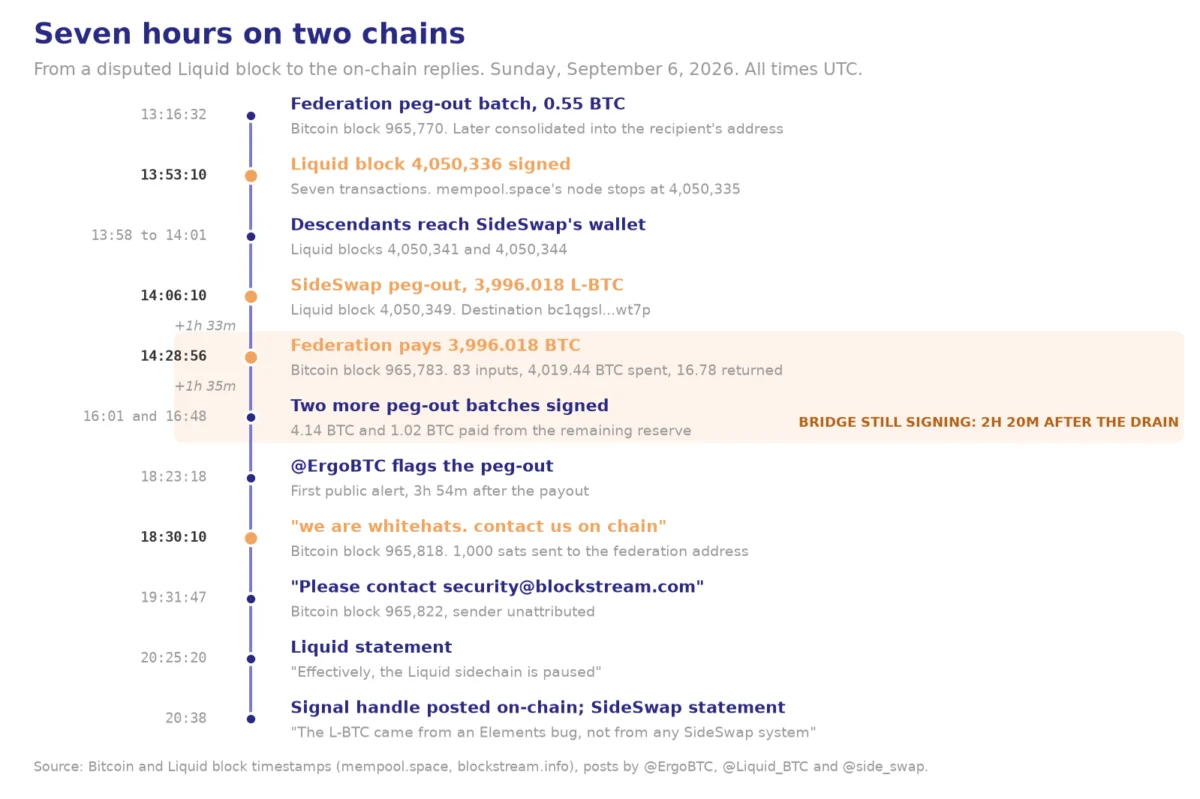
The sequence of events began to manifest in the early hours of September 6. At 13:16 UTC, an initial, smaller peg-out of 0.55 BTC was processed by the federation. While this appeared to be a routine operation, it later served as a precursor to the larger breach.
The core of the incident centers on Liquid block 4,050,336, which was signed at 13:53:10 UTC. This block contained a large, 64-input transaction that, according to blockchain data, introduced anomalous data into the Liquid ledger. Crucially, a consensus divergence emerged: while the Blockstream-maintained explorer accepted the block as valid, independent nodes—notably the infrastructure powering the mempool.space Liquid explorer—rejected it.
At 14:06:10 UTC, the system executed the fraudulent peg-out. SideSwap, acting as a authorized intermediary with a valid Peg-out Authorization Key (PAK), submitted the request. By 14:28:56 UTC, the Bitcoin mainnet recorded the federation’s 83-input transaction (block 965,783) paying out 3,996.01834922 BTC to a third-party address.
The entity behind the transfer subsequently moved the funds to a consolidation address. At 18:30:10 UTC, in Bitcoin block 965,818, the recipient issued an OP_RETURN message stating: "we are whitehats. contact us on chain." Despite this declaration, the funds remain stationary at the time of writing, and no further movement has occurred.
The Mechanism of the Failure
To understand why the Liquid Federation’s security measures failed to prevent this, one must examine the role of the Hardware Security Modules (HSMs) and the PAK system. The Liquid Network’s architecture is designed to prevent the unauthorized movement of funds by requiring that all peg-outs be sent to a pre-whitelisted address.
In this instance, the multisig wallet functioned exactly as programmed. The HSMs, managed by the fifteen federation functionaries, verified that the destination address was whitelisted and that the amount of Liquid Bitcoin (L-BTC) being "burned" matched the BTC being requested. The failure occurred at a deeper level: the consensus layer. The system correctly verified that the peg-out was "authorized," but it failed to verify that the L-BTC being burned was legitimately created.
Because all fifteen functionaries run the same underlying software—the Elements blockchain framework—a bug within that software allowed the generation of illicit L-BTC. When the federation members verified the transaction, they were essentially confirming the validity of an illegal mint that had been masked by the network’s own consensus rules.
Confidential Transactions: A Double-Edged Sword
The Liquid Network utilizes Confidential Transactions (CT), which leverage Pedersen commitments and range proofs to hide the amounts and types of assets being transferred. While this provides the privacy and fungibility that is a cornerstone of the Liquid value proposition, it also creates an "audit gap."
On a transparent blockchain, an anomalous minting event would be visible to all participants, as the total supply would deviate from expected norms. On Liquid, the minting of 4,000 L-BTC was effectively hidden from public view. Because observers cannot see the specific amounts within a CT output, the market was unable to detect the discrepancy until the federation’s Bitcoin reserve began to deplete. This design choice prioritized privacy over transparency, ultimately facilitating a theft that remained invisible to the wider network until the damage was complete.
Official Responses and Industry Reaction
Blockstream and SideSwap have both issued statements acknowledging the breach. Blockstream confirmed that the issue stems from a bug within the Elements software, though it has not yet provided a detailed technical breakdown of the vulnerability. SideSwap stated that its systems were not compromised, but rather that it processed a customer order that utilized L-BTC minted through the aforementioned bug.
The federation has taken the step of disabling bridge nodes, effectively pausing the Liquid sidechain’s peg-out functionality. While blocks are still being produced, the ability for users to move capital between Bitcoin and Liquid has been suspended. Exchanges and custodial services have also halted L-BTC deposits and withdrawals, leaving many users in a state of limbo.
Independent researchers, including those associated with mempool.space, have been instrumental in identifying the divergence in the chain’s history. The speed with which the community identified the discrepancy highlights the necessity of third-party monitoring in maintaining the integrity of custodial bridges.
Broader Implications for the Bitcoin Ecosystem
The incident raises fundamental concerns regarding the "Strong Federation" model. By relying on fifteen entities that all run identical software, the network suffers from a lack of diversity in its validation logic. If a single bug exists in the shared codebase, the entire multi-signature threshold is rendered ineffective.
Furthermore, the lack of an on-chain governance structure or a dedicated emergency treasury poses a massive risk to L-BTC holders. Unlike decentralized protocols that might have a DAO-controlled insurance fund, the Liquid Network is a centralized service. The question of who bears the loss—the federation, the partner, or the end-user—remains unanswered.
The potential existence of a bug fix in the Elements repository, specifically the commit regarding range proof cache binding, has sparked intense speculation. While there is no official confirmation that this specific change would have prevented the exploit, the timing of the pull request relative to the incident suggests that the vulnerability was known or suspected by the core development team shortly before or during the breach.
Conclusion and Future Outlook
The Liquid Network security incident is a sobering reminder that complexity is the enemy of security. Even with sophisticated multisig hardware and a whitelist-based authorization system, the underlying consensus software remains a single point of failure.
As the Bitcoin community reflects on this event, the focus will undoubtedly shift toward the necessity of more robust, transparent, and diversified validation mechanisms for sidechains. For now, the L-BTC holders are left to wait for a resolution, with the network effectively frozen and the stolen funds held in a single, silent wallet. The incident serves as a definitive case study in the risks of custodial bridges and the trade-offs between privacy-centric transaction models and the requirement for public, verifiable transparency. Whether the Liquid Federation can restore the peg and regain the trust of its users will depend on its ability to provide a full, transparent post-mortem and a clear path toward asset recovery or compensation.

