

At 06:25:47 UTC on Sunday, August 23, 2026, a sophisticated governance exploit targeted Term Finance, a decentralized fixed-rate lending protocol, resulting in the unauthorized withdrawal of approximately $8.5 million in assets. The attack exploited a critical vulnerability in the protocol’s governance module, which allowed an unprivileged user to queue and execute a parameter change that bypassed established security timelocks. By manipulating the governance process, the attacker successfully drained 2,841.74 WETH from the protocol’s ETH Meta Vault and an additional 1,679,639 USDC from five associated USDC vaults, highlighting the inherent risks in automated "opt-out" governance models.
Chronology of the Exploitation
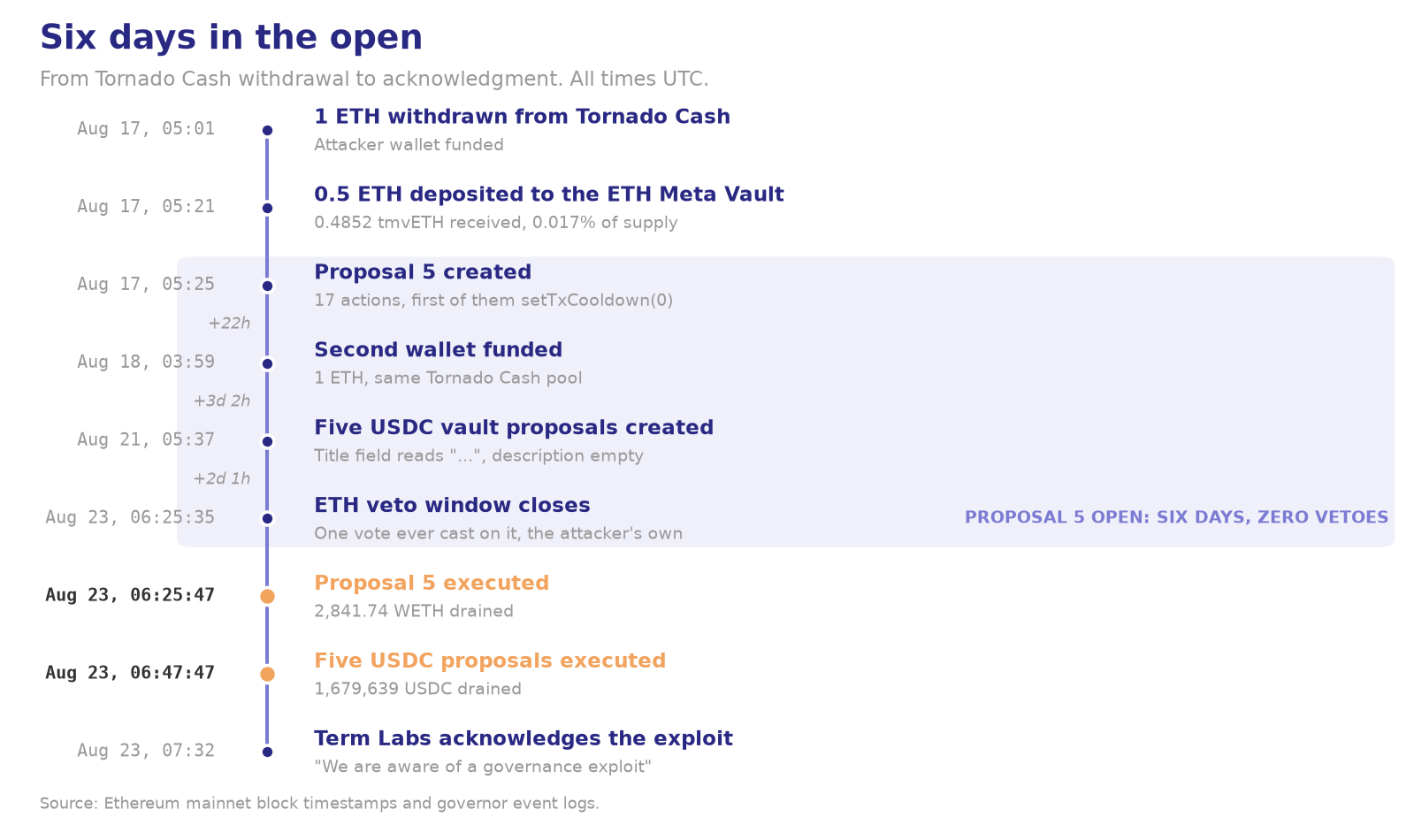
The methodical nature of the attack suggests a period of preparation and observation. The sequence of events, verified through Ethereum mainnet logs, began on August 17, 2026, when a wallet address—funded by 1 ETH transferred via the privacy protocol Tornado Cash—made a strategic deposit of 0.5 ETH into the Term Finance ETH Meta Vault. This initial investment provided the attacker with 0.4852 tmvETH, a negligible stake representing roughly 0.017% of the total vault supply, yet sufficient to interact with the governance module.
On August 17 at 05:25:35 UTC, the attacker deployed a custom contract to initiate "Proposal 5" on the meta vault’s governor. This proposal, while labeled as a standard parameter change, contained a malicious payload designed to disable the protocol’s seven-day security timelock. For six consecutive days, this proposal remained visible on-chain. During this period, the protocol’s governance mechanism functioned under an "opt-out" framework: silence from depositors was interpreted as consent. Because no vetoes were cast, the proposal automatically progressed toward execution.
On August 23, the voting window closed. Within 12 seconds, the attacker executed the transaction. The first instruction in the payload effectively set the protocol’s txCooldown to zero, nullifying the seven-day delay. Once the safety mechanism was disabled, the remaining actions in the payload triggered the transfer of 2,841.74 WETH to the attacker’s controlled wallet. Less than 20 minutes later, at 06:47:47 UTC, a second attacker wallet executed a similar maneuver across five USDC-denominated vaults, extracting nearly $1.7 million in stablecoins.

Technical Anatomy of the Failure
The exploit did not rely on traditional vulnerabilities such as reentrancy attacks, oracle manipulation, or flash loans. Instead, it leveraged a design flaw in the protocol’s authorization hierarchy. Term Finance utilizes a curator model where third-party entities manage vault allocations. To ensure efficiency, the governance system requires depositors to actively "veto" unwanted changes.
The critical failure occurred in two parts: the permissioning of the proposal queue and the accessibility of the timelock. Firstly, the protocol’s governance contract lacked sufficient safeguards to prevent an unprivileged, low-stake address from queuing a high-impact parameter change. Typically, such sensitive operations are restricted to authorized curator addresses or require a significant token stake to prevent malicious proposals.
Secondly, the timelock, intended as a "fail-safe" to allow for the cancellation of malicious transactions, was itself under the control of the governance module. By including a setTxCooldown(0) instruction within the same proposal that initiated the withdrawal, the attacker was able to dismantle the security barrier immediately before triggering the theft. This circular dependency meant that the very mechanism designed to protect the treasury was susceptible to the same governance process it was meant to oversee.
Supporting Data and Asset Valuation
The financial impact of the event is significant, particularly given the total assets under management (AUM) within the affected vaults. Based on market data from August 23, 2026, the cumulative loss is estimated at approximately $8.5 million. The following breakdown illustrates the distribution of the theft:
- WETH Drained: 2,841.7435 units.
- USDC Drained: 1,679,639.29 units.
- Total USD Value: ~$8.5 million, calculated based on the prevailing ETH/USD exchange rate at the time of the transaction.
Despite the loss, the internal accounting of the Term Finance vaults remained skewed in the immediate aftermath. Because the assets were technically "loaned" to a strategy contract—the malicious strategy created by the attacker—the protocol’s totalAssets() function continued to report inflated figures. This created a discrepancy between the reported share price and the actual collateral backing those shares, as the vault recorded the stolen funds as active debt rather than a total loss.
Official Responses and Industry Reaction
Term Labs, the development team behind the protocol, acknowledged the breach via social media at 07:32 UTC on August 23, stating, "We are aware of a governance exploit impacting Term vaults. We will share more details once it has been further investigated." As of this writing, a comprehensive post-mortem report has yet to be released.
External observers and security firms, including PeckShield, corroborated the timeline and the use of Tornado Cash to obfuscate the origin of the attacker’s funds. Furthermore, downstream effects were noted in other DeFi protocols. For instance, the RockawayX Tori USDC vault, which had allocated funds to Term, suffered a direct loss. Reports suggest that the Tori Finance team is working to cover these losses for their depositors, underscoring the contagion risks inherent in the interconnected "vault-of-vaults" ecosystem where users may be exposed to risks from protocols they have not directly vetted.
Implications for Decentralized Governance
The Term Finance incident serves as a stark case study in the risks of automated governance. In the pursuit of efficiency, many DeFi protocols have shifted toward "opt-out" or low-friction governance models. While these models address the issue of voter apathy, they shift the burden of security entirely onto the depositors and community monitors.
The primary implications for the broader DeFi industry include:
- Authorization Limits: Protocols must enforce strict, non-governance-accessible limits on sensitive parameters. The ability to disable security timelocks should never be available to a standard proposal payload.
- Economic Thresholds: Implementing a "bond" system—where proposers must stake a significant amount of capital that is forfeited if a proposal is vetoed—could serve as a powerful economic deterrent against malicious actors.
- Governance Auditing: Security audits for decentralized protocols often focus on smart contract logic (e.g., math errors or reentrancy) but may overlook the governance "state machine." The logic that determines who can propose changes and what those changes can alter is as critical as the core protocol logic.
- Monitoring Responsibilities: The reliance on passive monitoring by curators or users is insufficient. There is a growing need for automated "governance guardians" that can automatically pause or veto proposals that meet specific high-risk criteria, such as those attempting to modify security settings.
As the DeFi sector continues to mature, the Term Finance exploit highlights a growing tension between the ideal of total decentralization and the practical necessity of robust security. When a governance system is designed to favor speed and ease of use, it risks becoming a weapon for those willing to exploit the latency between proposal submission and execution. The incident serves as a reminder that in the absence of vigilant oversight, silence is not merely consent—it is an invitation for catastrophic loss.

