
A sophisticated, worm-like malware toolkit designated as SCKit has been deployed in a sweeping wave of cyberattacks targeting managed service providers (MSPs). The campaign, which security researchers say struck dozens of organizations within a remarkably compressed timeframe, leverages compromised cloud-hosted environments to install unauthorized remote-access software. More alarmingly, the toolkit is engineered to function as a digital vector, attempting to leap from infected customer endpoints back onto the workstations of IT technicians. By turning routine
remote support sessions into potential threat vectors, the malware aims to compromise broader enterprise networks, though recent analysis indicates that its automated exploitation methods have thus far been successfully blocked by patched software.
The rapid escalation of these events has placed the managed services sector on high alert. Cybersecurity firms Huntress and Blackpoint Cyber, which independently analyzed the recovered malware components, revealed that the campaign hit at least 288 endpoints across 48 distinct organizations. The speed of the onslaught underscored its automated nature, with all identified devices compromised within a 90-minute window and approximately one-third of those systems impacted inside the first ten minutes.
Chronology and Initial Vector Analysis
The sequence of events began unfolding during a wave of widespread ScreenConnect security breaches. ScreenConnect, a widely utilized remote access and support platform, serves as the operational backbone for many IT teams and MSPs managing client infrastructure. In these attacks, malicious actors gained unauthorized access to cloud-hosted ScreenConnect environments. Utilizing the platform’s native Run Command functionality, the intruders deployed rogue ScreenConnect remote-access clients onto customer endpoints, establishing persistent footholds independent of standard operational oversight.
Subsequent investigations by Huntress pointed to an initial access vector involving RMM+, a third-party ScreenConnect extension. Designed to allow external management tools to interact seamlessly with ScreenConnect sessions without requiring a standard technician console, RMM+ versions 1.0.31 and 1.0.32 contained a critical authentication flaw. The extension relies on a shared access key rather than conventional user accounts and multi-factor authentication (MFA) mechanisms. However, the vulnerable versions permitted this access key to remain entirely blank if an administrator had never actively configured one.
Attackers exploited this oversight by supplying an empty access key, thereby bypassing authentication checks and issuing remote commands directly through the ScreenConnect environment. Log analysis corroborated this finding, revealing command execution across multiple ScreenConnect instances without any corresponding user login activity, directly linking the administrative anomalies to the RMM+ extension. In response to these findings, platform developer ConnectWise disabled five potentially related third-party extensions across approximately 400 partner environments, while emphasizing that the presence of these extensions did not inherently confirm a compromise.
Anatomy of the SCKit Malware Toolkit
Following initial access, the adversaries deployed SCKit, an intricate collection of 16 scripts and components designed to secure persistent remote access and propagate across networks. Blackpoint Cyber’s Adversary Pursuit Group (APG) successfully recovered the malware’s loader directly from attacker-controlled infrastructure. Decryption of subsequent stages yielded the complete loader alongside a specialized ScreenConnect installer utilized in the offensive operations.
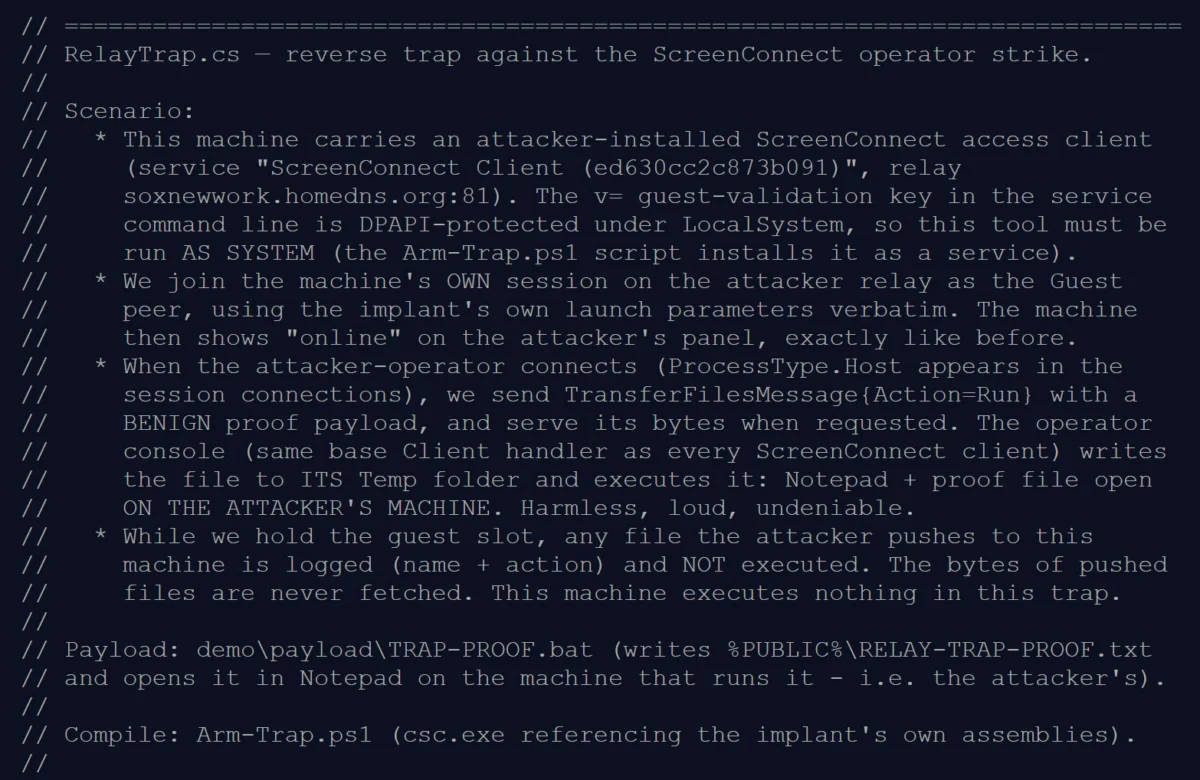
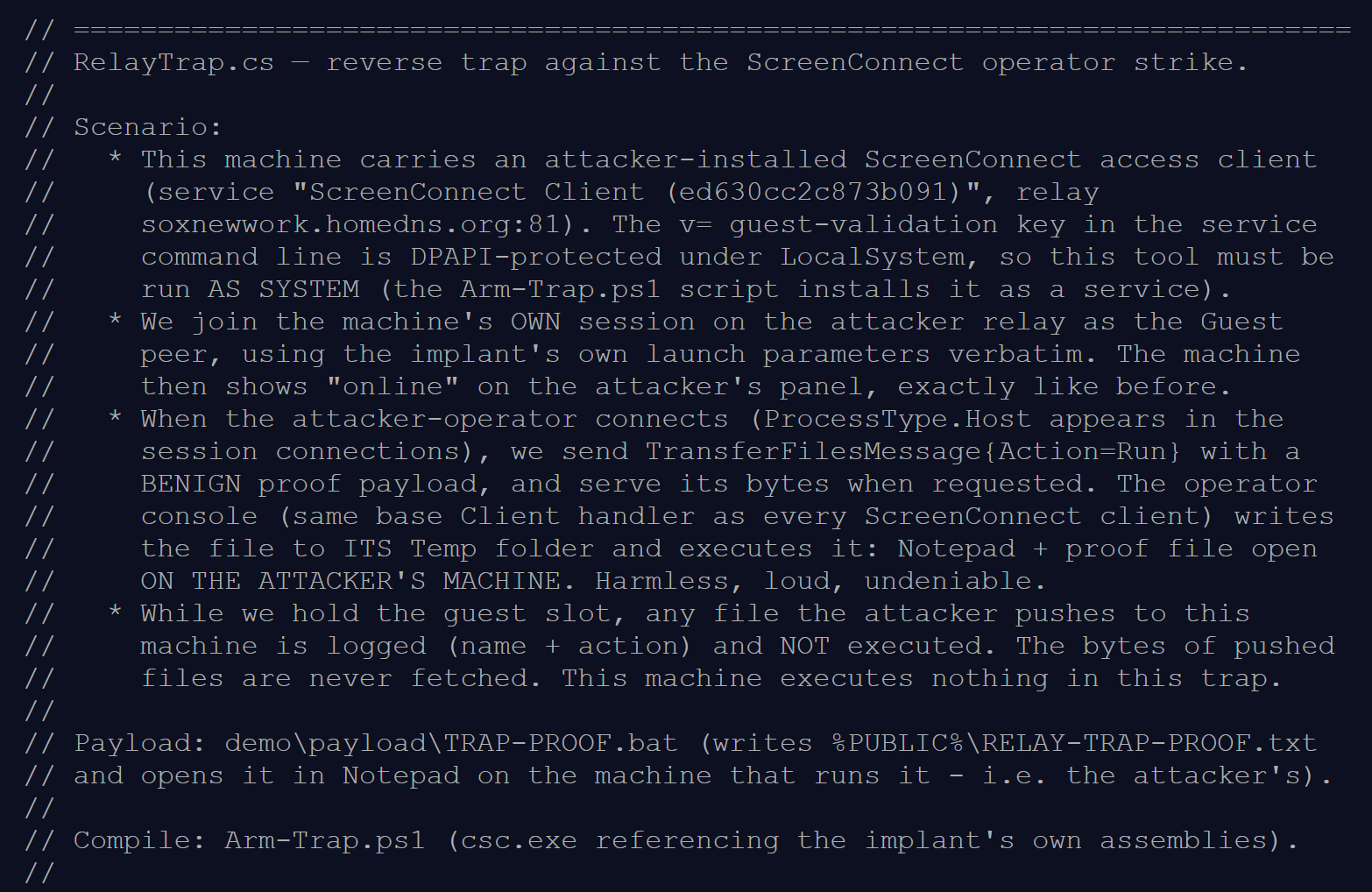
While the attackers deployed supplementary ScreenConnect Access clients to ensure persistence even if primary MSP sessions were terminated, SCKit’s most distinguishing attribute is its attempt to invert the traditional dynamic of remote IT support. The toolkit features a component designated as RelayTrap, which replaces the legitimate ScreenConnect Guest process running on a compromised endpoint. Instead of dropping a precompiled executable, the attackers store RelayTrap as a C# source code file (RelayTrap.cs) on external infrastructure, which is then downloaded and compiled locally into an executable via PowerShell scripts upon reaching the target device.
A companion component, TrapWatch, continuously monitors ScreenConnect services, priming the replacement Guest process to intercept incoming support sessions. When an MSP technician initiates an interactive connection to troubleshoot the device, RelayTrap attempts to reverse the standard data flow. Rather than receiving files from the technician, the malicious Guest process attempts to transmit a malicious file back to the technician’s workstation.

This reverse-transmission technique is designed to exploit CVE-2026-84869, a critical client-side file-transfer vulnerability previously patched by ConnectWise in version 26.6.5. Under normal operational parameters, ScreenConnect enables technicians to send and execute files on managed endpoints. The vulnerability, however, theoretically allows a compromised Guest entity to push a file back to the technician and trigger its execution locally.
Interestingly, forensic analysis of the RelayTrap.cs source code revealed unusually detailed commentary explaining its functionality, compatibility workarounds, and historical coding corrections. Both Huntress and Blackpoint Cyber noted that the stylistic indicators and structural characteristics of the code strongly suggest it was generated using a large language model (LLM).
Propagation Mechanics and Current Defense Efficacy
Should a technician’s workstation become successfully compromised via this reverse-infection chain, supplementary SCKit components are engineered to harvest ScreenConnect authentication cookies stored within web browsers. Such theft would allow malicious actors to hijack authenticated management sessions seamlessly, bypassing user credentials and secondary MFA challenges entirely.
Armed with a technician’s elevated permissions, the malware would subsequently seek to enumerate accessible endpoints and distribute malicious commands across other customer organizations through legitimate management features, such as the platform’s Shared Toolbox. This mechanism outlines a theoretical worm-like propagation loop: a single compromised client device infects an MSP technician, who subsequently exposes an entire portfolio of managed corporate networks.
Despite the theoretical sophistication of this attack chain, extensive forensic testing has provided reassuring news for enterprise defenders. Security researchers from both Blackpoint Cyber and Huntress confirmed that they have not observed successful exploitation of CVE-2026-84869 in the wild.
Blackpoint researchers Sam Decker and Nevan Beal successfully reproduced the toolkit’s attempted exploit against a contemporary, fully patched ScreenConnect client in a laboratory environment. Their findings confirmed that the security patch successfully neutralized the threat. "The Guest side queued the transfer, but the current client never requested or ran the payload," the researchers explained. Huntress similarly reported that console takeover attempts failed uniformly across all recovered host logs examined during the investigation.
Industry Implications and Recommendations
The emergence of SCKit highlights a concerning evolutionary trend in cybercriminal tactics: the weaponization of trusted management tools against the very service providers charged with securing them. By targeting the trusted conduit between IT professionals and client infrastructure, attackers seek to bypass traditional perimeter defenses and leverage established administrative trust relationships.
Cybersecurity authorities and incident response teams have issued urgent guidance for managed service providers and enterprise IT departments. Organizations utilizing ScreenConnect are strongly advised to ensure their software is updated to the latest patched iterations, immediately disable affected third-party extensions—particularly vulnerable iterations of RMM+—and meticulously audit Run Command histories and Shared Toolbox activity for indicators of compromise.
Furthermore, security analysts recommend that MSP technicians exercise heightened caution when establishing interactive remote support sessions with endpoints exhibiting unusual behavior. Rather than relying solely on remote support consoles to diagnose potentially compromised systems, organizations should leverage out-of-band security tooling to isolate and investigate anomalous environments safely, mitigating the risk of lateral movement before it can take root.

