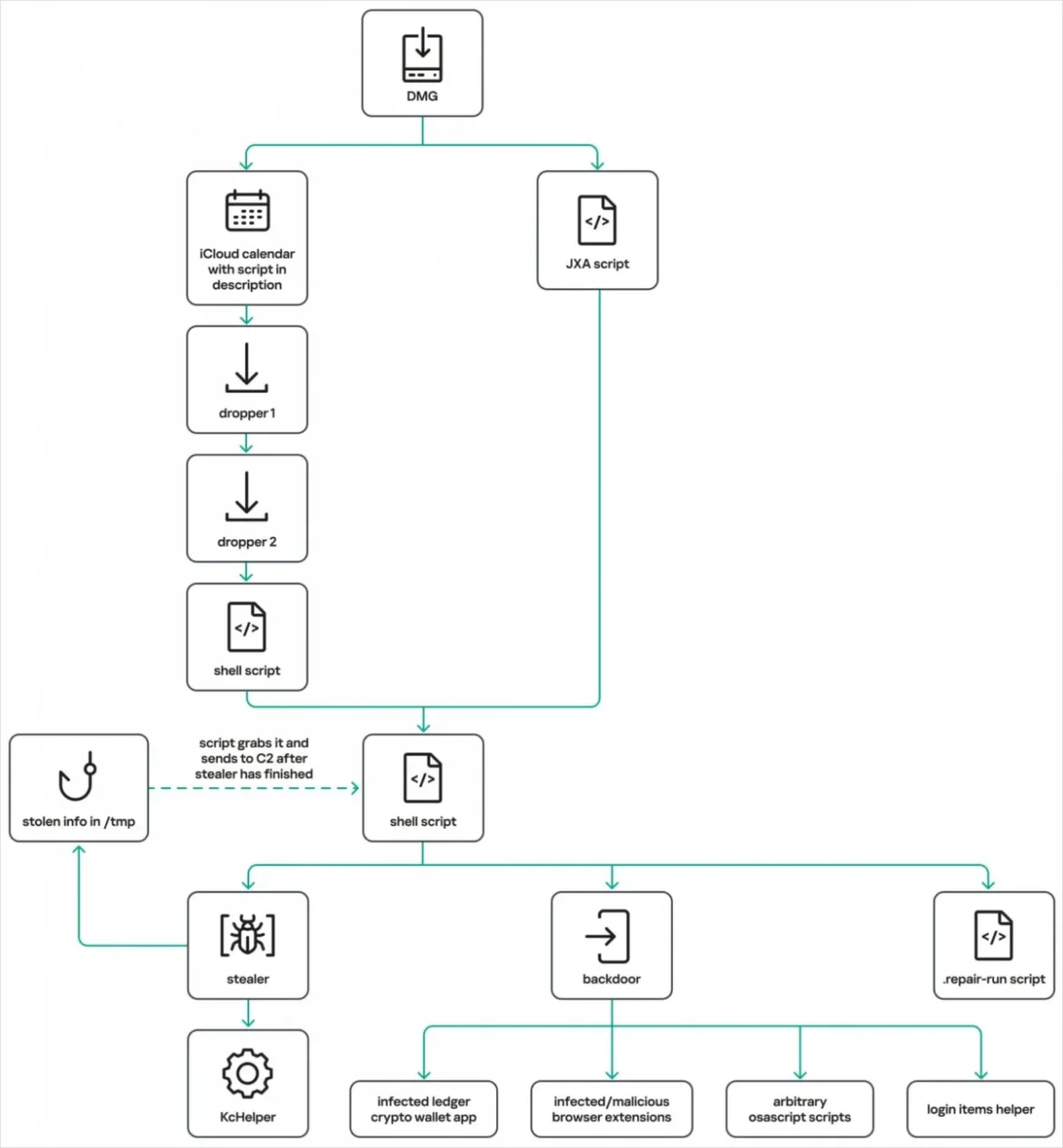
Cybersecurity researchers have uncovered a sophisticated new iteration of the MacSync information-stealing malware that introduces an unconventional vector for command and control: public iCloud calendars. Initially spotted in early 2025 as a Swift-based variant loosely tied to the AMOS stealer family, MacSync has rapidly evolved into a modular, multi-stage threat targeting macOS environments. According to telemetry and analysis from Kaspersky, recent campaigns utilize elaborate social engineering—including deceptive ClickFix schemes and fraudulent cryptocurrency applications—to slip past user defenses. By leveraging legitimate cloud infrastructure such as Apple’s iCloud services, the operators of MacSync have demonstrated an increasing capacity to evade traditional endpoint detection systems, posing a renewed challenge for enterprise security teams and individual Mac users alike.
The Evolution of MacSync: From AMOS Offshoot to Advanced Multi-Stage Threat
To understand the current threat landscape surrounding MacSync, security analysts must examine its trajectory since it first emerged in April 2025. Initially characterized as a relatively straightforward Swift-based info-stealer derived from the notorious AMOS (Atomic macOS Stealer) family, the malware quickly caught the attention of threat intelligence researchers due to its rapid iteration cycle. Unlike early versions that relied solely on conventional payload delivery methods, the recent campaign analyzed by Kaspersky reveals a significant architectural overhaul.
The malicious operators behind MacSync have steadily modularized the malware, decoupling the initial downloader from the core infostealer modules and the newly introduced backdoor components. This modular design not only complicates the task of reverse-engineering the malware but also allows threat actors to dynamically provision payloads based on the compromised system’s profile. By separating the initial reconnaissance and delivery phases from data harvesting and remote administration capabilities, the creators of MacSync have mirrored the sophisticated tactics typically observed in advanced persistent threat (APTs) groups, bringing enterprise-grade stealth techniques to the macOS consumer and enterprise threat landscape.
Anatomy of an Attack: Social Engineering and iCloud Calendar C2

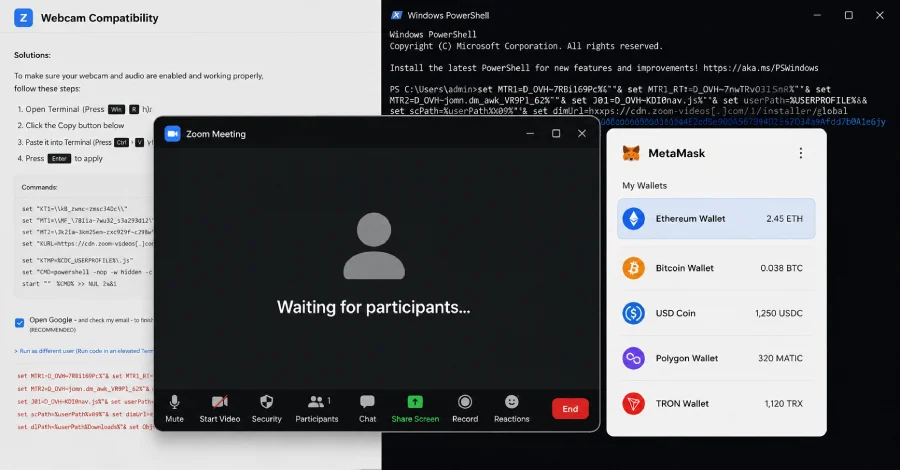
The primary distribution vector for MacSync relies heavily on social engineering, capitalizing on user trust and the growing prevalence of browser-based deception tactics. Recent campaigns have heavily leveraged so-called ClickFix attacks, where users are manipulated into copying and pasting malicious terminal commands under the guise of fixing minor software errors or updating legitimate utilities such as Homebrew and disk space analyzers. Furthermore, threat actors have deployed bespoke fraudulent infrastructure, including dedicated promotional websites and social media campaigns advertising a fake cryptocurrency wallet application named "Toria."
Once a victim is lured into interacting with these malicious assets, the infection chain bifurcates into standard and highly complex delivery mechanisms. In the more intricate variant identified by Kaspersky, a specialized downloader script fetches hidden commands embedded directly within the description field of a public iCloud calendar event.
The mechanics of this technique highlight a clever abuse of native macOS utilities and legitimate cloud services. The downloader feeds the retrieved calendar data directly into the system’s default interactive shell, the Z shell (zsh). Because the calendar description contains a mixture of unstructured text and hidden executable code, standard lines generate benign parsing errors. However, specific instructions placed immediately following the designated description delimiter (DESCRIPTION:) are executed by the shell. These commands orchestrate the fetching of a subsequent archive containing multi-stage malware components from iCloud. Ultimately, this leads to the deployment of an application bundle acting as a dropper, which unpacks and launches the core MacSync payloads.
Comprehensive Data Harvesting and the New Objective-C Backdoor
Once successfully established on a compromised macOS host, MacSync executes a comprehensive sweep of the system to extract sensitive information. The core infostealer module targets a vast repository of personal, professional, and financial data. This includes browser history, cookies, and saved authentication credentials from all major web browsers; data associated with cryptocurrency wallet browser extensions and desktop applications; local data stores from messaging platforms like Telegram; and the system’s native Keychain file.
In addition to user-level credentials, the malware performs aggressive reconnaissance of developer and administrative assets. It scans for Secure Shell (SSH) keys, AWS credentials, Kubernetes configuration files, Git repositories, and various shell initialization and configuration files. This makes MacSync particularly dangerous for software engineers, systems administrators, and corporate employees who handle elevated access tokens on their personal or work-managed Mac computers.
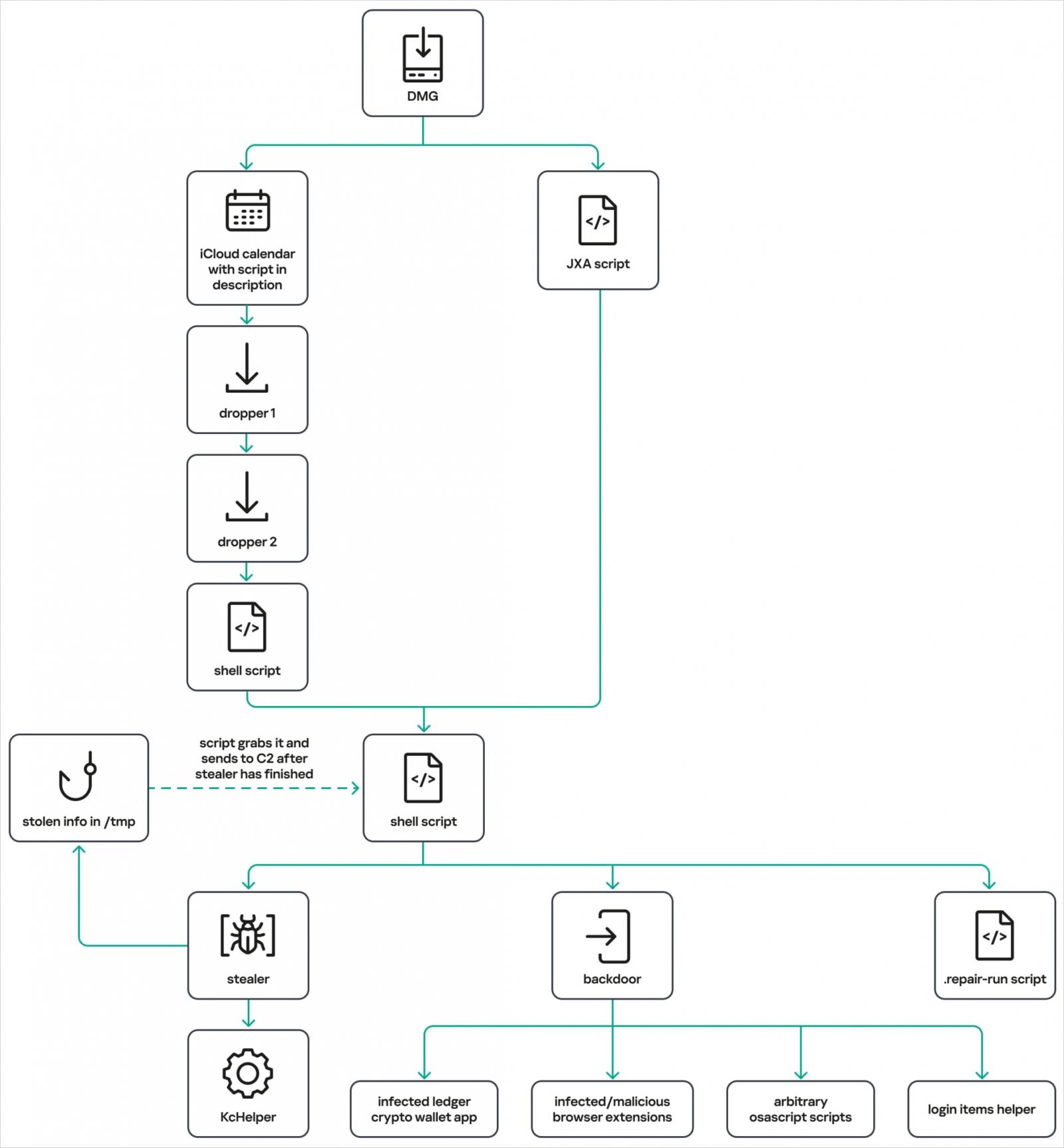
Compounding the threat is a newly observed Objective-C backdoor module. Disguising itself as Finder—the fundamental file manager interface of macOS—this backdoor is designed to maintain persistent unauthorized access. Upon installation, the backdoor establishes persistence mechanisms by configuring a LaunchAgent, modifying local .zshrc profile files, and injecting global Git hooks. To ensure the user remains oblivious to the compromise during these automated operations, the backdoor actively terminates legitimate macOS notification processes, effectively silencing system alerts and preventing warning banners from appearing on the desktop.
Capabilities and Mystery Components of the Backdoor Module
While security researchers were unable to fully analyze the specific AppleScript payloads executed by the backdoor due to obfuscation and missing script components, they were able to infer the intended functions of various commands based on their internal naming conventions and status messages. The backdoor is equipped to execute remote management commands, manipulate file systems, and execute arbitrary scripts supplied by the command-and-control (C2) infrastructure.
Of particular note to analysts is a mysterious command identified in the backdoor’s codebase designated as live_browser. When invoked, this command downloads and executes an auxiliary component known as sn_relay. As of the latest Kaspersky reports, the precise functional objective of sn_relay remains undetermined, leaving researchers to monitor its behavior closely for signs of secondary payloads, lateral movement tools, or proxy capabilities. The inclusion of such obscure components underscores the fluid nature of the MacSync project and suggests that the threat actors are actively testing new functional modules in the wild.
Industry Implications and the Broader Threat to macOS
The weaponization of public iCloud calendars and the integration of sophisticated backdoors into MacSync highlight a broader, concerning trend within the threat landscape: the continuous expansion of malware targeting Apple’s macOS ecosystem. Historically, macOS users enjoyed a degree of immunity from widespread cybercrime due to the platform’s stringent security controls, sandboxing, and market share dynamics. However, as enterprise adoption of Macs grows and cryptocurrency wealth becomes increasingly centralized on desktop environments, cybercriminals have invested heavily in bypassing macOS-specific security barriers.
Security analysts emphasize that techniques abusing cloud services—such as leveraging public calendar events for command and control—blur the lines between legitimate administrative traffic and malicious activity. Because connections to Apple’s iCloud domains are universally trusted by corporate firewalls and endpoint security solutions, they rarely trigger traditional network-level alerts. This makes cloud-abusing malware exceptionally difficult to detect using legacy signature-based defenses, placing a heavier burden on behavioral monitoring and proactive user awareness.
Defensive Recommendations and Best Practices for macOS Users
In light of the evolving capabilities demonstrated by the MacSync malware family, cybersecurity professionals and incident responders strongly urge users to adopt rigorous defensive habits. Chief among these recommendations is avoiding the execution of raw terminal commands found in online forums, social media posts, or unexpected pop-up windows—a primary vector exploited by ClickFix campaigns.
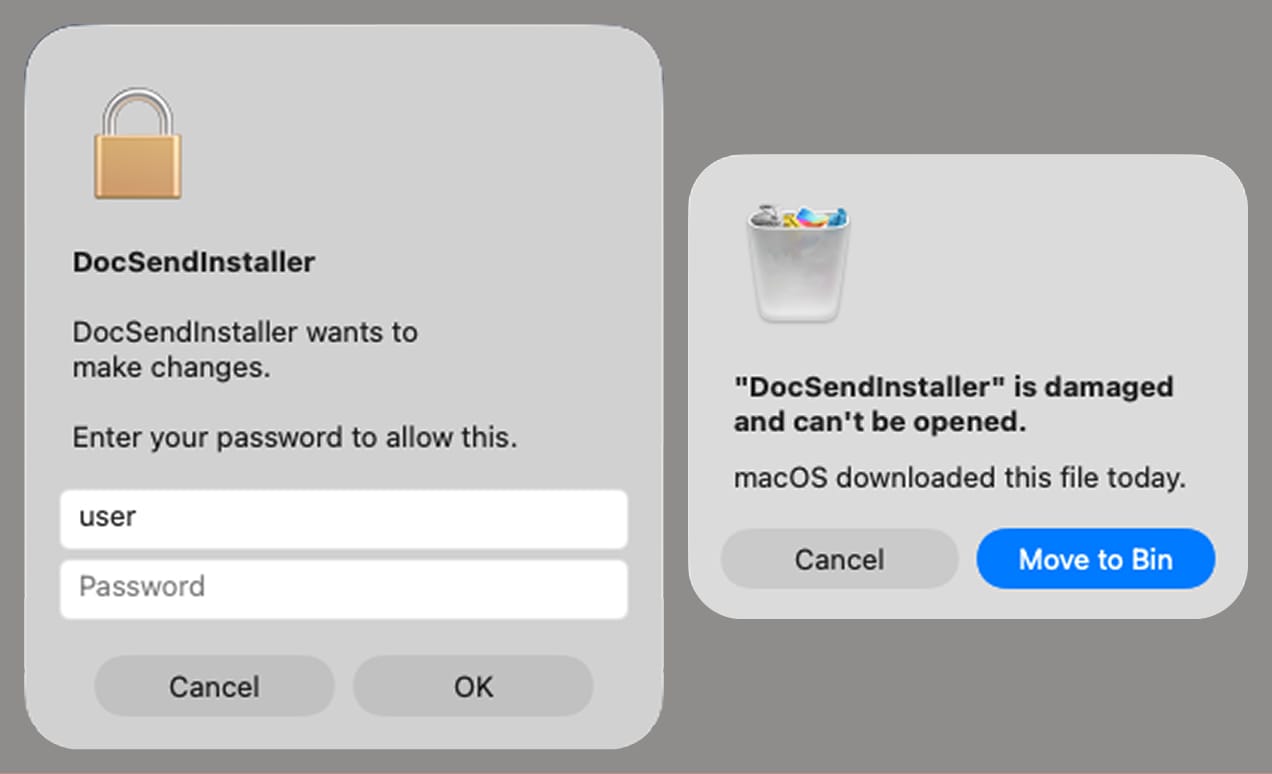
Furthermore, users should exercise extreme caution when downloading disk image (.DMG) files, installers, or software updates from untrusted third-party websites, peer-to-peer networks, or unsolicited social media advertisements. Whenever an application requests administrative password prompts or terminal execution rights, users should independently verify the authenticity of the software vendor. Organizations managing fleets of macOS endpoints are encouraged to deploy modern endpoint detection and response (EDR) solutions capable of monitoring shell behavior, unauthorized modifications to shell configuration files, and abnormal launch agent installations to catch multi-stage threats like MacSync before critical data can be exfiltrated.