
Cryptocurrency hardware wallet manufacturer Trezor has officially confirmed that at least three of its Safe 5 devices, distributed through the Southeast Asian third-party reseller CryptoBilis, contained unauthorized, malicious hardware implants. These rogue components were specifically engineered to intercept sensitive user credentials—namely wallet recovery phrases and passphrases—and clandestinely exfiltrate them to attacker-controlled command-and-control servers utilizing cellular networks.
The confirmation follows a rigorous laboratory investigation into a suspected supply-chain compromise first flagged in October. At that time, an alert customer in Indonesia discovered a foreign circuit board nested inside a newly purchased Trezor Safe 5. While the initial report raised immediate alarms across the cybersecurity and cryptocurrency communities, Trezor’s engineering teams had not yet taken physical possession of the device, leaving the true mechanics and capabilities of the implant speculative. Now, having analyzed the original hardware alongside photographic evidence submitted by other vigilant consumers, the firm has validated the threat vector and taken aggressive countermeasures to stem the fallout.
Anatomy of a Supply-Chain Interception
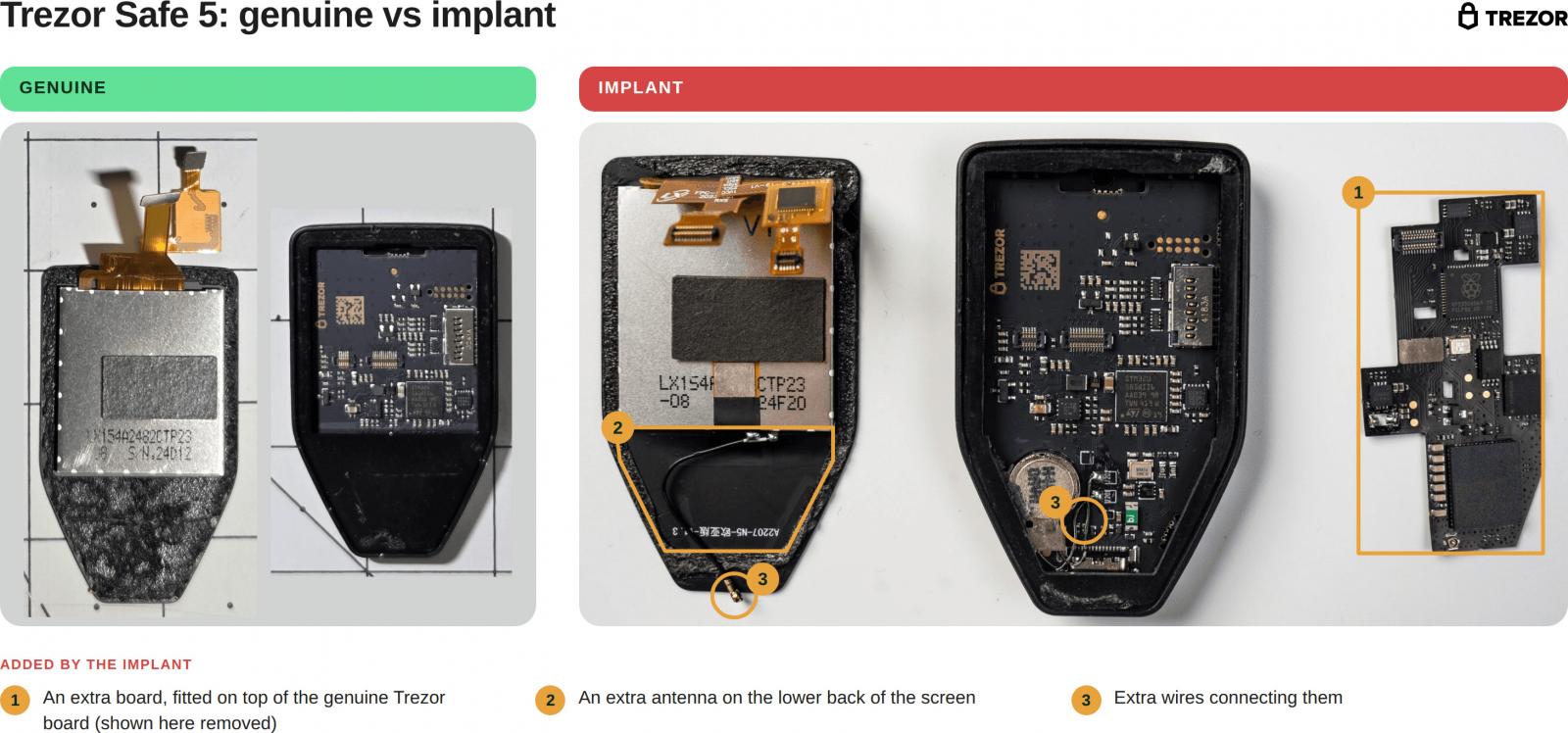
According to Trezor’s technical disclosures, the malicious hardware implant is a masterclass in covert physical tampering. The intrusion mechanism relies on an auxiliary, unauthorized micro-circuit board purposefully wedged between the Safe 5’s primary motherboard and its digital display panel. This physical positioning allows the rogue hardware to passively monitor and record visual data rendering on the screen without altering or disrupting the device’s legitimate, secure factory firmware or its underlying Secure Element chip.
Whenever a user initiates the process of generating a brand-new wallet backup or restoring an existing crypto asset portfolio, the mandatory recovery words—often referred to as seed phrases—flash across the hardware wallet’s display. The malicious implant intercepts this visual output in real time. In addition to recovery seed phrases, the hardware can capture user-defined passphrases entered or shown during setup.
Once captured, the hardware encrypts the sensitive strings of data and prepares them for wireless transmission. The implant features an integrated cellular communication module, enabling it to bypass local network monitoring and dispatch the stolen recovery phrases directly over a mobile network to an external server operated by the malicious actors. To ensure data loss does not occur in areas with poor cellular reception, the implant is programmed with persistent retry logic: if a connection cannot be immediately established, the device stores the intercepted data locally in temporary memory, periodically attempting to transmit it until a successful handshake is made.
Despite the sophistication of the hardware modifications, Trezor has confirmed that all three verified implants were exclusively isolated to Safe 5 hardware units sold through CryptoBilis between August 20 and September 23. Furthermore, extensive audits of other regional distributors yielded zero evidence of similar tampering. Most crucially, as of this reporting, no affected customers have reported actual financial losses or unauthorized asset drainage from their wallets.
Chronology of the Investigation and Early Warnings
The timeline of discovery highlights the persistent and evolving nature of hardware supply-chain attacks targeting cryptocurrency investors. The chronology of events unfolds as follows:
- August 20 – September 23: The specific batch of compromised Trezor Safe 5 devices is sold to consumers via the Indonesian-based reseller CryptoBilis.
- Early October: A customer publicly exposes the presence of an unauthorized internal circuit board inside a newly acquired Trezor Safe 5, prompting public warnings from Trezor regarding suspected hardware tampering. Around this same period, separate reports emerge concerning compromised Ledger hardware wallets also traced back to CryptoBilis distribution channels, pointing to a broader campaign targeting Southeast Asian supply chains.
- November 11: Trezor officially releases firmware version 2.13.1, incorporating advanced defensive code designed to neutralize the operational capabilities of the discovered hardware implants.
- Mid-November: Following laboratory examinations of the original device and visual verification of two additional compromised units submitted via customer photographs, Trezor formally confirms the existence of the cellular implants. In response to the widening security crisis, the company enacts an 80% reduction in its global third-party reseller network.
Firmware Defenses and Immediate User Guidance
In response to the physical tampering discovered in the supply chain, Trezor rushed out a software patch designed to neutralize the threat at the operational level. On November 11, the company deployed firmware version 2.13.1.
Engineers designed this update to alter how the hardware handles display rendering and internal logic checks, successfully blocking the implanted circuit boards from capturing sensitive data shown on the screen. Trezor representatives noted that running this updated firmware renders the current generation of discovered hardware implants entirely inert, as they are starved of the data streams they were built to siphon.

However, company executives have issued stern warnings regarding the limitations of software patches against hardware-level compromises. While the update prevents future capture attempts, it offers zero remediation for recovery phrases that may have already been successfully exfiltrated prior to the firmware installation.
Consequently, Trezor has urged all customers who purchased their hardware wallets through CryptoBilis—regardless of whether their specific unit has been laboratory-confirmed as compromised—to exercise extreme caution. Users are strongly advised to immediately migrate their digital assets to an entirely new, uncompromised wallet generated with a fresh recovery seed phrase. To alleviate the financial and logistical burden on its customer base, Trezor has extended an offer to provide complimentary replacement hardware devices to anyone who purchased a wallet through CryptoBilis dating back to March.
Drastic Overhaul of the Global Reseller Network
The discovery of cellular implants in Trezor hardware—hot on the heels of similar supply-chain attacks plaguing rival manufacturer Ledger through the exact same reseller—has forced a monumental paradigm shift in how hardware wallet companies manage third-party distribution.
Recognizing that localized retail channels represent a glaring vulnerability in the hardware security lifecycle, Trezor has executed a sweeping restructuring of its commercial operations. The company has permanently slashed its global reseller network by approximately 80%, drastically trimming the roster of third-party vendors authorized to sell its products.
Trezor clarified that the vast majority of the wholesale partners removed during this purge were trustworthy, reputable businesses that posed no malicious threat to consumers. Nevertheless, they were cut from the distribution chain because they failed to meet the radically elevated, enterprise-grade supply-chain security requirements being implemented in the wake of the CryptoBilis incident.
Going forward, the surviving minority of authorized retail partners will be subjected to rigorous oversight, adhering to stringent, end-to-end controls that dictate how physical hardware units are manufactured, securely transported, warehoused, and accessed prior to reaching the end consumer.
Broader Implications for Cryptocurrency Hardware Security
The incidents involving CryptoBilis underscore a sobering reality for the cryptocurrency ecosystem: physical hardware wallets, long considered the gold standard for self-custody and digital asset security, are not entirely immune to sophisticated supply-chain interdiction.
While cryptographic software and secure elements protect users against remote malware, phishing, and network-based exploits, they have traditionally relied on the assumption that the physical shell of the device remains untouched between the factory floor and the buyer’s hands. The deployment of micro-circuitry equipped with cellular transmission capabilities proves that well-funded adversaries are willing to invest heavily in physical supply-chain interdiction, intercepting shipments at regional hubs to install bespoke surveillance hardware.
For the broader hardware wallet industry, the episode serves as a watershed moment. Manufacturers are now forced to reevaluate the security of their global logistics and distribution networks, shifting away from decentralized, far-flung third-party retail models in favor of direct-to-consumer shipping or tightly controlled, auditable fulfillment centers.
As hardware manufacturers tighten their grip on supply chains, consumers are simultaneously reminded of the foundational tenet of cryptocurrency self-custody: eternal vigilance. Even the most secure hardware must be treated with suspicion if sourced through unverified intermediaries, reinforcing the necessity of purchasing security-critical devices exclusively from official, manufacturer-verified channels.

