
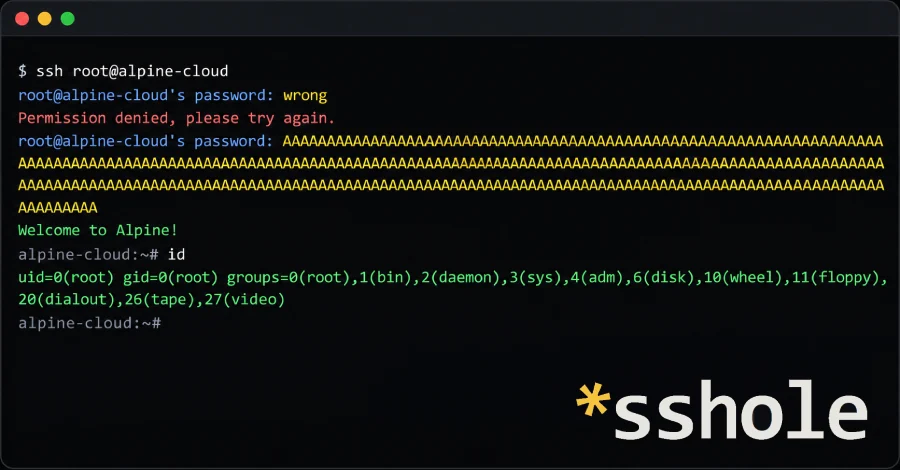
A critical security vulnerability has been identified within the OpenSSH server (sshd) implementation on Alpine Linux, allowing unauthorized attackers to bypass authentication and gain access to systems that utilize key-based authentication or lack defined passwords. The flaw, which has been assigned a critical severity rating by the OpenSSH project, stems from an interaction between the OpenSSH daemon and the musl C library, the standard library used by Alpine Linux. Security researchers have warned that this vulnerability could enable remote attackers to gain unauthorized access to servers, provided they possess network connectivity to the target, a valid username, and a crafted password string between 257 and 1,024 bytes in length.
Technical Genesis and Vulnerability Mechanics
The vulnerability arises due to the specific way the musl C library handles password hashing during authentication requests. Unlike many standard Linux distributions that rely on glibc and the Pluggable Authentication Module (PAM) interface for security, Alpine Linux utilizes musl. When the OpenSSH daemon (sshd) processes a login attempt, it compares the provided password hash against the stored hash in the system’s shadow file.
In configurations where password authentication is enabled, the system attempts to authenticate users. If an account has no password set—represented by an asterisk (*) in the shadow file—the system lacks the necessary salt to verify the password. In such instances, the daemon inadvertently borrows the salt from another account on the same machine that does have a password.
The flaw is triggered when an attacker provides an unusually long password. The musl implementation of the crypt() function returns an unmatchable hash rather than a NULL value when a password exceeds 256 characters. Because this returned value can coincide with the stored asterisk in the shadow file, the OpenSSH daemon incorrectly validates the login attempt. This logic error allows attackers to successfully bypass the authentication layer entirely, provided they have identified a target account name and have access to at least one other account on the machine that possesses a standard password hash.
Chronology of the Discovery and Disclosure
The discovery of this vulnerability highlights the growing speed at which security researchers and project maintainers must operate in the era of automated threat intelligence. The vulnerability was brought to light by security researcher Özgün Kültekin, who documented the flaw in a comprehensive technical analysis. Following the disclosure, the OpenSSH project team moved with unprecedented speed to develop and release a patch.
Damien Miller, a lead developer on the OpenSSH project, noted that the team intentionally bypassed long-term embargoes typically associated with vulnerability disclosures. This decision was driven by the observation that AI-driven exploit generation tools are increasingly capable of discovering and weaponizing vulnerabilities within hours of their initial identification. By releasing the patch immediately, the OpenSSH maintainers aimed to mitigate the window of opportunity for malicious actors.

The OpenSSH project released version 10.6p2 on November 5, 2026, specifically to address the flaw. Simultaneously, the Alpine Linux security team released updated packages for all supported branches, including legacy versions back to 3.16, to ensure that users across various environments could remediate the risk immediately.
Scope of Exposure and Affected Environments
The vulnerability is highly specific to systems that satisfy four distinct criteria: the use of the musl C library, the use of OpenSSH without PAM, the presence of enabled password authentication, and the existence of at least one user account on the system with a valid password hash.
While the primary focus of the advisory is on Alpine Linux, the nature of the flaw implies that other musl-based distributions, such as OpenWrt, Buildroot, and Yocto, may warrant investigation. However, in the case of OpenWrt, the default usage of the Dropbear SSH server—which is not affected by this specific logic error—provides a layer of inherent protection. The risk in these environments is largely confined to instances where a system administrator has manually installed and configured the OpenSSH server.
Cloud-native environments are particularly sensitive to this disclosure. Specifically, "tiny-cloud" images for Alpine Linux versions 3.18.11 through 3.24.3 were identified as having a configuration where the alpine user is granted passwordless doas privileges. While these systems are secure upon their initial boot, they become vulnerable as soon as a user sets a console password, as the creation of a password hash provides the necessary "salt" for an attacker to exploit the bypass. Once access is gained as the alpine user, the attacker can leverage the passwordless doas capability to escalate their privileges to root, effectively compromising the entire machine.
Mitigation and Remediation Strategies
Security administrators are urged to verify their systems immediately. The primary fix is to update the openssh-server package to the latest version provided by the Alpine Linux repositories. It is critical to note that updating the package does not automatically restart the running sshd process; therefore, a manual restart of the service is required to finalize the remediation.
For environments where an immediate patch deployment is not feasible, the OpenSSH project and the Alpine Linux team recommend disabling password authentication as a temporary workaround. This can be achieved by setting PasswordAuthentication no in the SSH server configuration file. Administrators should ensure that key-based authentication is functioning correctly before making this change to avoid locking themselves out of their own servers.
The recommended steps for mitigation are as follows:

- Update the
openssh-serverpackage using the distribution’s package manager. - Restart the
sshdservice to ensure the new binary is loaded into memory. - Verify the configuration by running
sshd -T | grep -i passwordauthenticationto confirm that the value is set tono. - Audit system logs, specifically
/var/log/messages, to look for unauthorized "Accepted password for" entries associated with accounts that should not have password access.
Broader Implications for Linux Security
The emergence of this vulnerability serves as a stark reminder of the complexities inherent in cross-component dependencies. The flaw is not a direct defect in the OpenSSH codebase itself, but rather an emergent behavior caused by the interaction between the OpenSSH daemon’s logic and the underlying C library’s handling of password hashing.
Historically, such "inter-dependency" bugs have been notoriously difficult to track, as they often fall into the cracks between individual project maintainers. The fact that this specific issue has roots dating back to a 2012 change in the musl library and a 2016 modification in OpenSSH demonstrates that technical debt and architectural decisions made years prior can have significant security repercussions in modern production environments.
Furthermore, the incident underscores the shifting landscape of threat modeling. As AI-powered tools become more adept at auditing codebases, the traditional "responsible disclosure" window—often lasting weeks or months—is rapidly shrinking. The decision by the OpenSSH team to prioritize speed over a standard disclosure process reflects a broader trend in cybersecurity where the speed of defense must be commensurate with the speed of automated discovery.
For organizations running Alpine Linux, the implication is clear: rigorous configuration management and a proactive approach to vulnerability patching are no longer optional. Systems that were previously deemed "hardened" by virtue of their minimal, container-oriented design are still subject to the fundamental logic of their system libraries. Administrators are advised to review their entire fleet of Alpine-based servers, particularly those in cloud environments where default images may include configurations that inadvertently satisfy the conditions for this bypass.
While no active exploitation of this vulnerability has been reported at the time of writing, the availability of the technical details means that the clock is ticking for administrators. The relative ease of the exploit—requiring only network access and a long password string—makes it an attractive target for automated botnets and opportunistic attackers. Security teams should prioritize this remediation in their current maintenance cycles to ensure the integrity of their infrastructure.

