

The open-source community surrounding Alpine Linux faced a major security crisis when malicious actors attempted to exploit a maximum-severity remote code execution vulnerability within the project’s core development infrastructure. The incident, which unfolded over a critical 48-hour window on October 20 and 21, forced project maintainers to take the drastic measure of completely wiping and rebuilding their primary GitLab instance from scratch. Furthermore, administrators ordered a mandatory password reset for all users to mitigate potential credential exposure.
The attack vector at the center of the breach attempt was CVE-2026-97229, a severe security flaw residing in GitLab. While extensive forensic investigations launched by the Alpine Linux team uncovered no definitive evidence that the attackers successfully executed arbitrary code or tampered with official software releases, missing log files and a lack of reliable outbound connection records made it impossible to rule out a complete compromise entirely. Faced with this uncertainty, project maintainers chose the path of maximum security, prioritizing the integrity of their downstream users over convenience.
Understanding the Vulnerability: CVE-2026-97229
To comprehend the scale of the threat facing Alpine Linux, one must examine the nature of CVE-2026-97229. Rated as a maximum-severity flaw, the vulnerability originates as an integer overflow within Onigmo, the regular expression compiler bundled into the Ruby programming language utilized by GitLab. Because GitLab integrates this engine deeply into its continuous integration and continuous deployment (CI/CD) pipelines, unauthenticated attackers can trigger the flaw under specific conditions. By submitting a carefully crafted, malicious regular expression via a CI/CD pipeline configuration file, an external actor can potentially achieve remote code execution on the underlying host server.
GitLab first disclosed this critical vulnerability and published official patches on October 12, warning system administrators globally about the urgency of updating their instances. However, complex enterprise software deployments often introduce deployment nuances that complicate patching cycles. In the case of Alpine Linux, the gap between vulnerability disclosure and remediation exposed a fatal configuration oversight.
The Path to Exposure: Configuration and Patching Complications

Alpine Linux initially deployed GitLab version 19.3.4, missing the newly released patched version, 19.3.5. When maintainers subsequently updated the server to version 19.3.6, the patch still failed to neutralize the threat. The complexity of CVE-2026-97229 meant that fixing the GitLab application code was insufficient; the underlying Ruby interpreter itself required a patch.
While official GitLab enterprise packages bundle the correct patched version of Ruby, Alpine Linux utilized a custom container image configuration. This custom deployment inadvertently failed to pull in the necessary Ruby updates. Consequently, the server remained vulnerable even after administrators believed they had completed the upgrade process.
Attack Chronology and Exploitation Attempts
The attackers wasted no time identifying and probing this lingering vulnerability. On October 20 and 21, automated scripts and manual interventions targeted the Alpine Linux GitLab server by submitting malicious CI configurations designed to trigger CVE-2026-97229.
According to incident reports, these malicious payloads caused eight distinct GitLab worker process crashes. Forensic analysis later revealed that at least four of these attempts were partially successful in destabilizing the environment, bringing the attackers dangerously close to achieving full remote code execution. During the peak of the intrusion attempts, telemetry data indicated that the attackers went so far as to download the project’s GitLab container image. Security analysts interpret this action as a clear indicator that the perpetrators were actively laying the groundwork for a sophisticated software supply chain attack.
The Aftermath and Forensic Findings
Following the alarming spikes in server instability, the Alpine Linux security team initiated a comprehensive forensic audit. They sought to determine whether the intruders managed to leverage their partial process crashes into persistent access, data exfiltration, or repository tampering.

Fortunately, investigations into the project’s core repositories, software packages, and official releases up to October 27 revealed no signs of tampering. Crucially, the project’s cryptographic signing keys—the digital certificates used to verify the authenticity of Alpine Linux packages—remained completely secure because they were stored entirely offline, isolated from the compromised GitLab server environment.
Despite these reassuring findings, the complete absence of certain critical system logs and outbound network telemetry prevented the team from achieving 100% certainty. Because the technical evidence required to definitively rule out code execution had been wiped out or overwritten during the crash loops, the project opted for a scorched-earth remediation strategy.
Broader Impact on Alpine Linux and the Software Supply Chain
Alpine Linux holds a uniquely critical position in the global software ecosystem. As an exceptionally small, lightweight, and security-oriented Linux distribution, it serves as the foundational base image for millions of Docker containers deployed across cloud environments worldwide.
The project’s GitLab instance is the beating heart of its development ecosystem. It hosts essential development repositories, comprehensive code review discussions, and vital CI jobs—including the aports build recipes utilized to compile and produce every single software package distributed by Alpine Linux. Because downstream developers, enterprises, and cloud-native applications rely heavily on these packages, any successful compromise of the aports build system would have triggered a catastrophic global supply chain cascade, injecting malicious code into countless corporate infrastructures and microservices.
Had the exploitation attempt succeeded completely, the attackers would have gained access to a trove of sensitive data. Potentially exposed assets included user account details, salted password hashes, multi-factor authentication (2FA) secrets, CI/CD pipeline environment variables, third-party integration credentials, and private project repositories. While Alpine Linux maintains that there is no active confirmation of data exfiltration, the theoretical exposure radius was immense.
Official Response, Mitigation, and Remediation Steps
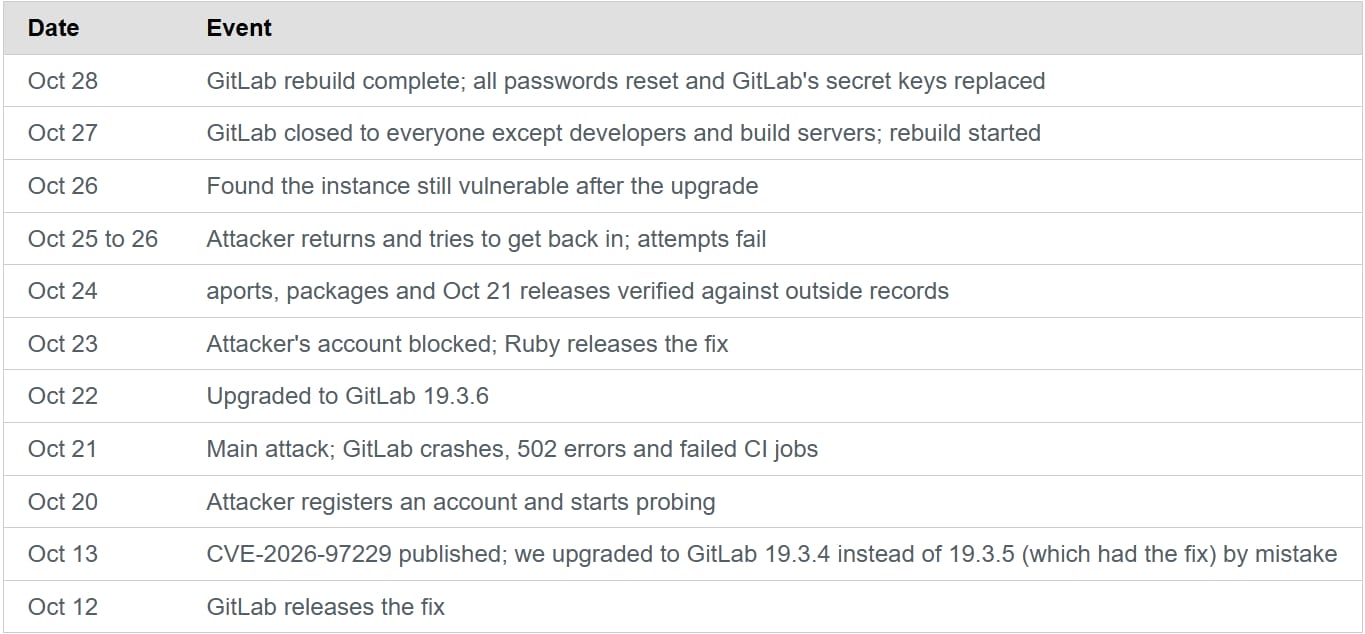
In response to the near-miss incident, the Alpine Linux development team acted decisively. Beyond rebuilding the GitLab instance from the ground up, they implemented mandatory password resets for all registered users to neutralize any potential risks arising from exposed password hashes or stolen session tokens.
Furthermore, the project published an updated and secure container image, alpinelinux/gitlab:19.3.6, on October 27. This newly rebuilt image properly integrates Ruby version 3.3.13, definitively closing the door on CVE-2026-97229. Administrators operating self-hosted instances connected to the project have been strongly advised to verify their environments, pull the updated container images, and immediately rotate all administrative and service credentials.
Implications for Open-Source Security and Supply Chain Defense
The near-compromise of Alpine Linux serves as a stark reminder of the persistent and sophisticated threats targeting open-source maintainers and software supply chains. Modern development pipelines rely on complex chains of dependencies, ranging from application-level frameworks like GitLab down to underlying interpreters such as Ruby and compiler engines like Onigmo.
Security analysts note that vulnerabilities residing deep within third-party components frequently catch organizations off guard, particularly when standard application updates fail to encompass deep-seated runtime environments. As threat actors increasingly professionalize their operations to target software build systems, open-source projects face unprecedented pressure to maintain flawless visibility, exhaustive logging, and rapid, end-to-end patching protocols.
The swift and transparent response by Alpine Linux highlights both the fragility of modern software infrastructure and the resilience of open-source communities. By choosing total transparency and radical remediation over hidden uncertainty, the project has averted what could have easily blossomed into one of the most severe supply chain security incidents of the decade.
