
The rapid integration of Large Language Models (LLMs) into enterprise workflows has created a significant divide between casual users and technical practitioners. While much of the public discourse centers on "prompt engineering"—the act of constructing prompts from scratch—a growing body of evidence suggests that the true bottleneck for production-grade AI is "prompt optimization." This process involves the methodical refinement of existing prompts to increase reliability, accuracy, and parseability. Unlike the blank-page approach, optimization focuses on iterative, data-driven adjustments that transform conversational AI into a consistent engine for business operations.
The Challenge of Ambiguity in LLM Processing
To understand the necessity of optimization, one must examine the limitations of LLMs when processing unstructured data. Consider a standard meeting transcript involving three team members—Priya, Tom, and Jake—discussing a checkout redesign, billing service migration, and support ticket management. The transcript is intentionally messy: assignments are shifted, tasks are consolidated, and one critical action item is left without a clear owner.
In a baseline test, a standard prompt requesting a list of action items frequently fails. The model may incorrectly attribute the mobile review to Priya (the first person mentioned), ignore the tablet-breakpoint update, or fabricate an owner for the support-queue triage. These errors represent a failure of logic, not just language. In a corporate environment, these "plausible-sounding" errors are far more dangerous than obvious hallucinations, as they can lead to missed deadlines and failed service level agreements (SLAs).
Strategy 1: The Mandate for Structured Output
The most immediate hurdle in professional LLM deployment is the transition from prose to machine-readable formats. Relying on an LLM to generate natural language lists is a common point of failure for downstream automated systems. When a model produces prose, it lacks the rigid syntax required for programmatic ingestion.
Industry standard practices now favor the use of schema-based validation. By employing frameworks like Pydantic, developers can enforce a strict structure on LLM output. If the model returns text that fails to conform to the predefined JSON schema, the system can trigger an automated rejection rather than attempting to parse faulty data. Research indicates that enforcing structured output via schema validation reduces integration errors by nearly 90% in high-volume environments, as it eliminates the variability inherent in natural language responses.
Strategy 2: Contextual Role-Play and Persona Assignment
Models operate within a latent space of probability; assigning a persona acts as a functional filter, narrowing the model’s focus to specific training data subsets. A generic instruction to "extract action items" is significantly less effective than instructing the model to act as a "meticulous executive assistant familiar with the nuance of mid-sentence reassignment."
This technique, known as persona prompting, primes the model to adopt a more critical analytical posture. By explicitly defining the persona’s experience level and professional expectations, the prompt alerts the model to look for potential "traps"—such as a change in task ownership or the presence of unresolved items. This does not change the model’s core parameters, but it significantly adjusts its internal weightings to prioritize accuracy and context-awareness over conversational fluency.
Strategy 3: Dynamic Few-Shot Demonstration Selection
The impact of "few-shot" prompting—providing the model with examples of desired input-output pairs—is well-documented, yet its implementation is often flawed. Most users select examples based on availability or personal preference. However, data-driven optimization suggests that the diversity of examples is more important than the quantity.
Using algorithms such as TF-IDF (Term Frequency-Inverse Document Frequency) or cosine similarity, developers can identify which examples are mathematically distinct. A set of three examples where each one demonstrates a different edge case (e.g., an reassignment, a merged task, and an unresolved item) is exponentially more effective than three variations of a simple task. By ensuring that the few-shot demonstrations cover a broad spectrum of potential failure modes, the model learns the boundaries of the task rather than just mimicking a single, simple pattern.
Strategy 4: Chain-of-Thought and The Logic of Reasoning
Chain-of-thought (CoT) prompting requires the model to articulate its reasoning steps before providing a final answer. While modern frontier models have improved their internal reasoning capabilities, explicitly requesting a step-by-step trace remains vital for complex scenarios.
For example, when a prompt includes a requirement to "trace the history of each task owner before concluding," the model is forced to hold the entire transcript in its attention window. This prevents it from latching onto the first mention of an owner. For cost-conscious organizations, the "Chain of Draft" variant offers a middle ground, where the model provides abbreviated reasoning (roughly five words per step). This approach has been shown in recent studies to maintain high accuracy while reducing the token count—and therefore the inference cost—by over 90%.
Strategy 5: Automated, Iterative Optimization
The pinnacle of prompt engineering is moving away from manual "tinkering" toward automated, objective-based search. By creating a suite of test cases with a defined ground truth, developers can use hill-climbing algorithms to systematically test different prompt variations.
In this process, a "composite score" is calculated for each variation. This score penalizes the model for hallucinations and rewards it for correct ownership, recall of items, and structural compliance. Through this method, a system can automatically identify the minimum set of instructions required to achieve perfect performance. Often, this reveals that the "perfect" prompt is significantly shorter and more focused than a manually crafted one, as it eliminates redundant instructions that might conflict with one another.
Implications for Enterprise AI Integration
The transition from "prompting" to "prompt optimization" signifies the maturation of AI as an industrial tool. Organizations that continue to treat prompt construction as an intuitive, artistic endeavor will likely struggle with the "last-mile" reliability issues that plague production systems.
The implications for business are clear:
- Reliability: By enforcing structured output and automated validation, companies can integrate LLMs into legacy pipelines without risking data corruption.
- Efficiency: Through techniques like Chain of Draft and targeted few-shot selection, organizations can reduce the computational overhead of AI tasks.
- Accountability: The use of ground-truth testing allows for a formal audit trail, ensuring that the model’s behavior is consistent and verifiable.
The Future of AI Prompting
As AI models become more sophisticated, the role of the human engineer will shift from providing raw input to managing the optimization lifecycle. The goal is no longer to "trick" the model into the right answer but to provide a framework where the model is mathematically constrained to deliver high-quality, actionable output.
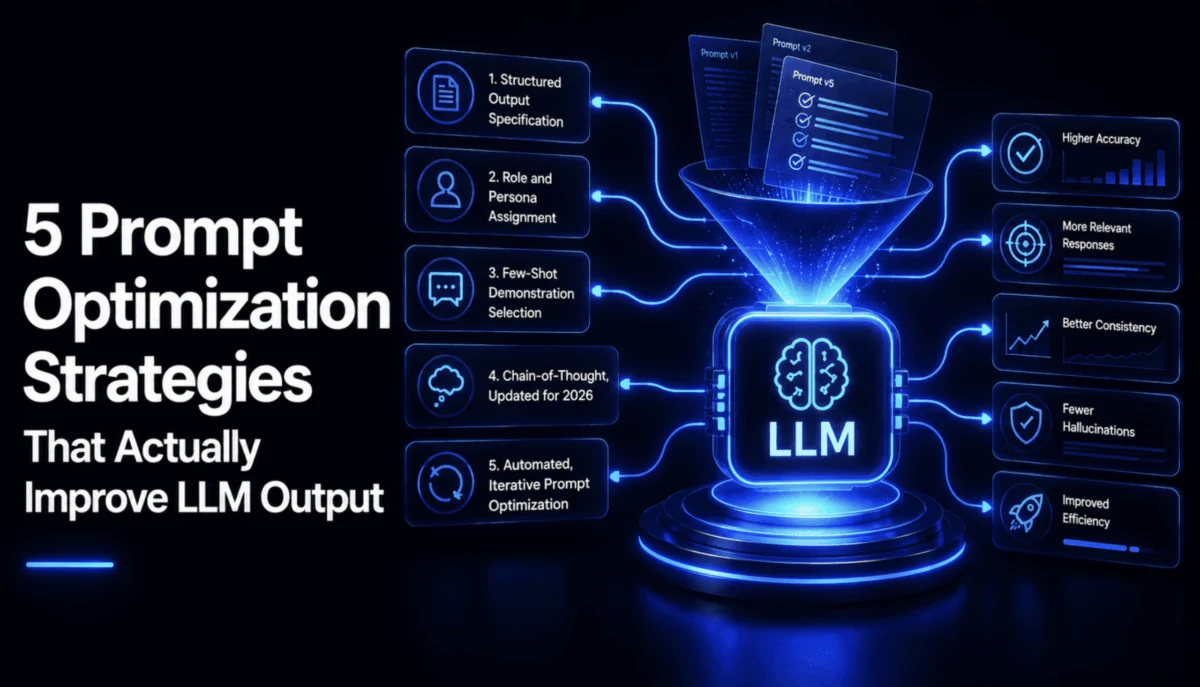
The five strategies discussed—structured output, persona assignment, diverse few-shot demonstrations, chain-of-thought reasoning, and iterative optimization—represent the core pillars of a professional prompt engineering framework. By adopting these strategies, developers and business leaders can move beyond the "black box" phase of AI adoption and into a new era of predictable, scalable, and highly reliable artificial intelligence. The success of this transition will depend on the willingness of practitioners to embrace data-driven rigor, replacing subjective guesswork with verifiable, performance-based benchmarks. As the technology continues to evolve, the ability to iterate quickly and measure performance accurately will remain the primary competitive advantage for any organization leveraging Large Language Models.

