
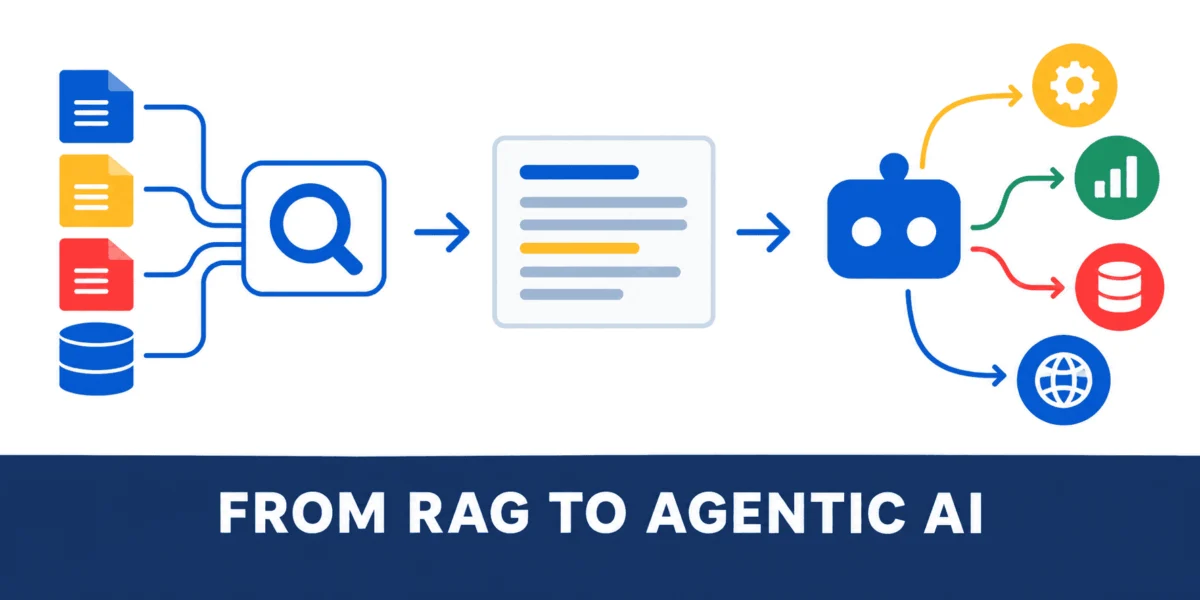
Retrieval-Augmented Generation (RAG) has served as the foundational architecture for the current wave of enterprise artificial intelligence, providing a mechanism to ground large language models (LLMs) in verified, proprietary documentation. However, as organizations move beyond initial proofs of concept, the limitations of "vanilla" RAG—characterized by simple vector similarity searches—have become increasingly apparent. Enterprises are now transitioning toward more sophisticated agentic frameworks, moving from static information retrieval to dynamic, reasoning-based systems.
The Technical Evolution of Enterprise Search
The adoption of RAG in 2022 and 2023 marked a paradigm shift in how corporations handled internal data. By bypassing the need for expensive and slow model fine-tuning, RAG allowed businesses to query massive repositories of unstructured data. Yet, industry data suggests that nearly 60% of enterprise RAG implementations face significant hurdles regarding accuracy, latency, and the inability to handle multi-step reasoning.
The primary failure point of first-generation RAG is its reliance on "semantic proximity." When an employee queries a system regarding internal policy differences, a standard vector search often struggles with domain-specific acronyms and synonym variations. Furthermore, these systems frequently fail to express uncertainty, leading to high-confidence "hallucinations" that can undermine user trust. These challenges have necessitated a shift toward a three-generation evolutionary model of enterprise AI development.
Generation One: The Hybrid Retrieval Standard
The first major pivot in production-grade AI was the departure from single-method retrieval. Recognizing that vector embeddings often sacrifice precision for semantic breadth, engineers adopted hybrid retrieval architectures. This approach integrates dense vector search with sparse keyword-based retrieval, typically utilizing the BM25 algorithm.
The integration of these methods requires a sophisticated orchestration layer. Practitioners have found that "Rank Fusion"—specifically Reciprocal Rank Fusion (RRF)—is critical for normalizing results across disparate search technologies. By prioritizing documents that rank highly in both keyword and semantic searches, firms have managed to reduce retrieval failures by an estimated 25% to 30%.
Crucially, the engineering community has moved toward asynchronous execution in these pipelines. By running vector and keyword searches in parallel, latency is reduced by nearly 40% compared to sequential processing. This optimization is vital, as user engagement studies consistently show that response times exceeding two seconds lead to a precipitous drop in adoption within corporate environments.
Generation Two: The Integration of Knowledge Graphs
While hybrid retrieval improves the "where" of information gathering, it does not solve the "what." Standard RAG pipelines treat documents as fragmented islands, lacking an understanding of the underlying ontology or relationships between entities. The emergence of GraphRAG—which incorporates knowledge graphs into the retrieval process—addresses this by mapping entities and their relationships.
In current production environments, a key debate involves the methodology for entity extraction. While early tutorials suggested using LLMs to perform Named Entity Recognition (NER) on every document chunk, the industry has shifted back toward deterministic, rule-based extraction. This shift is driven by three factors:
- Cost Efficiency: LLM-based extraction is prohibitively expensive at scale.
- Deterministic Output: Regulatory and compliance requirements necessitate predictable, repeatable results that LLMs, due to their probabilistic nature, cannot guarantee.
- Latency: Rule-based matching operates in microseconds, compared to the hundreds of milliseconds required for LLM inference.
By tagging documents with structured entity metadata, organizations can now use graph-based signals to boost relevant results in the rank fusion phase, effectively ensuring that documents containing the correct entities are surfaced even if the terminology used in the text is non-standard.
Generation Three: The Rise of Agentic AI
The current frontier of enterprise AI is the shift from "retrieve-then-generate" pipelines to "agentic" systems. Unlike fixed pipelines, agentic architectures are designed to reason. They can decompose complex, multi-part inquiries into sub-tasks, evaluate their own intermediate results, and decide whether to consult a documentation database, an external API, or a structured SQL database.
Key architectural requirements for these systems include:
- Architectural Safety Boundaries: Effective enterprise AI systems treat security as a primary constraint rather than a secondary filter. Data loss prevention (DLP) protocols are integrated as the first step in the pipeline, ensuring that sensitive data is scrubbed or rejected before it reaches the reasoning layer.
- Conservative Confidence Scoring: To mitigate the risk of hallucination, advanced systems utilize multiplicative confidence scoring. Rather than averaging scores across different stages—which can mask failures—the system calculates the product of confidence across components. If any single stage (e.g., retrieval) has low confidence, the cumulative score drops significantly, triggering a "human-in-the-loop" fallback or a request for clarification.
- Self-Correction Mechanisms: Modern agents are equipped with "reflection" loops. If a system identifies a low-confidence response, it triggers a critique-and-replan cycle. This iterative process is bounded by strict constraints to prevent infinite loops, ensuring the system remains both functional and performant.
Implications for the Enterprise Landscape
The transition to agentic AI is not merely a technical upgrade; it is a fundamental shift in corporate strategy. As enterprises adopt frameworks like the Model Context Protocol (MCP), the focus is moving toward interoperability. The next stage of development, "multi-agent orchestration," will likely allow specialized agents from different business units to discover and leverage each other’s capabilities dynamically.
Analysis from industry experts, including researchers at major technology firms like Dell Technologies, highlights that the most successful implementations prioritize determinism over flexibility. By reserving expensive LLM calls for genuine generative reasoning and utilizing deterministic logic for routing, disambiguation, and safety, firms can build systems that are auditable and scalable.
Challenges and Future Outlook
Despite the progress, significant challenges remain. The primary constraint for most organizations is the maintenance of high-quality, structured knowledge bases. Furthermore, the push for human-in-the-loop oversight, while necessary for building trust, creates a friction point that engineers must balance against the demand for automation.
The consensus among industry practitioners is that the "Wild West" era of RAG is closing. We are entering an era of "architectural discipline," where the focus is on building systems that are, above all, reliable. For CIOs and technical leads, the mandate is clear: the winners of the next decade will not be those who simply deploy the largest models, but those who build the most robust, self-correcting, and safe reasoning architectures.
As these technologies mature, the integration of agentic workflows into existing enterprise software suites—from CRM to ERP—will become the new standard. Organizations that invest today in the underlying data infrastructure, entity mapping, and safety-first design principles will be uniquely positioned to capitalize on the agentic shift. RAG was the catalyst for enterprise AI adoption; agentic reasoning is the vehicle for its long-term, sustainable impact on the global economy.

