
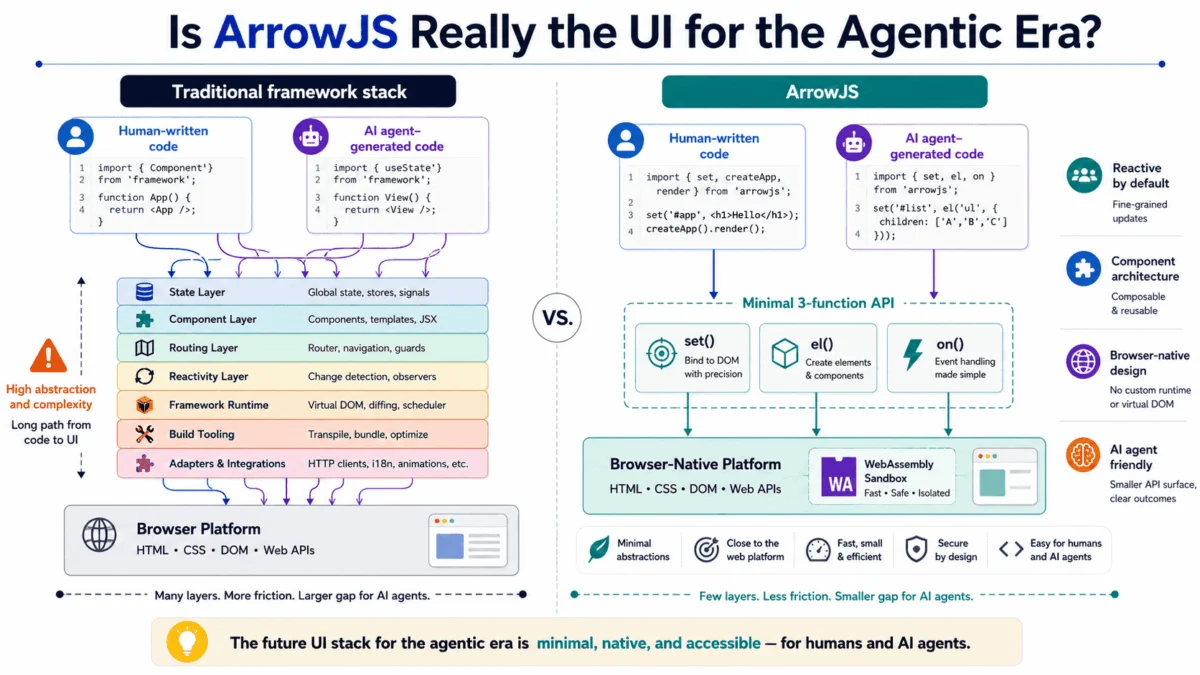
For the past decade, the JavaScript ecosystem has operated on a comfortable assumption: developers write the code, frameworks organize it, and browsers render it. React, Vue, Angular, and their vast ecosystems were all architected with a human at the keyboard in mind. This paradigm, however, is undergoing a profound transformation as AI coding agents—such as Anthropic’s Claude Code, GitHub Copilot, and Cursor—begin to generate significant portions of production-grade code. As these autonomous agents become integral to the software development lifecycle, a critical friction point has emerged: frameworks optimized for human cognitive patterns often prove difficult for AI models to navigate effectively.
The Breakdown of Human-Centric Abstractions
The core challenge lies in the nature of existing frameworks. React, currently the dominant library with over 39% market share among professional developers, relies on a complex set of conventions. Rules regarding hook execution order, the nuances of controlled versus uncontrolled components, and the necessity of JSX compilation create a high barrier for AI agents. While human developers internalize these patterns through practice, AI models rely on statistical probability. When a framework’s abstractions are dense, an agent’s tendency to produce "plausible-looking but broken" code increases, leading to hallucinations in syntax or misapplications of architectural rules.
Vue.js and Svelte, while offering distinct advantages in readability and performance respectively, present similar hurdles. Vue’s reactivity system, while elegant, introduces a framework-specific layer between intent and execution. Svelte, which achieves superior performance by compiling components into vanilla JavaScript, requires agents to master a unique, compiler-dependent syntax. In each instance, the abstraction layer—while beneficial for human productivity—becomes a source of "noise" for an agent operating on large-scale pattern recognition.
The Genesis of ArrowJS
Recognizing these limitations, the development team behind ArrowJS released a stable 1.0 version in early 2026. Marketed as the first UI framework built specifically for the "agentic era," ArrowJS fundamentally reorients the relationship between the framework and the code-generator. Its architecture is built on the premise that if a framework mimics the underlying primitives of the web platform, the surface area for AI error is significantly reduced.
The framework’s design is characterized by three core pillars that prioritize machine-readability:
- Platform-Native Primitives: ArrowJS eschews custom build steps and proprietary JSX compilation. Instead, it leverages tagged template literals—a standard JavaScript feature—to define UI components. This ensures that the code generated by an agent is essentially standard JavaScript, requiring no complex transpilation.
- Minimalist API Surface: The entire framework is contained within three functions:
reactive,html, andcomponent. This extreme simplicity serves a functional purpose; the entire documentation fits within a tiny fraction of a standard 200,000-token context window. This allows an AI agent to "hold" the entire framework in its operational memory, reducing the likelihood of context-based errors. - Sandboxed Execution: Perhaps the most significant innovation is the inclusion of a WebAssembly (Wasm) sandbox. This allows the application to execute AI-generated code in complete isolation from the main browser thread. By sandboxing untrusted or generated UI components, developers can safely render content generated by an AI on-the-fly, mitigating the security risks historically associated with dynamic code execution.
Chronology of the Agentic Shift
The transition toward agent-ready tooling did not happen in a vacuum. The timeline of this shift highlights a rapid acceleration in AI capabilities:
- 2023: The rise of LLM-powered coding assistants like GitHub Copilot introduces "code completion" as a standard workflow.
- 2024: The emergence of IDE-integrated agents such as Cursor and v0.dev shifts the focus from simple completion to multi-file project generation.
- 2025: Industry data indicates that AI-generated code contributes to approximately 25-30% of new feature development in high-growth startups.
- Early 2026: ArrowJS 1.0 launches, representing the first explicit attempt to design a framework for the agent rather than for the developer.
Comparative Analysis and Industry Implications
The debate surrounding ArrowJS is not merely technical; it is strategic. Proponents of established frameworks argue that React’s massive ecosystem, which includes a decade of design systems, testing utilities, and community-driven solutions, provides a level of maturity that a new, minimalist framework cannot match. Critics of the "minimalist" approach point to companies like Vercel and their development of v0.dev, which utilize existing React conventions to generate highly accurate UI components. The argument here is that instead of simplifying the framework for the AI, the industry should focus on training more capable agents that can handle the complexity of existing, proven standards.
However, for specialized use cases—such as dynamic data visualization, adaptive dashboards, and generative AI interfaces—the utility of ArrowJS is becoming increasingly clear. Data scientists and machine learning engineers working with frameworks like FastAPI or Streamlit often find that integrating a full React stack for minor UI modifications creates significant "infrastructure overhead." ArrowJS, by contrast, offers a lightweight, secure alternative that allows AI agents to act as dynamic UI architects.
Official Perspectives and Market Reality
While the maintainers of ArrowJS argue that the industry is at a "fork in the road," the broader developer community remains cautious. As of mid-2026, the project has garnered roughly 3,500 stars on GitHub. While this reflects a growing interest, it remains a fraction of the adoption seen by legacy libraries.
"The fundamental question," notes Vinod Chugani, an expert in AI-driven workflows, "is whether ‘agent-friendliness’ will become a standard requirement for all future web technologies, or if it will remain a niche optimization for specific generative applications. As agent capabilities improve, the friction caused by complex frameworks may decrease, effectively making the ‘minimalist’ argument moot. But for now, ArrowJS is the only tool that addresses the specific challenges of agentic code generation head-on."
Broader Impact on Software Development
The existence of ArrowJS signals a broader shift in how we conceive of software architecture. We are moving away from an era where human readability is the sole metric for code quality. In the agentic era, machine-readability, safety, and architectural transparency become equally vital.
The security implications of sandboxed execution cannot be overstated. As enterprise applications increasingly allow AI to influence or generate frontend code, the risk of "prompt injection" in the UI layer becomes a primary concern. ArrowJS’s focus on Wasm-based isolation provides a template for how future web frameworks might handle the inherent risks of autonomous code generation.
Ultimately, ArrowJS is not attempting to replace the Reacts of the world in the enterprise space. Instead, it is establishing a proof-of-concept for how infrastructure must evolve when the primary consumer of an API is not a human developer, but a machine agent. Whether this approach becomes a standard or remains a specialized tool, it has successfully forced a conversation about the limitations of current development workflows. As teams continue to integrate agentic AI into their production stacks, the demand for frameworks that prioritize agentic efficiency is likely to grow, potentially forcing even the largest ecosystems to adapt their design philosophies to ensure compatibility with the next generation of autonomous developers.

