
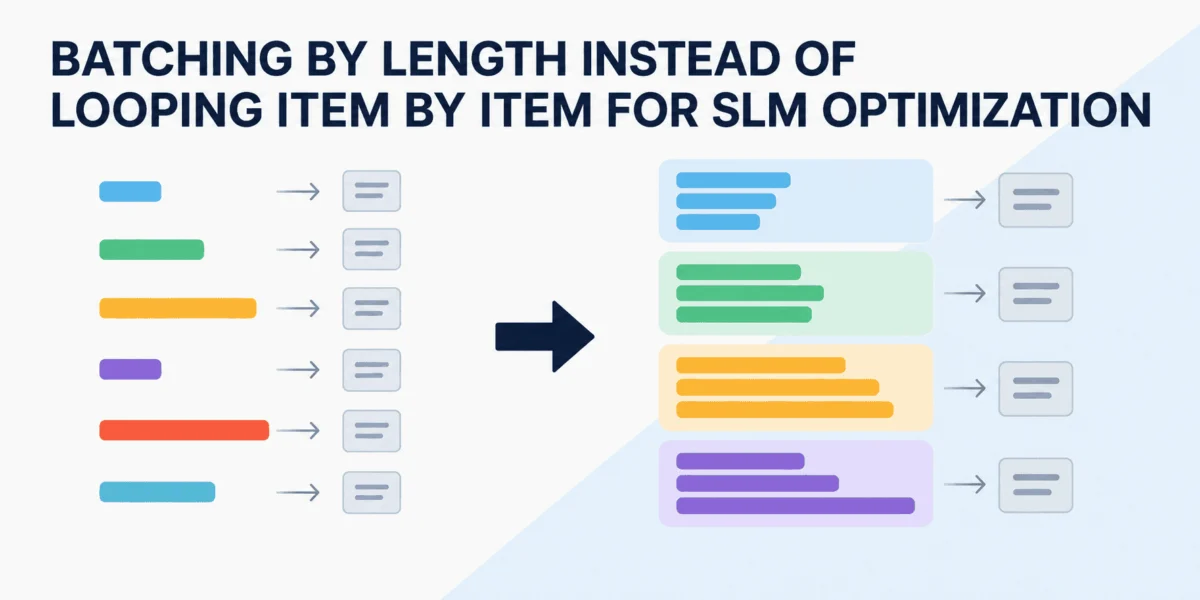
Processing individual data points through small language models (SLMs) in a sequential, iterative loop represents a significant bottleneck in modern machine learning pipelines. As organizations increasingly deploy SLMs for narrow, task-specific automation—such as support ticket classification or sentiment analysis—the efficiency of the inference process becomes as critical as the accuracy of the model itself. When models are executed one item at a time, the hardware, whether it be a GPU or a CPU, spends a disproportionate amount of time loading weights into memory, leaving arithmetic units underutilized. This state, known as being memory-bandwidth bound, is a primary source of computational waste. The solution lies in strategic batching, specifically by organizing data by token length to minimize padding overhead, thereby maximizing hardware throughput.
The Mechanics of Computational Inefficiency
In a standard inference loop, the model performs a forward pass for every single input sequence. On hardware like the Apple M2 chip, which utilizes a unified memory architecture, the overhead of repeatedly streaming the model’s weights from the RAM to the Neural Engine for every small ticket is substantial. The processor effectively spends more time managing memory movement than performing the actual matrix multiplications required for inference. While researchers often aim to scale models to accommodate larger datasets, the reality of small-scale automation is that the cost per inference is rarely optimized.
When practitioners attempt to solve this via naive batching—grouping multiple inputs into a single tensor—they often encounter the "padding problem." Because matrix operations require tensors of uniform dimensions, every sequence in a batch must be padded with tokens to match the length of the longest sequence in that batch. In real-world datasets, which typically follow a long-tailed distribution (where a few very long sequences coexist with many short ones), this approach leads to a massive waste of computational cycles. Processing a batch where most of the content consists of empty padding tokens effectively lowers the efficiency of the model, as the hardware computes results for "nothing."
Implementing Length-Bucket Batching: A Chronology of Optimization
The evolution of these optimization techniques has occurred over a series of stages, each building on the previous to refine the deployment of models like the Qwen2.5-0.5B-Instruct.
- Phase One: Constraining the Output Space. Initial efforts focused on restricting the model’s vocabulary and output expectations. By forcing the model to select from a predefined set of labels (e.g., "billing," "technical," or "account"), engineers can bypass the need for full-sequence generation. This significantly reduces the number of operations per forward pass.
- Phase Two: KV Cache Reutilization. The second stage involved the implementation of Key-Value (KV) caching. By reusing the prompt prefix—the system instructions and classification context that remain constant across all tickets—the model avoids redundant calculations. This technique allows the model to "remember" the static parts of the prompt, saving precious compute time.
- Phase Three: Length-Bucket Batching. The current and final stage of this optimization series involves sorting input data by token length before batching. By grouping tickets of similar lengths, each batch requires only the minimum amount of padding necessary for that specific set of inputs, rather than padding to the global maximum of the entire dataset.
Quantitative Benchmarking and Performance Metrics
Empirical testing using the Qwen2.5-0.5B-Instruct model provides a clear view of the impact of these strategies. When processing 600 synthetic support tickets, the baseline "item-by-item" approach takes approximately 144.35 seconds, resulting in a throughput of 4.2 items per second. In this scenario, the model is essentially idling while waiting for data to be prepared and moved through the architecture.
When the same dataset is processed using length-bucketed batching with a batch size of 32, the performance metrics shift dramatically. The duration for the same set of tasks drops to approximately 79.60 seconds, nearly doubling the throughput to 7.5 items per second. Critically, the "padding overhead"—the percentage of processed tokens that contribute nothing to the model’s understanding—is reduced to just 7.6%. This is a stark improvement over naive batching, where padding could account for over 70% of the total token budget in a dataset with significant length variance.
Technical Implications for Deployment
The adoption of length-bucketed batching requires a shift in how inference pipelines are constructed. It is no longer sufficient to treat the inference function as a simple "call-and-response" loop. Instead, the system must incorporate a pre-processing stage that sorts the incoming queue.
This, however, introduces a new challenge: the integration of prefix caching with dynamic batching. In a serial process, maintaining a single KV cache is straightforward. When using batches, the cache must be expanded to match the batch dimension, meaning the tensors representing the cached keys and values must be replicated for every item in the batch. If the prefix is long, this creates a significant memory footprint. Developers must balance the speed gains of batching against the memory constraints of their hardware. For smaller models running on edge devices, this is a delicate equilibrium that requires precise management of tensor shapes and cache indices.
Broader Industry Impact and Expert Consensus
The consensus among machine learning engineers is that these "micro-optimizations" are essential for the viability of SLMs in enterprise settings. As the industry shifts away from massive, cloud-dependent Large Language Models (LLMs) toward smaller, locally deployable models, the focus must inevitably land on execution efficiency.
"Optimization is not just about reducing latency; it is about ensuring that the model is doing meaningful work at every clock cycle," notes an anonymous contributor to the development of these benchmarks. "When we see a 3x or 4x improvement in throughput, we aren’t just saving time; we are making the deployment of AI at scale economically and technically feasible."
From a cost-analysis perspective, the implications are profound. If a business can process twice the number of support tickets on the same hardware, they effectively halve their operational cost for AI-driven automation. Furthermore, by ensuring that optimized paths (like batching) yield identical results to unoptimized, slower paths, developers can maintain the "trust factor" necessary for adopting automated systems in customer-facing roles.
Conclusion: The Future of Efficient Inference
The series of optimizations—constraining the output space, reusing the KV cache, and implementing length-bucketed batching—highlights a fundamental truth in contemporary AI development: the hardware-software interface is where the most significant gains are found. While the "intelligence" of a model is a function of its architecture and training data, its "utility" is a function of its engineering.
By systematically eliminating sources of waste, from redundant forward passes to excessive padding tokens, the development community is paving the way for SLMs to become the workhorses of the digital economy. These techniques do not change the underlying model’s predictions, but they ensure that the model can be deployed in environments where speed, memory efficiency, and cost-effectiveness are paramount. As we move forward, the focus will likely remain on these granular refinements, proving that in the world of high-performance computing, the most effective path to intelligence is through rigorous, well-measured efficiency.

