
The Forward Deployed Engineer (FDE) has emerged as a cornerstone role within the modern artificial intelligence landscape, bridging the gap between cutting-edge research and the practical, often messy, reality of enterprise infrastructure. As AI transitions from a novelty to a critical utility, the demand for professionals who can navigate both high-level system architecture and client-facing technical consulting has reached a fever pitch. In 2026, major organizations, including Anthropic and its strategic partners, have prioritized the cultivation of this workforce, signaling a shift in how AI is being operationalized across the global economy.
The Evolution of the Forward Deployed Engineer
The concept of the FDE originated in high-growth technology firms that required engineers to act as the "tip of the spear" during complex product implementations. Unlike traditional software engineering roles—which are often characterized by clearly defined requirements and internal product ownership—the FDE role is inherently reactive and problem-centric.
A standard software engineer might be tasked with building a specific microservice or optimizing a database query. In contrast, an FDE is frequently presented with an ambiguous, high-stakes business challenge. For instance, a legacy insurance firm might possess nearly two decades of unstructured claims data scattered across six siloed legacy systems. The FDE’s mandate is not merely to "build an AI," but to determine if generative tools can reduce investigation times from four hours to twenty minutes while strictly adhering to data privacy regulations and maintaining decision-making reliability.
This role effectively merges four distinct professional disciplines: software engineering, AI and data engineering, solutions architecture, and technical consulting.
Chronology and Industry Scaling
The year 2026 marks a turning point in the professionalization of the FDE. Following years of "proof of concept" stagnation, large enterprises have begun the migration toward full-scale AI integration. This transition was underscored in mid-2026 when Anthropic and DXC announced a multi-year global alliance. The initiative aims to train tens of thousands of Claude-certified forward-deployed engineers. This move suggests that the industry is moving away from bespoke, boutique consulting toward a standardized, scalable framework for enterprise AI deployment.
According to data from ZipRecruiter, as of August 2026, the average annual salary for an FDE in the United States sits at approximately $116,463, with a median of $124,300. In specialized AI firms, these figures are frequently exceeded, reflecting the scarcity of candidates who possess the rare combination of high-level coding proficiency and the soft skills required for direct customer interaction.
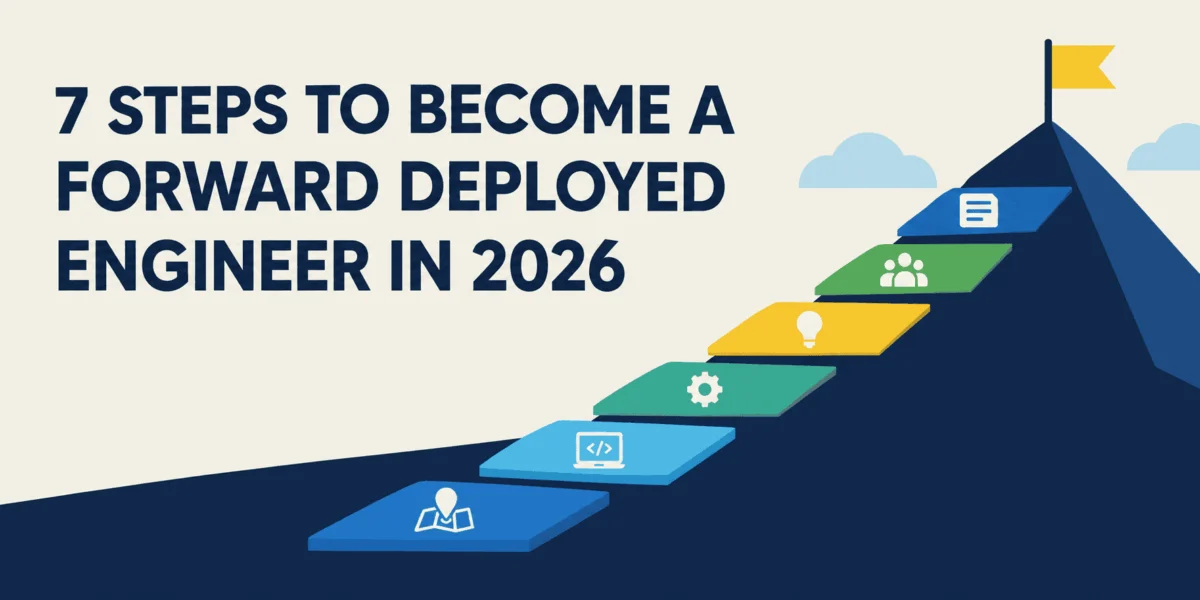
The 7-Step Roadmap to Professional Competency
Becoming an effective FDE requires a deliberate approach to skill acquisition that balances technical rigor with situational awareness.
1. Establishing Software Engineering Foundations
Python remains the lingua franca of the AI era, appearing in over 40% of analyzed FDE job descriptions in 2026. However, mastery of syntax is insufficient. Prospective engineers must demonstrate proficiency in backend development, automation, and the nuances of data pipelines. While competitive programming skills are often a standard requirement for initial screening, the day-to-day role demands an ability to write maintainable, production-grade code that can withstand the rigors of real-world enterprise use.
2. Mastery of Data Integration and APIs
The "messiness" of enterprise data is the primary hurdle for any AI implementation. Real-world systems are characterized by fragmented PostgreSQL databases, outdated schemas, proprietary REST APIs, and restrictive permissions protocols. An FDE must be adept at traversing these legacy environments. This includes understanding OAuth authentication, managing webhooks, and interpreting documentation for systems that may have been implemented before the advent of modern cloud computing.
3. Operationalizing Deployment
The mantra "works on my laptop" is a career-limiting mindset for an FDE. The role requires full-cycle ownership of a deployment, from the initial prototype to a stable, scalable production environment. Engineers must be fluent in containerization (Docker, Kubernetes), cloud infrastructure (AWS, GCP, or Azure), and CI/CD pipelines. The ability to monitor a system in production, diagnose latency issues, and roll back failed updates is what differentiates an engineer from an implementer.
4. Applied AI Engineering
In 2026, the focus has shifted from theoretical machine learning to applied AI. The objective is no longer to train frontier models from scratch, but to effectively harness LLMs, agents, and Retrieval-Augmented Generation (RAG) systems to solve specific business problems. Proficiency in prompt engineering, fine-tuning for specific enterprise domains, and managing vector databases is now considered the baseline requirement for most FDE positions at organizations like OpenAI and its peers.
5. Prioritizing Security and Reliability
For a corporation, the integration of AI represents a significant security risk. FDEs must be deeply familiar with tenant isolation, least-privilege access models, and the nuances of PII (Personally Identifiable Information) handling. These are not merely tasks for the security team; they are integral to the system design process. Engineers who can proactively architect for compliance are significantly more valuable than those who treat security as an afterthought.
6. Customer Discovery and Strategic Consulting
This is the most challenging transition for traditional developers. When a client requests an "AI chatbot," an FDE’s primary task is to challenge that request through rigorous discovery. Are the underlying business processes optimized? Is the data clean enough to support an LLM? Does the solution provide a tangible ROI? Turning an ambiguous customer desire into a concrete, technically feasible project is the core competency that separates a senior FDE from a junior developer.
7. Building a Domain-Specific Portfolio
A strong portfolio for an FDE should not contain disconnected tutorials. It should feature two or three integrated systems that demonstrate the ability to navigate constraints. A high-quality project might include an enterprise support agent that links RAG with a ticketing system, incorporates human-in-the-loop validation, and tracks cost metrics. By focusing on specific industries—such as logistics, healthcare, or legal services—engineers can demonstrate their ability to learn the "language" of a client’s business, which is a critical differentiator during the hiring process.
Analytical Implications
The rapid expansion of the FDE role suggests that we are entering a phase of "technological pragmatism." The initial AI boom was defined by the excitement of new model capabilities; the current phase is defined by the struggle to integrate those capabilities into the existing infrastructure of the global economy.
The emphasis on "Claude-certified" and similar training programs suggests that employers are looking to standardize the role, likely in response to the high failure rates of early, poorly scoped AI pilot projects. For the individual engineer, this creates a clear incentive structure: move away from being a "code generator" and toward becoming a "system solver."
Ultimately, the Forward Deployed Engineer represents the human face of machine intelligence. As businesses continue to automate their back-office operations, the demand for individuals who can translate between the binary logic of AI and the nuanced requirements of human enterprise will continue to grow, cementing the FDE as a vital link in the future of the digital economy.

