
The rapid proliferation of autonomous AI agents has introduced a significant operational challenge: the "token tax" associated with search-driven workflows. As agents increasingly rely on web-based retrieval to provide context-aware responses, the sheer volume of data being ingested by Large Language Models (LLMs) has become a primary bottleneck for both performance and profitability. Recent industry data indicates that AI agents frequently consume massive amounts of tokens by processing redundant metadata, tracking parameters, and complex nested objects that serve no functional purpose for the model’s reasoning process. To combat this, developers are turning to a more streamlined approach: replacing traditional JavaScript Object Notation (JSON) with Markdown output to drastically reduce the size of the data context window.
The Rising Cost of AI Context Bloat
In the current landscape of generative AI, the context window—the "working memory" of an LLM—is a finite and expensive resource. When an AI agent performs a search query, it typically pulls in raw data from the search engine. Traditionally, this data is formatted in JSON, a standard for web APIs that is highly effective for machines but inefficient for LLMs. JSON payloads include extensive structural characters, such as brackets, quotes, and repetitive key labels, all of which count toward the token limit.
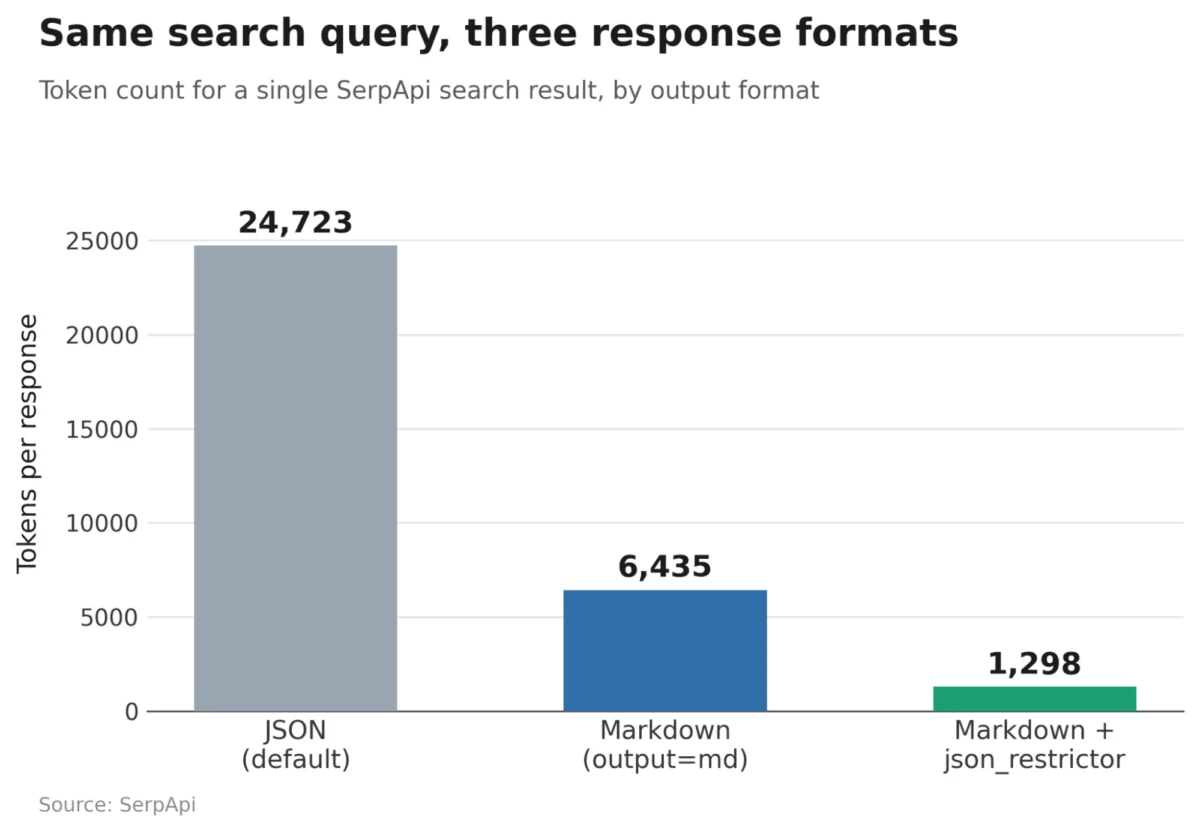
For instance, a standard query for local services, such as "look up coffee shops," can result in a payload cluttered with nested objects, tracking links, and redundant metadata. These elements are necessary for front-end rendering or backend database ingestion, but for an LLM tasked with summarizing information, they represent "noise." A recent analysis of SerpApi outputs showed that a standard search query generated 24,723 tokens when formatted in JSON. When converted to Markdown, the same information was delivered in 6,435 tokens—a 74% reduction. In an environment where companies pay per thousand tokens, such inefficiencies translate into thousands of dollars in wasted operational expenditure over millions of queries.
A Chronology of Token Management
The evolution of AI retrieval has occurred in three distinct phases over the last 24 months:
- The Raw Retrieval Phase (2022–2023): Early AI agents utilized standard search APIs that returned raw JSON. Developers focused on integration rather than payload optimization, leading to high latency and inflated costs as agents struggled to parse overly complex nested structures.
- The Prompt Engineering Phase (2023–Early 2024): Developers began using complex system prompts to instruct models to "ignore" or "filter" certain fields within the retrieved data. While this improved results, it was inherently inefficient because the model still had to read the entire JSON payload before it could discard the unnecessary parts, effectively paying for the tokens anyway.
- The Structural Optimization Phase (Mid-2024–Present): The current shift focuses on "server-side shaping." By transforming the data format before it ever hits the LLM, developers are reducing the token burden at the source. The adoption of Markdown as a retrieval format represents the maturity of this phase, allowing for high-density information delivery with minimal structural overhead.
Technical Breakdown: JSON vs. Markdown
The fundamental difference between JSON and Markdown in the context of LLMs lies in their intended audiences. JSON is a data-interchange format designed for machines to serialize and deserialize data. It requires strict syntax, including opening and closing braces, quotation marks around every string, and explicit key-value pairings. For an LLM, these characters provide little semantic value but consume the same token budget as critical information.
Markdown, conversely, is a lightweight markup language designed for human readability. It uses minimal characters—such as hash signs for headers, asterisks for lists, and standard brackets for links—to denote structure. When a search API provides a response in Markdown, it strips away the programmatic metadata (like internal tracking IDs or duplicate database references) while retaining the human-readable content.
Industry analysts observe that this shift does not necessarily sacrifice data integrity for most use cases. For an AI agent tasked with summarizing search results, a Markdown table is functionally equivalent to a JSON array, but it is parsed by the LLM with significantly higher token efficiency. However, there remains a clear distinction for specialized tasks. If an application requires precision—such as a financial dashboard needing exact float values for stock prices or an analytics engine requiring nested arrays for downstream computational processing—JSON remains the industry standard. The utility of Markdown is strictly for "agentic" applications where the primary goal is reasoning, summarization, or synthesis.
Official Perspectives and Implementation Strategies
The industry-wide move toward Markdown output is supported by API providers who have recognized that the constraints of LLMs require a new approach to data delivery. SerpApi, for instance, has integrated this functionality directly into its service, allowing developers to toggle between JSON and Markdown output via simple query parameters. This move signifies a broader trend among infrastructure providers to move away from "one-size-fits-all" data delivery toward "model-optimized" delivery.
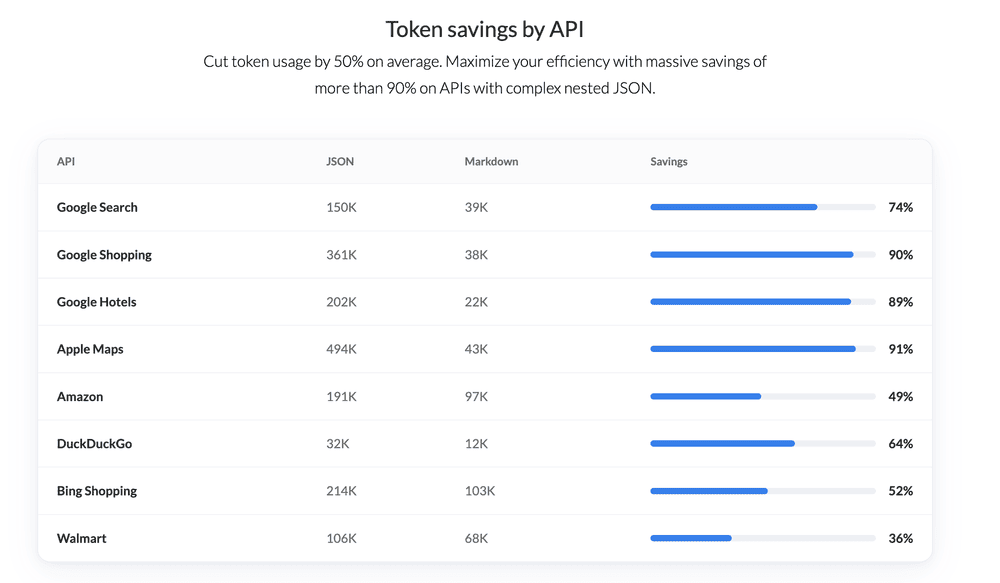
Implementation is straightforward. By appending a parameter such as output=md to an API call, developers can receive a response that has already been purged of "tracking noise" and duplicate fields. Furthermore, the use of json_restrictor tools allows developers to refine the payload at the server level, ensuring that only the essential data points—such as titles, snippets, and links—are sent over the network.
"The delta is your real-world savings," notes one lead engineer in the space. "By measuring the token count before and after implementing a format switch, organizations can immediately quantify the impact on their bottom line. We are seeing a direct correlation between payload optimization and the ability to maintain longer, more accurate context windows for agents."
Implications for the AI Economy
The transition toward optimized data formats has significant implications for the scalability of autonomous agents. As companies look to scale their AI operations from proof-of-concept to production-level deployment, the "token tax" becomes a primary inhibitor.
First, Cost Efficiency: By reducing the token footprint by 70% or more, companies can significantly extend their budget, allowing them to run more sophisticated models or increase the frequency of agentic queries.
Second, Performance and Latency: LLMs process tokens sequentially. Fewer tokens mean faster time-to-first-token (TTFT) and reduced overall latency. In a real-time retrieval-augmented generation (RAG) system, this speed is the difference between a responsive AI agent and one that feels sluggish to the end-user.
Third, Context Window Preservation: By removing extraneous metadata, developers free up space in the model’s context window. This allows for more search results to be included in a single prompt, leading to more comprehensive and accurate answers. Instead of hitting the model’s limit with three search results in JSON, an agent might be able to ingest ten search results in Markdown, drastically improving the quality of the synthesized output.
Looking Ahead
As AI agents become more deeply embedded in enterprise workflows, the focus will continue to shift from "getting the data" to "getting the right data in the right shape." While Markdown is not a panacea for all data transmission needs, its emergence as a tool for token-efficient retrieval is a vital development. Organizations that neglect to analyze the shape of their data feeds are likely incurring significant, avoidable costs.
For developers, the mandate is clear: audit your data pipelines. Measure the token consumption of every search result, identify the structural bloat that provides no value to the LLM, and implement format-specific outputs to ensure that your agent’s context window is filled with signal, not noise. The future of AI efficiency will not just be about better models, but about the smarter, more economical delivery of the data those models depend on.

