

The technological architecture of the global internet is undergoing a profound structural shift, moving away from systems designed purely for automated execution toward platforms capable of interpreting and realizing human intention. This emerging framework, widely defined by industry researchers as the Agentic Layer of the Post Web, introduces autonomous artificial intelligence agents designed to act on behalf of human users. By interpreting high-level goals, making contextual decisions, and executing complex actions across decentralized systems, these technologies represent a departure from traditional digital interfaces.
While the advent of Web3 established a decentralized internet centered on ownership and utilized smart contracts to automate trustless transactions between parties, its primary focus remained anchored in programmable money and financial infrastructure. Industry analysts note that whereas the previous paradigm digitized value, the Post Web introduces the era of programmable agency. This evolution transitions digital interaction from passive, reactive engagement to a dynamic, living network capable of reasoning, adaptation, and continuous coordination.
Evolution and Background of the Agentic Infrastructure
The genesis of this shift lies in the convergence of advancements in natural language processing, reinforcement learning, and distributed ledger technology. For decades, the internet operated on deterministic principles: users provided explicit inputs, and software executed rigid, predefined outputs. Web3 added a layer of cryptographic verification and economic self-sovereignty, allowing smart contracts to execute agreements without intermediaries. However, these protocols still relied heavily on human intervention to initiate transactions, write code, and manage operational outcomes.
As artificial intelligence models matured beyond simple chatbots and predictive text generators, the limitation of task-based automation became apparent. Traditional software bots operate reactively, following strict instruction sets within closed environments without the capacity to learn or adapt. In contrast, modern AI agents are engineered as goal-oriented systems capable of evaluating complex virtual environments, optimizing their decision-making processes through experience, and collaborating with other digital entities.
According to Greysen Cacciatore, a research associate at Outlier Ventures, this capability marks the beginning of an entirely new economic paradigm. "AI agentic systems mark the beginning of a new paradigm," Cacciatore notes in the foundational Outlier Ventures research. "With their capabilities to orchestrate intention, navigate complex virtual environments, and achieve sophisticated outcomes, they are poised to transform the global economy."
Defining the Shift: Traditional Bots Versus Autonomous Agents
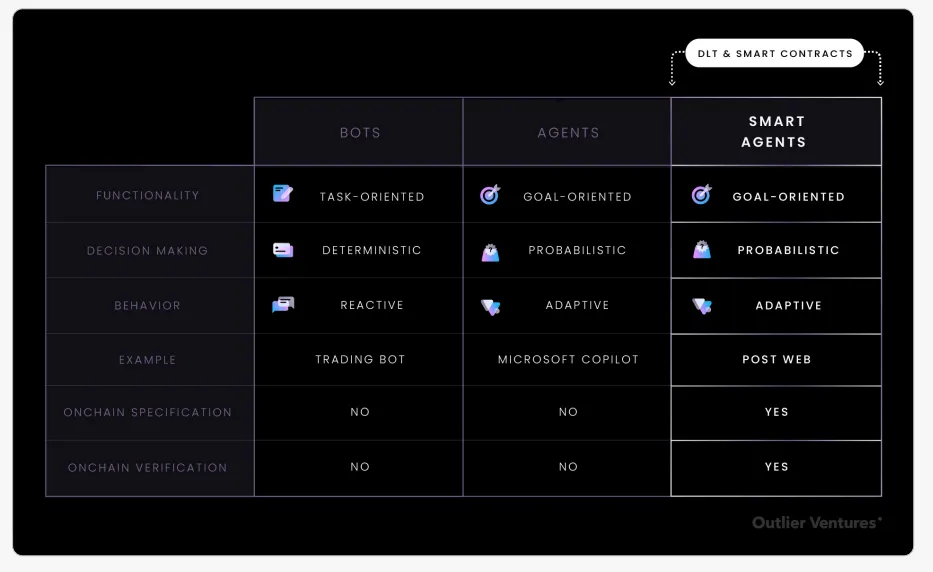
To understand the operational significance of the Agentic Layer, industry taxonomies draw a sharp distinction between legacy automated scripts and next-generation autonomous agents. While traditional bots are deterministic, reactive, and constrained to rigid task-based execution, autonomous agents operate probabilistically, allowing their outcomes to evolve dynamically based on surrounding context.
Legacy bots possess no capacity for learning and cannot alter their behavioral patterns without manual code updates. Conversely, autonomous agents continuously learn from their environment, optimize their operational pathways, and exhibit proactive problem-solving behaviors. This fundamental difference redefines software from a passive tool that automates repetitive tasks into an active participant capable of managing comprehensive outcomes.
Building upon this capability, researchers have identified a specialized classification known as Smart Agents. These advanced entities bridge the gap between artificial intelligence and distributed ledger technology. Unlike standard AI models that interact solely with application programming interfaces or centralized data feeds, Smart Agents are capable of owning cryptographic tokens, signing transactions, and independently executing smart contracts. Operating as native economic actors within the Post Web, these agents manage digital assets, verify ownership rights, enforce complex agreements, and execute multi-step workflows in real time.
Ecosystem Classification and Orchestration
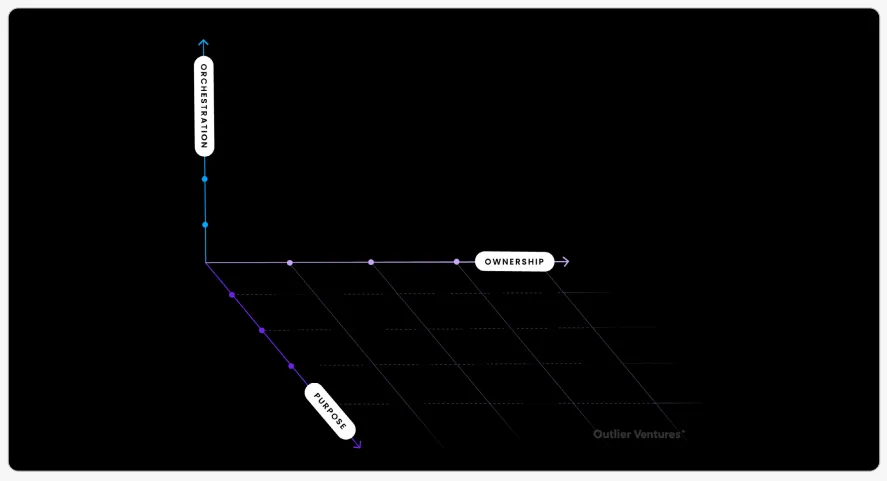
The proliferation of Smart Agents requires a structured classification model to manage their diverse functions across the digital economy. Industry frameworks categorize these agents along three primary axes: orchestration, ownership, and purpose.
Orchestration refers to whether an agent operates as a centralized tool controlled by a single entity or as part of a decentralized swarm utilizing consensus mechanisms to achieve collective goals. Ownership dictates whether the agent serves an individual human user, an enterprise organization, or operates as a self-sovereign entity governed entirely by decentralized autonomous organizations or algorithmic parameters. Purpose defines the functional specialization of the agent, ranging from financial yield optimization and supply chain logistics to automated legal arbitration and content curation.
This diversity transforms the internet from a static network of interconnected servers into a vibrant digital ecosystem. In this environment, self-directing entities continuously optimize for efficiency, value creation, and institutional coordination without requiring constant micro-management from human operators.
Protocol Networks and Interoperability Standards
As the infrastructure of the Agentic Web develops, industry leaders emphasize the critical importance of open standards and decentralized network architecture. Echoing observations made by technology analyst Chris Dixon regarding the foundational economics of digital networks, technology architects stress that protocol networks must prevail over closed, rent-extractive corporate platforms.
In the emerging agentic economy, this distinction is a practical necessity rather than an ideological preference. Without interoperable standards, the agentic web risks replicating the siloed fragmentation that characterizes the current web architecture. To prevent this, developers are advancing composable standards such as Model Context Protocols, Agent-to-Agent communication frameworks, and Autonomous Agent Communication Protocols.
These open-source, transparent standards act as the connective tissue of the Agentic Web. Anchored on distributed ledgers, they ensure that autonomous entities remain accountable, secure, and capable of transacting safely across heterogeneous systems. The underlying ethos that decentralized ownership in the Web3 era must now be applied to decentralize agency itself.
Broader Economic Implications and Future Outlook
The maturation of the Agentic Layer carries profound implications for global commerce, enterprise operations, and human-computer interaction. By delegating complex workflows—such as cross-border treasury management, dynamic resource allocation, and automated multi-party negotiations—to autonomous digital actors, organizations can achieve unprecedented levels of operational efficiency.
However, the integration of Smart Agents into critical economic infrastructure also introduces new challenges. Economists and technologists highlight the need for robust verification mechanisms, standardized security frameworks, and clear legal delineations regarding liability when autonomous agents execute financial or contractual transactions. Balancing human oversight with cryptographic verifiability remains a central design challenge for developers building the next phase of the decentralized internet.
Ultimately, the transition to the Post Web represents a fundamental evolution from an internet of execution to an internet of intention. As reinforcement learning, natural language processing, and decentralized compute converge, the digital landscape is shifting away from static interfaces toward active, autonomous participants. In this newly realized framework, humans will articulate high-level objectives in natural language, while intelligent networks and sovereign smart agents collaborate continuously to turn those intentions into reality.

