

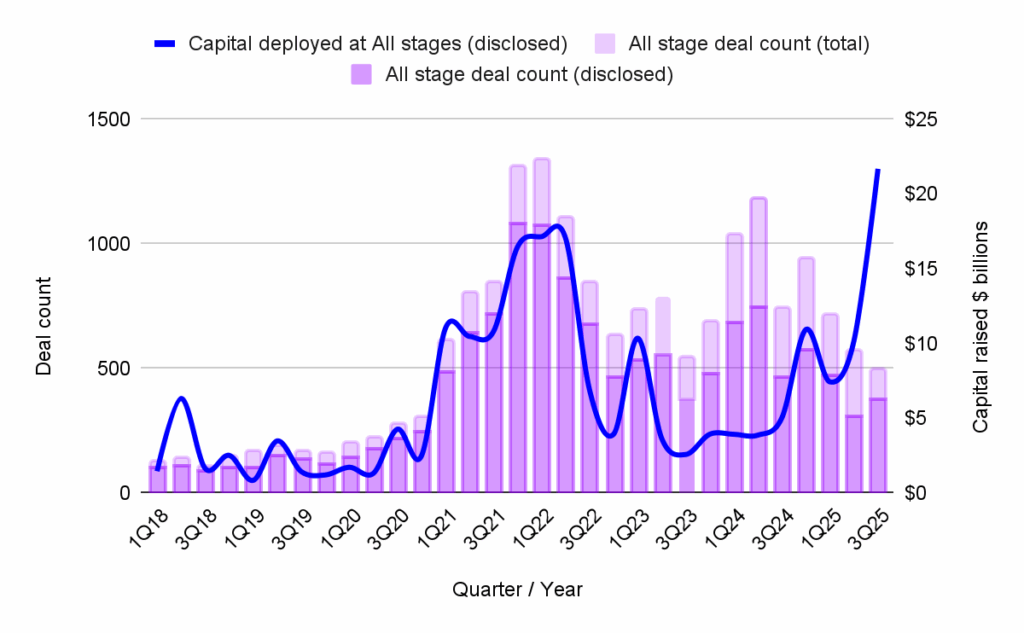
The global Web3 fundraising landscape underwent a profound transformation in the third quarter of 2025, recording a staggering cycle high of nearly $22 billion deployed across 376 disclosed deals, according to comprehensive industry reports from Outlier Ventures and Messari. This performance marked a monumental 113% increase in capital deployment compared to the preceding quarter, which saw $10.2 billion distributed across 309 deals. Analysts note that this unprecedented surge in funding outpaced the growth in total deal counts, signaling a market overwhelmingly driven by significantly larger checks and high-conviction institutional participation rather than broad-based retail or early-stage activity.

This quarter’s financial trajectory underscored a continuation of the "conviction over coverage" paradigm observed throughout the first half of 2025. However, third-quarter data introduced a distinct structural evolution: the institutional plumbing of the crypto economy—including exchange-traded funds (ETFs), digital asset treasuries (DATs), tokenization initiatives, and enterprise settlement rails—transitioned decisively from conceptual promises to fully operational production environments. Consequently, venture capital flows closely mirrored these mature infrastructure channels, favoring projects capable of absorbing capital at scale and operating seamlessly within regulatory boundaries.
Macroeconomic Context and Chronological Evolution
To understand the scale of the third-quarter milestone, industry analysts look back at the steady, methodical tightening and recalibration of digital asset markets following the turbulence of prior cycles. The first half of 2025 established a cautious baseline characterized by stringent due diligence and a flight to quality. While general partners and venture funds exercised extreme selectivity, regulatory clarity gradually solidified across major jurisdictions.
By the onset of the third quarter in July 2025, the maturation of regulatory frameworks—catalyzed by landmark legislative measures such as the GENIUS Act and concurrent international guidance from financial authorities—effectively lowered the barrier to entry for mainstream financial institutions. This policy shift coincided with a significant operational push by global banking giants. Major financial institutions transitioned their blockchain experiments into live production environments, creating a sustained demand for robust underlying infrastructure, custody solutions, and scalable settlement layers.
Throughout July, August, and September, this institutional momentum translated into record-breaking capital allocations. Major public listings, including high-profile market debuts by entities like Bullish and Figure, further reinforced the viability of public market exits, setting the stage for a quarter defined by historic capital concentration.
Granular Analysis of Supporting Data and Deal Distribution
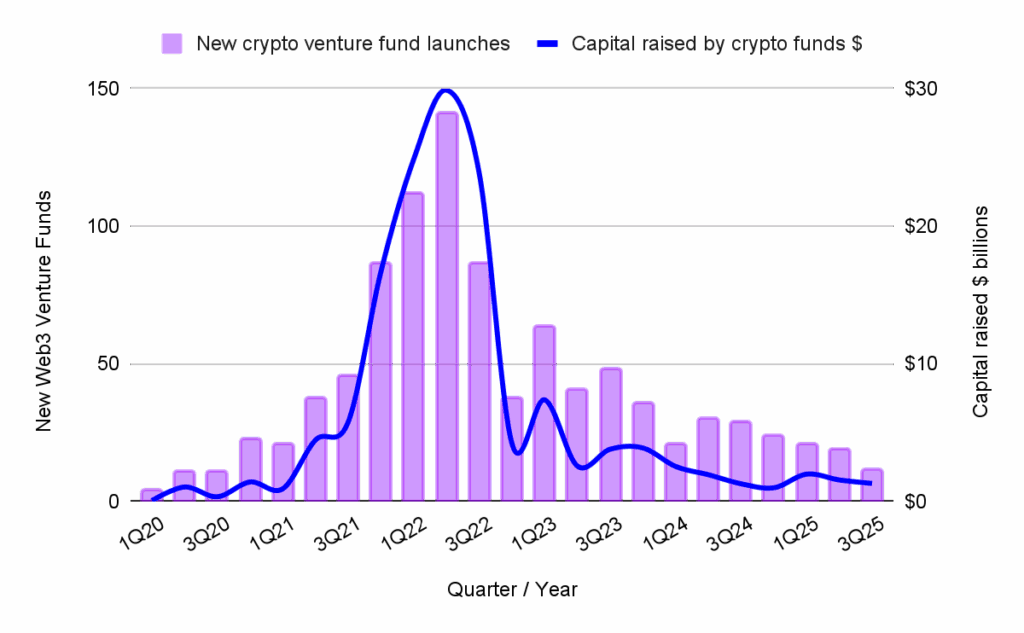
Despite the record headline figures, a closer examination of the data reveals a heavily skewed market where capital concentration superseded market breadth. Data compiled jointly by Outlier Ventures and Messari highlights that the ten largest funding rounds of the third quarter accounted for approximately half of the total capital deployed.
Furthermore, venture financing dynamics varied starkly across different developmental stages:
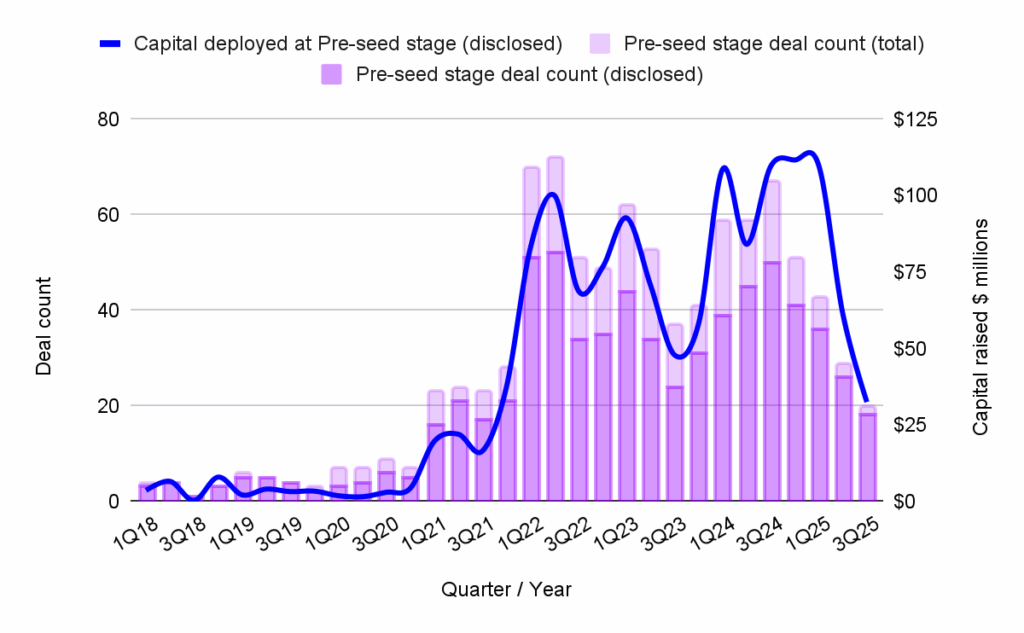
- Pre-Seed Stage: The earliest stage of venture creation experienced a sharp contraction. The pre-seed sector recorded a mere 18 disclosed rounds, totaling $32.5 million—representing a multi-year low. The 12-month running median for pre-seed valuations slipped to just under $2.5 million, exacerbated by a notable decline in accelerator program activity that narrowed the funnel for nascent ideas.
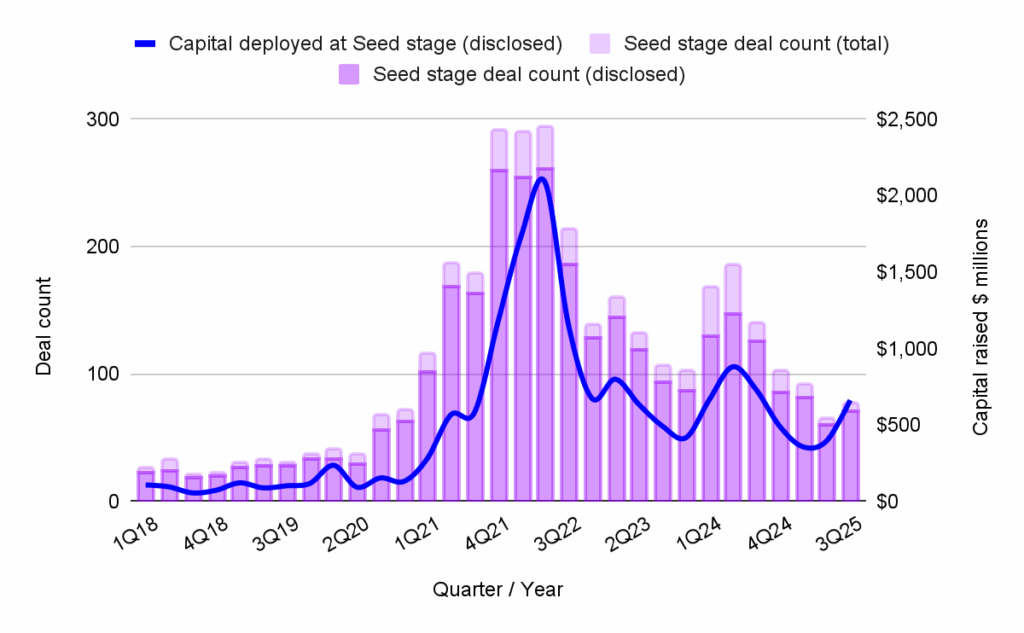
- Seed Stage: Seed-stage fundraising appeared robust on the surface, registering 71 disclosed rounds totaling nearly $663 million. However, this metric was heavily distorted by outliers, most notably the $200 million financing secured by Flying Tulip. Utilizing an unconventional, capital-efficient structure that granted investors on-chain redemption rights and yield exposure, this single transaction accounted for nearly a third of all seed capital for the period.
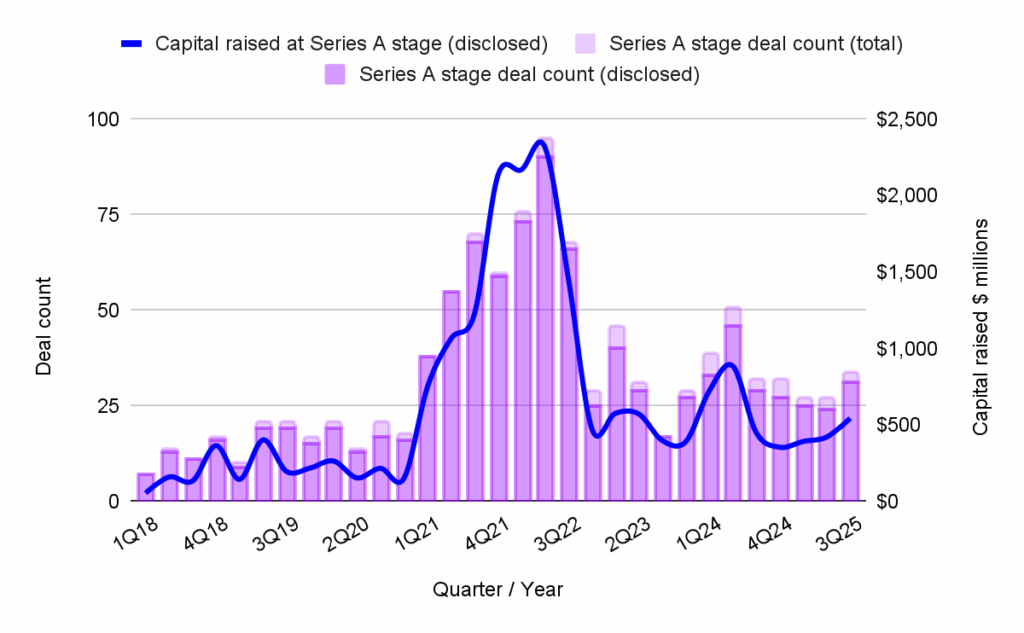
- Series A Stage: Mid-stage activity demonstrated relative stability, logging 31 disclosed rounds totaling approximately $545 million. The 12-month running median for Series A held steady at around $16 million, pointing to a sustained investor appetite for ventures that demonstrated clear product-market fit and direct alignment with institutional infrastructure rails.
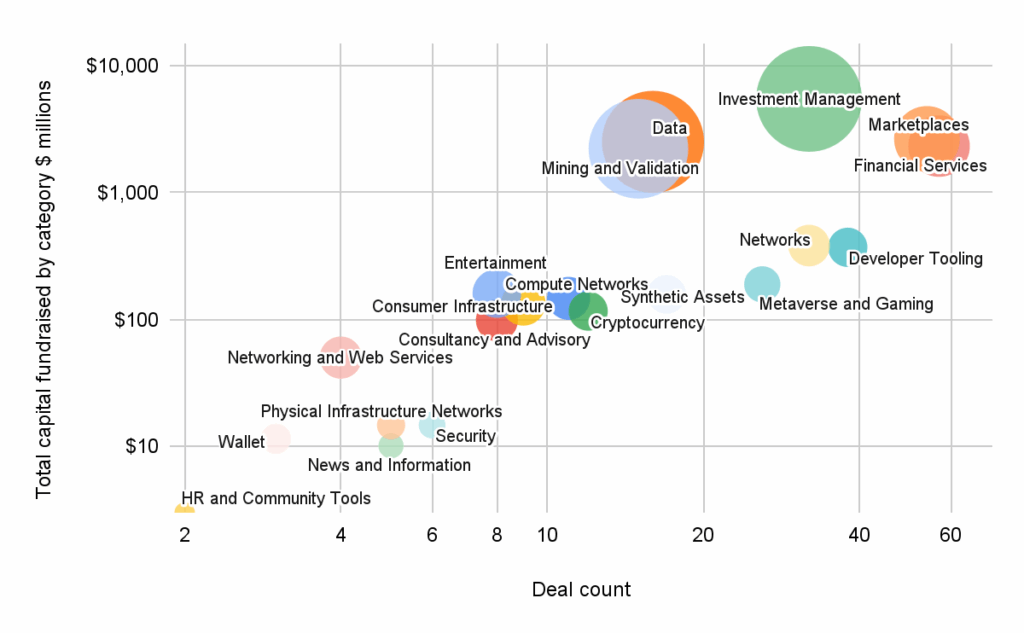
Category-wise, capital allocation was overwhelmingly concentrated in sectors bridging traditional finance and decentralized technology. Investment Management, Marketplaces, Data Infrastructure, Financial Services, and Mining & Validation collectively absorbed roughly 70% of all venture dollars in the third quarter. Conversely, consumer-centric verticals such as metaverse gaming and retail-focused wallet applications remained peripheral as investors prioritized compliance-ready B2B architectures.
Institutional Rails and Traditional Finance Integration
The dominance of institutional channels during the quarter was vividly illustrated by the performance of exchange-traded products and enterprise settlement networks. According to Messari’s specialized reviews, Ethereum-focused ETFs experienced massive inflows of approximately $8.7 billion during the third quarter, outstripping Bitcoin-focused funds and driving Ethereum ETF Assets Under Management (AUM) up by roughly 170% quarter-on-quarter to $27.4 billion.
Concurrently, Digital Asset Treasuries captured approximately 3.8% of the total circulating Ethereum supply, signaling a structural shift in corporate treasury management. Major financial institutions operationalized blockchain networks at scale:
- JPMorgan’s Kinexys network went live for the settlement of tokenized repurchase agreements.
- SWIFT successfully expanded its multi-institutional tokenization trials in collaboration with global custodians such as BNY Mellon, Citi, Clearstream, Euroclear, and Northern Trust to test cross-network settlement of bonds and fund shares.
- Visa Direct advanced its operational capabilities by processing cross-border payments utilizing USD Coin (USDC).
These developments provided institutional investors with the regulatory assurance and operational efficiency required to deploy capital at institutional scale. Because traditional asset managers operate under strict governance mandates and short delivery horizons, writing numerous small checks into unproven early-stage ventures remains operationally inefficient. To bridge this gap, hybrid investment vehicles—such as strategic partnerships between traditional asset managers like Morgan Creek and specialist web3 incubators like Outlier Ventures—emerged to channel institutional capital safely into vetted early-stage pipelines.
Token Fundraising Dynamics: Private Retreat and Public Rebound
The third quarter also marked a distinct pivot in token fundraising mechanisms, characterized by a steady retreat in private token sales and a robust rebound in public distribution routes. Public token sales climbed to 47 events, amassing a combined $819 million, while private token sales dwindled to just 7 events totaling $331 million.
This resurgence in public sales was mirrored by broader macroeconomic indicators in the crypto economy, including rising market capitalization and increasing trading volumes highlighted in CoinGecko’s industry reports. Observers note that as market depth improved and regulatory uncertainty receded, project teams increasingly favored public token launches for efficient price discovery and community alignment. Furthermore, the reopening of initial public offerings (IPOs) served as a vital sentiment marker, functioning as a regulatory compliance certification mark that signaled public market receptiveness to digital asset exposure.
Implications and Outlook for Upcoming Quarters
The third-quarter fundraising figures paint a clear picture of a maturing industry. The convergence of decentralized technology and traditional finance is no longer a speculative hypothesis but the foundational assumption driving capital allocation. While infrastructure providers, regulated custodians, and tokenized settlement rails continue to attract massive tranches of institutional liquidity, early-stage founders face an increasingly rigorous operating environment.
Looking ahead to the final quarter of 2025 and into 2026, the primary challenge for the Web3 ecosystem will be successfully bridging the narrow pre-seed pipeline with scalable growth-stage opportunities. Investors have made it unequivocally clear that future funding rounds will demand rigorous proof points, working deployments, and verifiable integration into enterprise or regulated financial frameworks. As capital concentration persists, the ability of startups to align with institutional standards will ultimately determine the breadth and resilience of the next wave of digital asset innovation.

