

The architecture of the global internet is undergoing its most profound structural shift since the commercialization of the World Wide Web in the 1990s. While successive technological eras have focused
on improving information retrieval, social connectivity, and financial decentralization, the next evolutionary leap centers on the automation of human intent. According to a landmark industry thesis published by Outlier Ventures in late 2025, the technological stack is transitioning from a framework designed for executing predetermined instructions to one capable of interpreting, orchestrating, and fulfilling complex human goals autonomously. This emerging stratum of the digital economy has been designated the "Agentic Layer" of the Post Web.
To understand the magnitude of this transition, analysts point to the limitations of previous internet paradigms. Web1 provided a read-only infrastructure for static information dissemination. Web2 introduced interactive, user-generated content underpinned by centralized platform monopolies that captured user data and attention. Subsequently, Web3 revolutionized the digital landscape by introducing decentralized ownership and programmable money through smart contracts. These cryptographic protocols allowed individuals to execute trustless transactions and agreements without intermediaries. However, Web3 remained fundamentally dependent on human users to supply intention—writing code, initiating transactions, and manually managing financial outcomes. The Post Web seeks to resolve this friction by introducing programmable agency.
The Evolution of Digital Actors: From Reactive Scripts to Prototypical Economic Participants
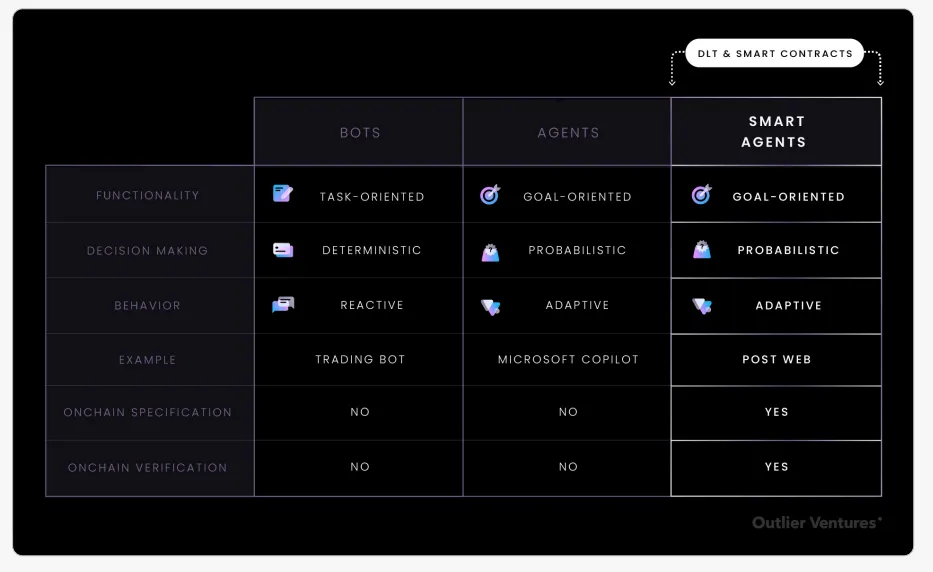
The cornerstone of the Post Web is the emergence of artificial intelligence agents. While automated scripts, web scrapers, and customer service bots have populated the internet for decades, advanced AI agents represent a qualitative leap in computing. Traditional bots are deterministic, reactive, and constrained to rigid input-output loops. They execute predefined tasks without the capacity for contextual learning or dynamic adaptation.
In contrast, AI agents are probabilistic, goal-oriented systems capable of navigating complex virtual environments, learning from real-time feedback, and optimizing their decision-making processes over time. As outlined in the Outlier Ventures thesis, these entities do not merely automate tasks; they automate outcomes. They operate proactively, interpreting high-level human objectives expressed in natural language and independently determining the most efficient pathways to achieve them.
This capability achieves critical mass through the integration of artificial intelligence with distributed ledger technology (DLT). Known in the industry as "Smart Agents," these next-generation entities possess the unique ability to interact natively with decentralized financial infrastructure. Unlike legacy bots that rely on corporate application programming interfaces (APIs), Smart Agents can hold digital assets, sign cryptographic transactions, execute smart contracts, and manage complex workflows independently. Consequently, they are evolving into the primary economic actors of the Post Web, capable of verifying ownership, enforcing decentralized agreements, and coordinating resources in real-time.
Chronology of the Shift: From Web3 Infrastructure to the Agentic Layer
The convergence of artificial intelligence and decentralized systems has accelerated rapidly over the past several years, driven by breakthroughs in large language models, reinforcement learning, and decentralized compute capacity.
The groundwork for this transition was laid during the expansion of decentralized finance (DeFi) and layer-1 blockchain scaling solutions between 2020 and 2023. During this period, smart contracts established a secure, trustless settlement layer capable of handling billions of dollars in programmatic transactions. However, user experience remained a significant barrier to mainstream adoption, as retail participants struggled to navigate fragmented protocols, manage gas fees, and optimize yields manually.
By 2024, the rapid commercialization of generative artificial intelligence demonstrated the viability of autonomous decision-making systems. Tech developers began experimenting with localized AI assistants capable of executing multi-step workflows. The realization that these cognitive models required a secure, censorship-resistant settlement layer catalyzed the convergence of AI and Web3.
By 2025, venture capital firms and decentralized autonomous organizations (DAOs) formally conceptualized the Post Web. Research published by firms such as Outlier Ventures categorized these developments into structured taxonomies, defining smart agents not merely as software tools, but as independent economic stakeholders. Industry initiatives began standardizing protocols—such as Model Context Protocols (MCPs) and Agent-to-Agent (A2A) communication frameworks—to ensure that autonomous agents from disparate developers could safely interoperate, negotiate, and trade value across open networks.
Taxonomy and Classification of Smart Agents
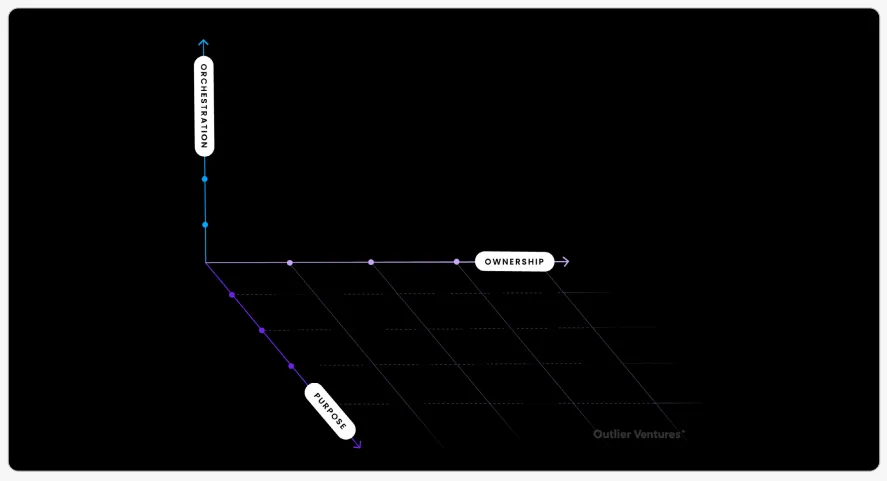
The ecosystem of the Post Web is not monolithic. According to industry classifications, smart agents vary widely in their architecture, purpose, and operational scope. They are systematically categorized along three primary axes: orchestration, ownership, and purpose.
Orchestration refers to the degree of autonomy an agent possesses relative to human oversight. While some agents operate as direct extensions of an individual user, executing routine administrative or financial tasks under strict parameters, others function as decentralized collectives—autonomous enterprises capable of pooling resources, voting on governance proposals, and executing long-term business strategies without direct human intervention.
Ownership defines the legal and cryptographic relationship between the agent and its assets. Smart agents in the Post Web may be owned by individuals, shared among cooperatives, or structured as sovereign entities backed by decentralized treasuries.
Purpose encompasses the functional domain of the agent. Specialized agents are currently being deployed across diverse sectors, including automated liquidity management in decentralized finance, supply chain verification, dynamic pricing negotiations, and autonomous legal compliance monitoring. This functional diversity transforms the internet from a passive repository of static pages into a dynamic ecosystem of self-directing entities continuously optimizing for efficiency and value creation.
Industry Perspectives and Expert Analysis
Market observers and researchers emphasize that the rise of the Agentic Layer has profound implications for the global economy and digital architecture.
"AI agentic systems mark the beginning of a new paradigm," notes Greysen Cacciatore, Research Associate at Outlier Ventures. "With their capabilities to orchestrate intention, navigate complex virtual environments, and achieve sophisticated outcomes, they are poised to transform the global economy by removing the operational friction that currently limits digital commerce and human productivity."
Financial analysts suggest that the widespread deployment of smart agents could drastically reduce transaction costs across enterprise and consumer markets. By automating complex, multi-party negotiations—such as corporate procurement, insurance claims processing, and cross-border settlements—agents can execute business logic at speeds and scales unattainable by human operators.
Furthermore, industry leaders emphasize the necessity of open-source standards in governing the Agentic Layer. Citing principles articulated by technology strategist Chris Dixon, decentralized advocates warn against the dangers of closed corporate networks capturing the agentic economy. Without open, permissionless protocols—such as composable standards pioneered by networks like Virtuals—the agentic web risks replicating the monopolistic fragmentation of the Web2 era. Consequently, the architectural imperative for the Post Web is to ensure that agency, like ownership before it, remains decentralized, transparent, and accountable to shared public standards.
Implications and Broader Market Impact
The maturation of the Agentic Layer signals a fundamental re-architecting of how humans interact with technology. As natural language models evolve into active participants in decentralized economies, the traditional user interface is expected to recede into the background. Users will no longer be required to navigate complex software dashboards, manually compare market rates, or execute multi-step digital transactions. Instead, human intent will serve as the primary input, while networks of autonomous smart agents handle execution, verification, and settlement.
This transition introduces new challenges, particularly regarding security, liability, and regulatory compliance. Ensuring that autonomous agents act within legal and ethical boundaries requires robust cryptographic verification frameworks and dynamic guardrails. Mechanisms combining human-in-the-loop oversight with automated cryptographic enforcement are currently being developed to mitigate systemic risks in autonomous financial markets.
As the digital landscape transitions into this next phase, the Post Web promises to redefine the boundaries between software and economy. By fusing the trustless settlement guarantees of distributed ledgers with the cognitive adaptability of artificial intelligence, the internet is evolving from a static repository of information into a living, responsive network where human intention is instantly translated into verifiable reality.

