
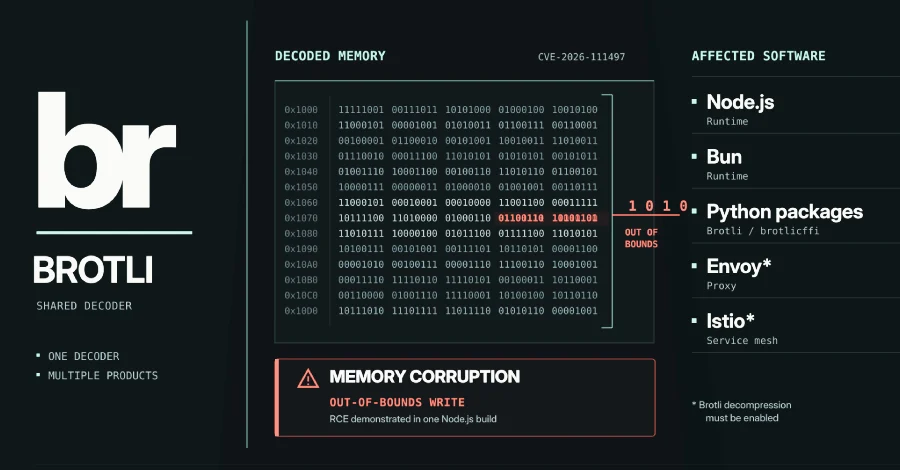
A severe memory-corruption vulnerability, tracked as CVE-2026-111497, has emerged within Google’s widely deployed Brotli compression library, triggering a cascade of emergency security updates across the global software ecosystem. The flaw resides in the C-based decompressor, which is embedded into a vast array of web-facing technologies, including Node.js, the Bun runtime, Envoy proxies, and various Python-based packages. By leveraging this vulnerability, an attacker could potentially execute arbitrary code, trigger system crashes, or cause significant memory leaks by sending malformed, crafted Brotli-compressed data to an unsuspecting client or server.
The vulnerability stems from an "out-of-bounds" write condition during the decompression process. When a program attempts to unpack a maliciously engineered Brotli stream, the decoder can be forced to overwrite memory buffers beyond their allocated boundaries. This structural weakness allows an attacker to manipulate the program’s execution flow, creating a pathway for remote code execution (RCE). Because Brotli is a industry-standard format for reducing web traffic volume, its ubiquity makes the scope of potential exposure remarkably broad.
The Unusual Origins of the Vulnerability
The discovery of CVE-2026-111497 is marked by a peculiar administrative anomaly. Investigations by OpenAI’s Codex Security team, led by researchers Khai Tran and Sylvie Mayer, revealed that the root cause of the flaw was actually addressed in the Brotli source code as early as February 27, 2026. However, at the time of the initial patch, the technical community was unaware that the bug posed a significant security risk. Consequently, the fix remained dormant in the source repository without being packaged into a formal, downstream release.
This lapse highlights a critical blind spot in modern supply chain security: when a library is updated in a source code repository without a corresponding versioned release, downstream maintainers—who often rely on official stable releases—remain vulnerable to known, yet un-triaged, issues. It was not until the security implications were fully understood and disclosed on October 21, 2026, that the necessary updates were finalized and pushed to users across the industry.
Timeline of Disclosure and Remediation
The public disclosure on October 21, 2026, triggered an immediate, coordinated response from major maintainers. The chronology of the event underscores the rapid escalation from a latent bug to a high-priority security advisory:

- February 27, 2026: The technical fix for the memory corruption bug is committed to the Brotli source repository, though its security significance is not recognized.
- October 21, 2026: OpenAI officially reports the flaw. Google and Node.js release emergency patches. The CVE identifier is assigned, and the security community begins the process of alerting affected software vendors.
- October 22, 2026: Vercel and other infrastructure providers begin implementing firewall-level mitigations to shield users who cannot immediately update their environments.
- October 23, 2026: CISA (Cybersecurity and Infrastructure Security Agency) conducts an initial assessment, noting "no" recorded exploitation in the wild. Debian and other Linux distributions begin rolling out patched versions of the Brotli library.
- Ongoing: Various downstream projects, including Envoy, Istio, and Python package maintainers, continue to release security updates to incorporate the corrected C library.
Impact Across the Software Stack
Because Brotli is a foundational compression tool, the impact of CVE-2026-111497 is not limited to a single application type. It spans runtimes, proxies, and specialized language libraries.
Node.js and Bun
In Node.js environments, the vulnerability is particularly concerning due to the prevalence of the fetch() API and body-parser middleware. If an application fetches data from a malicious server that returns a Brotli-compressed response, or if an Express-based server processes a crafted Brotli-encoded request body, the application becomes immediately exposed. The same risk applies to the Bun runtime, which includes built-in support for Brotli decompression via its high-performance fetch implementation.
Proxies and Service Meshes
Envoy and Istio, which serve as the backbone for many cloud-native and microservices architectures, are also susceptible. The risk here is contingent on the configuration; if an Envoy proxy or an Istio ingress gateway has Brotli decompression enabled—a common practice to save bandwidth between internal services—an attacker could theoretically exploit the proxy to gain a foothold in the service mesh.
Python Ecosystem
The risk in the Python ecosystem is perhaps the most insidious. Packages such as Brotli and brotlicffi are often pulled into environments as dependencies of higher-level HTTP libraries like requests, urllib3, or aiohttp. Because these libraries automatically handle Content-Encoding: br headers, a Python application can be compromised simply by having these packages installed, even if the application developer never explicitly interacts with the Brotli library.
Technical Analysis of the "Node2Shell" Concept
Imperva’s security researchers demonstrated the feasibility of the exploit through a proof-of-concept they dubbed "Node2Shell." By targeting an unpatched build of Node.js 24.22.0, the team successfully executed attacker-controlled code on an ARM64 Linux architecture. The research indicated that while the exploit requires precise orchestration and may take multiple attempts to stabilize, it represents a clear and present danger to production environments.
The vulnerability is bidirectional. As OpenAI noted in their advisory, an unpatched server can be compromised by a malicious client, and an unpatched client can be compromised by a malicious server. This "symmetric risk" means that security teams cannot simply focus on protecting their public-facing APIs; they must also account for any internal services that reach out to external, potentially untrusted, endpoints.

Severity and Risk Assessment
There remains a divergence in how organizations are scoring the severity of this vulnerability, illustrating the complexity of modern risk management:
- Google (CVSS 4.0): Rates the flaw at 9.2, classifying it as "Critical." This reflects the potential for full remote code execution and the ubiquity of the Brotli library.
- Red Hat: Assigns an 8.1 score, classifying it as "Important." While acknowledging the severity, this score accounts for the specific conditions required to trigger the exploit, such as the need for the library to be active and exposed to untrusted input.
- Node.js Maintainers: Officially categorize the bug as "High," prioritizing the remediation through their standard security update cycle.
The discrepancy underscores the fact that while the vulnerability is inherently critical, the "exploitability" is heavily dependent on the specific implementation of the Brotli library within a given software architecture.
Mitigation Strategies and Best Practices
For organizations struggling to assess their exposure, the following steps are recommended:
- Immediate Patching: The only definitive resolution is to upgrade to a patched version of the software. For Node.js, this means moving to versions 22.23.4, 24.22.1, or 26.12.1. Similar version bumps exist for Bun, Envoy, and Istio.
- Container Rebuilds: Simply updating the library within an existing container is insufficient. Because the Brotli decoder resides within the running process memory, all affected containers must be stopped, rebuilt with the updated binaries, and redeployed.
- Dependency Auditing: For Python users, standard vulnerability scanners may not yet show the risk due to the confusion surrounding the CVE’s attribution to the C library rather than the PyPI packages. Security teams should manually audit their
requirements.txtorpoetry.lockfiles to ensure they are not using versions ofbrotliorbrotlicffiolder than 1.2.1. - Network Configuration: In scenarios where patching is not immediately feasible, organizations should consider disabling Brotli decompression at the edge. While dropping
Accept-Encoding: brfrom headers is not a total solution—as servers can still push Brotli data—limiting the intake of compressed data from untrusted sources can reduce the attack surface. - Infrastructure Monitoring: Employing Web Application Firewalls (WAFs) can provide a layer of defense. While Vercel has noted that their firewall cannot cover all internal
fetchrequests, a well-configured WAF can still filter malicious incoming payloads at the ingress point.
Broader Implications for Supply Chain Security
CVE-2026-111497 serves as a stark reminder of the "dependency hell" that characterizes modern software development. Because the Brotli decoder is a low-level utility, it has been bundled and re-bundled into dozens of disparate tools. When a vulnerability is found in such a core component, the "blast radius" is immense.
Furthermore, the failure to release the February 2026 fix in a timely, versioned manner highlights a systemic issue in how open-source projects manage the transition from "code patch" to "security release." When the security community is left to identify vulnerabilities in dormant code, the window of risk for end-users remains unnecessarily wide.
As the industry moves forward, organizations must prioritize software bill of materials (SBOM) management. Knowing exactly which version of the Brotli library is being utilized by which service is the difference between a rapid, effective response and a prolonged, uncertain period of exposure. While no in-the-wild exploitation has been reported as of late October 2026, the potential for this flaw to be weaponized remains high. Organizations are urged to move beyond passive monitoring and actively confirm that their critical infrastructure has been updated to the latest, secure versions.

