
Cryptocurrency exchange Binance, the world’s largest digital asset trading platform by volume, has confirmed that it is actively investigating a potential security breach involving an estimated $5.8 billion in digital assets. If the compromise is officially confirmed and verified, the incident would dwarf all previous malicious cyberattacks in the history of decentralized finance and centralized exchange operations, shattering the previous record set earlier in 2025 by the North Korean Lazarus Group during the infamous Bybit heist.
The suspected exploit has triggered an immediate, synchronized defense mechanism across the broader cryptocurrency ecosystem. Major stablecoin issuers Tether and Circle moved swiftly within hours of the initial alerts to freeze more than $2.3 billion in assets tied to the suspicious wallet addresses. Meanwhile, blockchain intelligence firms, cybersecurity researchers, and law enforcement agencies are collaborating around the clock to trace the movement of funds, dissect the vector of attack, and evaluate the full structural impact of the breach on global digital asset liquidity.
Anatomy of the Alert and Massive On-Chain Transfers
The situation began to unfold when on-chain analytics platforms and prominent cryptocurrency journalists detected anomalous transactional behavior originating from several recognized Binance hot wallets. According to real-time blockchain transaction analysis, billions of dollars worth of cryptocurrency were rapidly siphoned out of corporate storage and funneled into a newly created, unverified Ethereum address.
The initial red flags were raised when a Binance hot wallet designated as "Binance 14" executed a massive transfer consisting of approximately $2.53 billion spread across 64 distinct cryptocurrency tokens. Just 24 seconds following this initial outflow, a secondary Binance hot wallet released an additional $174.4 million into the digital ether. Subsequent blockchain tracking revealed that a third hot wallet injected another 780 million USDC into the exact same receiving contract, driving the immediately observed transfer volume to an estimated $3.48 billion in short order.
As tracking mechanisms expanded, prominent blockchain intelligence platform Arkham Intelligence established an entity profile labeled "binance-hacker-1029." This entity currently monitors 55 distinct cryptocurrency addresses holding a combined portfolio valued at approximately $5.78 billion. A breakdown of these tracked holdings indicates a diversified trove of digital wealth, including roughly $1.77 billion in Tether (USDT), $1.44 billion in Bitcoin (BTC), $876 million in Ethereum (ETH), and $823 million in USD Coin (USDC).
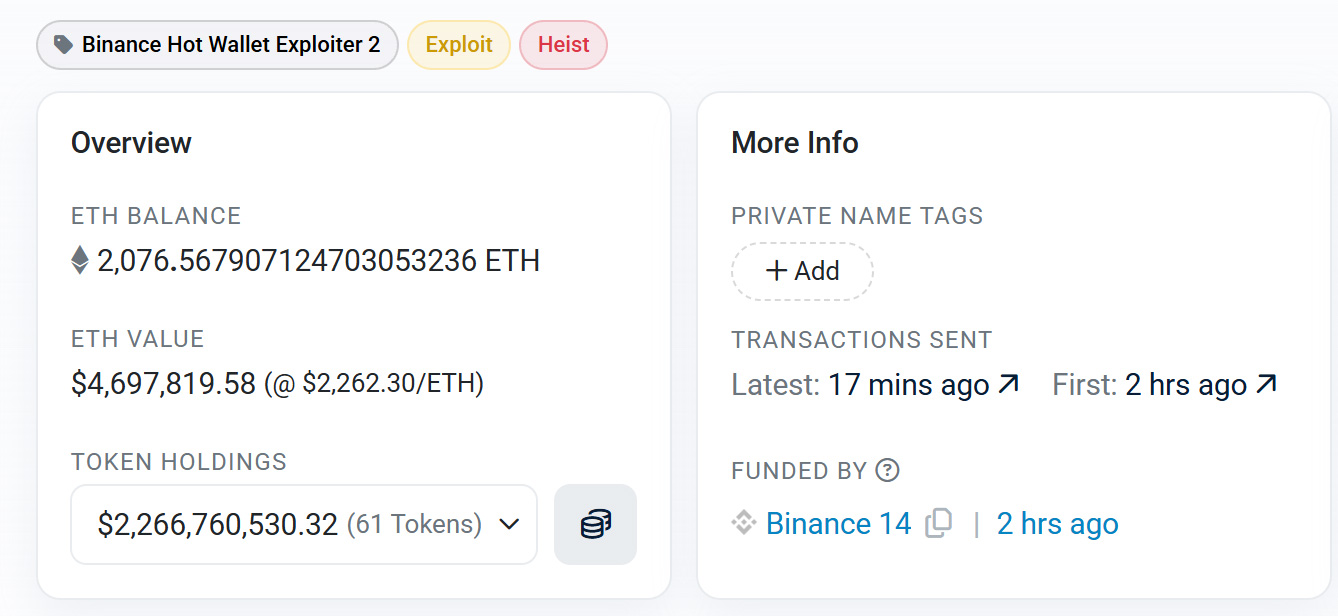
Etherscan, the leading blockchain explorer for the Ethereum network, quickly intervened by tagging the primary receiving address as "Binance Hot Wallet Exploiter 2," affixing stark warning labels reading "Exploit" and "Heist" to the contract. Industry analysts emphasize, however, that the $5.78 billion figure represents the aggregated balance across all monitored addresses associated with the entity rather than an officially verified and finalized sum stolen directly from Binance’s internal ledgers.
Immediate Ecosystem Response and Asset Freezing
The sheer magnitude of the suspected exploit prompted unprecedented, real-time coordination among stablecoin issuers and foundational industry infrastructure providers. Recognizing the existential threat posed by the liquidity drain, Tether and Circle initiated emergency freeze protocols to render the stolen tokens inert before they could be laundered through decentralized exchange (DEX) liquidity pools or cross-chain privacy bridges.

Tether Chief Executive Officer Paolo Ardoino took to social media platform X to confirm that the stablecoin issuer had successfully frozen more than $1.567 billion in USDT linked directly to the unfolding Binance incident. This proactive measure prevents the hackers from liquidating the assets into fiat currency or alternative cryptographic tokens.
Similarly, Circle CEO Jeremy Allaire confirmed that his firm had acted decisively to freeze more than $800 million in USDC associated with the breach. Allaire noted that Circle’s security division was in active communication with international law enforcement agencies and specialized blockchain forensic teams, pledging continued institutional support to secure the network and neutralize the threat actors.
Official Statements and Leadership Reactions
Binance leadership and corporate communications channels moved quickly to address growing panic within the global crypto community. A company spokesperson issued an official statement assuring the exchange’s hundreds of millions of registered users that their core capital remains secure.
"Our teams are aware of reports of a potential security issue and are actively investigating. Rest assured that user funds are completely safe," the Binance spokesperson stated. "Our security teams are reviewing all relevant information with urgency, and we will provide updates through official Binance channels as soon as we have verified information."
In tandem with these reassurances, Binance issued public security warnings urging retail and institutional customers to exercise extreme vigilance. The exchange cautioned users to disregard unofficial links, unsolicited messages, and fraudulent requests for account credentials or private keys circulating across social media channels in the wake of the news.
Changpeng Zhao (CZ), the founder of Binance, also addressed the crisis publicly on X. Zhao noted that the incident bore the distinct hallmarks of a sophisticated external hack. He reminded the public that he no longer participates in the daily operational management of the exchange, while expressing confidence in the platform’s financial resilience and asserting his expectation that all user funds would be completely covered by the company’s robust insurance reserves and corporate balance sheet in the worst-case scenario.
Contextualizing the Scale: Comparisons to Historical Crypto Heists
If the $5.8 billion figure is ultimately confirmed as an unauthorized loss, the incident will eclipse every historical security failure in the annals of financial technology and cryptocurrency history.
For perspective, the largest confirmed crypto heist on record occurred in February 2025, when the notorious state-sponsored North Korean hacking collective known as the Lazarus Group successfully infiltrated Bybit, making off with approximately $1.5 billion in digital assets. Prior to that, the industry reeled from massive exploits such as the 2021 Poly Network breach ($611 million), the 2022 Ronin Network bridge hack ($625 million), and the infamous 2014 Mt. Gox collapse, which involved around 850,000 Bitcoin—valued in the hundreds of millions at the time, but worth tens of billions today.
A breach of the scale currently being investigated at Binance would far exceed the Bybit catastrophe, establishing a sobering new benchmark for cybercriminal efficiency and systemic vulnerability within centralized financial intermediaries.
Broader Implications for Centralized Exchanges and Regulatory Scrutiny
The unfolding Binance situation carries profound implications for the cryptocurrency industry at large, raising urgent questions regarding hot wallet security architecture, internal access controls, and real-time anomaly detection protocols.
Centralized exchanges (CEXs) have long battled the inherent trade-off between operational liquidity—which requires hot wallets to be connected to the internet to facilitate rapid customer withdrawals and trades—and absolute security, which is best achieved through offline cold storage mechanisms. Critics and security auditors have frequently argued that maintaining billions of dollars in hot wallets creates an irresistible honeypot for advanced persistent threat (APT) groups and sophisticated cybercrime syndicates.
Furthermore, the incident is certain to attract intense scrutiny from global financial regulators and legislative bodies. Authorities in jurisdictions such as the European Union, the United States, and Asia have increasingly tightened compliance frameworks around digital asset service providers, demanding rigorous proof-of-reserves audits and institutional-grade cybersecurity standards. A security breach of this magnitude threatens to accelerate regulatory crackdowns, potentially leading to stricter oversight of how exchanges manage customer deposits and institutional custody solutions.
As investigations continue, blockchain forensics experts, regulatory watchdogs, and Binance’s internal security engineers remain locked in a high-stakes race to analyze the transaction logs, secure compromised systems, and recover the frozen funds before they can be successfully obfuscated through laundering networks.
This is a developing story and will be continuously updated as verified technical details and official findings emerge from Binance and investigating authorities.

