
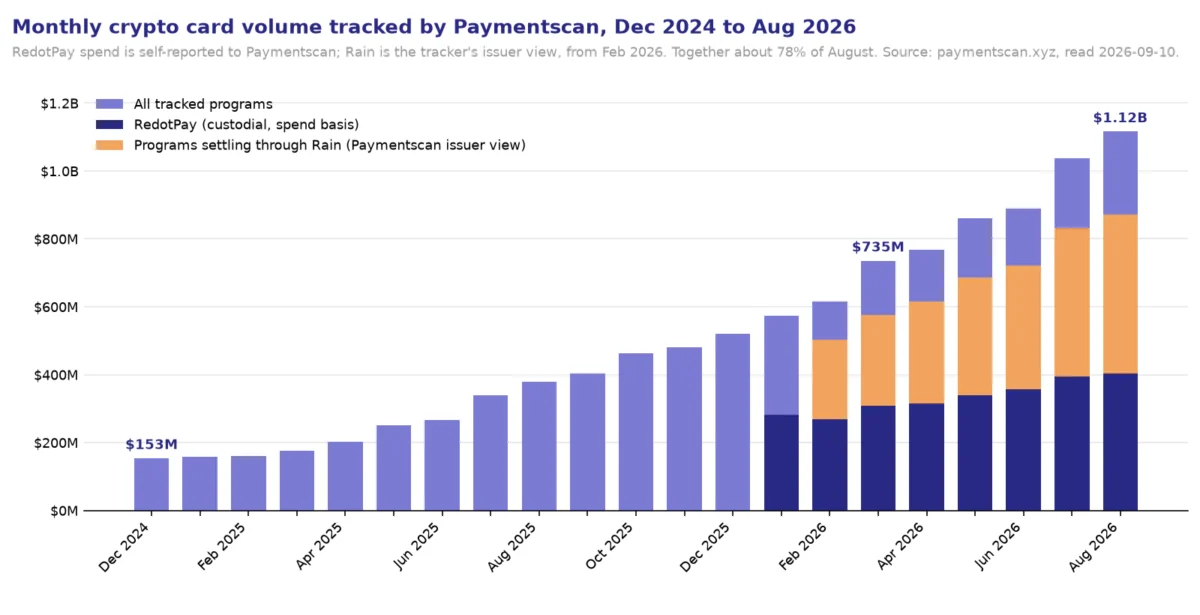
At 16:49:48 UTC on Friday, August 28, 2026, a Solana wallet—funded just three hours prior with 1.79 SOL derived from $190 in USDC bridged from Ethereum—initiated a series of precise, automated transactions that began siphoning funds from the card-balance accounts of Avici, a Solana-based neobank. By the time the incident concluded, 1,685 users had seen $500,859.22 vanish from their accounts. This event, while contained within a specific segment of the crypto-card market, exposed the underlying fragility of the "non-custodial" card model, a rapidly growing sector that has seen monthly transaction volumes surge to over $1.1 billion as of August 2026.
The breach was not a result of compromised private keys or stolen user wallets. Instead, it exploited a structural vulnerability within the smart contract architecture used by Rain, the card-issuing company that powers the back-end infrastructure for Avici and several other prominent self-custodial card programs. While Avici’s terms of service, last updated in June 2025, assured users that neither the company nor the issuer held custody of their collateral, the incident demonstrated that "non-custodial" is a term defined more by legal intent than technical impossibility.
The Anatomy of the August 28 Drain
The exploit followed a calculated timeline. The attacker’s address, 0xFVNFzq…, sat idle for 189 minutes after its initial funding before executing the first of 21,405 transactions. Of these, approximately 17,500 succeeded. The attack targeted a specific flaw in the Ed25519 signature-verification instruction within the Rain-controlled Solana program. By manipulating signature, key, and message offsets, the attacker bypassed a two-signature verification requirement, effectively granting themselves administrative rights over individual user collateral accounts.
Once the attacker achieved administrative status, they systematically initiated withdrawals. The median loss per user was roughly $24, though the largest individual losses exceeded $5,000. It is a critical distinction that the funds were not stolen from a centralized pot; rather, the "non-custodial" architecture relied on a single administrative authority—a plain signing key—which the attacker successfully spoofed.
Rain, the infrastructure provider, responded with significant speed, issuing a patch for the most severely affected program at 19:18:37 UTC, just seconds before the attacker ceased activity. While the company initially faced criticism for relying on outdated contract versions, it eventually moved the upgrade authority for its programs to a Squads multisig vault on September 5, 2026, adding a layer of security that was absent during the August breach.
The State of the Crypto-Card Market: A $1.1 Billion Ecosystem
According to data from Paymentscan, the crypto-card industry reached a new milestone in August 2026, processing $1.116 billion in volume across 11 million transactions. This growth represents a 32% increase since March 2026, even after accounting for restated figures that include previously untracked issuer flows.
However, the headline numbers obscure significant diversity in how these programs function. The market is effectively split into five distinct custody models, ranging from direct sales of assets to the operator (effectively creating an unsecured debt claim) to true self-custodial vaults where the operator lacks the power to move user funds.
The most controversial model, exemplified by KAST, involves the "sale" of virtual assets to the operator upon deposit. In this arrangement, the user’s balance is a ledger entry representing an enforceable debt claim against the company. Following a public feud with the CEO of Ether.fi, KAST amended its terms in July 2026 to clarify that deposited assets are owned by the company treasury, and users are essentially unsecured creditors in the event of insolvency. This model has drawn sharp criticism from industry peers who argue that such structures bypass the protective regulations governing traditional financial institutions.

Issuer Concentration and Infrastructure Risk
A significant portion of the self-custodial card market—including Avici, Tria, Payy, Solayer, Plasma One, and Ether.fi Cash—relies on a single issuer: Third National. Public filings and legal disclosures reveal that Third National is not a bank, but rather a Puerto Rico-licensed money transmitter operating under the Signify Holdings, Inc. umbrella.
This concentration of power is a double-edged sword. While it allows for rapid innovation and seamless integration with the Visa network, it creates a systemic "single point of failure." When a vulnerability is found in the underlying contract template, as happened in August, the contagion spreads instantly across multiple brands.
Despite the August incident, consumer confidence remains surprisingly resilient. The total value of stolen funds was fully refunded by the affected companies within 24 hours. Avici stated that the refunds were facilitated by Rain, signaling that the venture-backed infrastructure providers are prioritizing reputation and user retention over the strict legal liability definitions found in their terms of service.
The Regulatory Horizon: The End of Anonymous Spending?
As the industry matures, regulators are moving to close the loopholes that allowed for the proliferation of "no-KYC" (Know Your Customer) cards. The European Union’s Anti-Money Laundering Regulation (EU) 2024/1624, set to apply from July 2027, will effectively prohibit anonymous crypto-asset accounts. This regulation will specifically target the practice of loading cards from anonymous crypto sources, likely forcing a massive consolidation in the market.
Many of the smaller, niche cards identified in recent directories are already facing existential threats. Services like Bit.Store have already seen their operations shuttered following regulatory actions against their underlying electronic money institutions (EMIs), such as the revocation of Paytend Europe UAB’s license in early 2026. These shutdowns serve as a stark reminder that when a regulatory body intervenes, the brand the consumer interacts with often has no power to recover or return assets.
Analyzing the "Non-Custodial" Promise
The core lesson of the August 2026 exploit is not that self-custody is fundamentally flawed, but that the industry’s marketing language is often divorced from technical reality. In the context of a cardholder agreement, "non-custodial" often refers only to the status of the funds during normal operation. It rarely accounts for who holds the upgrade keys, whether the code currently running is the same as the code that was audited, or what happens when a program manager—like Rain—must act as a lender of last resort to keep a project solvent.
The resilience of the market is evidenced by the rapid adoption of new, more transparent models. Programs like Gnosis Pay, which utilizes a modular architecture with specific roles and delays, or Ether.fi Cash, which publishes its contract addresses and relies on advanced multisig security, represent the next generation of crypto-native finance. These programs aim to minimize the need for "corporate backstops" by moving the responsibility for security back to the user and the code itself.
As the industry enters the final quarter of 2026, the focus is shifting from pure volume growth to structural integrity. The $1.1 billion in monthly volume is a testament to the utility of stablecoin-powered payments, but the August 28 incident proves that the infrastructure supporting these transactions remains an evolving target. For the end user, the path forward requires a closer look at the fine print: understanding whether their funds are held in a vault they control, or if they are simply a secondary claimant in a complex, privately managed settlement network.
Ultimately, the crypto-card market has proven that it can weather technical breaches through sheer financial force. However, as regulatory pressure mounts and the market continues to consolidate around a handful of large infrastructure providers, the definition of "non-custodial" will likely undergo a necessary, more rigorous evolution. The era of blind trust in "smart contract" marketing is coming to an end, replaced by a demand for verifiable, immutable, and truly decentralized control.

