
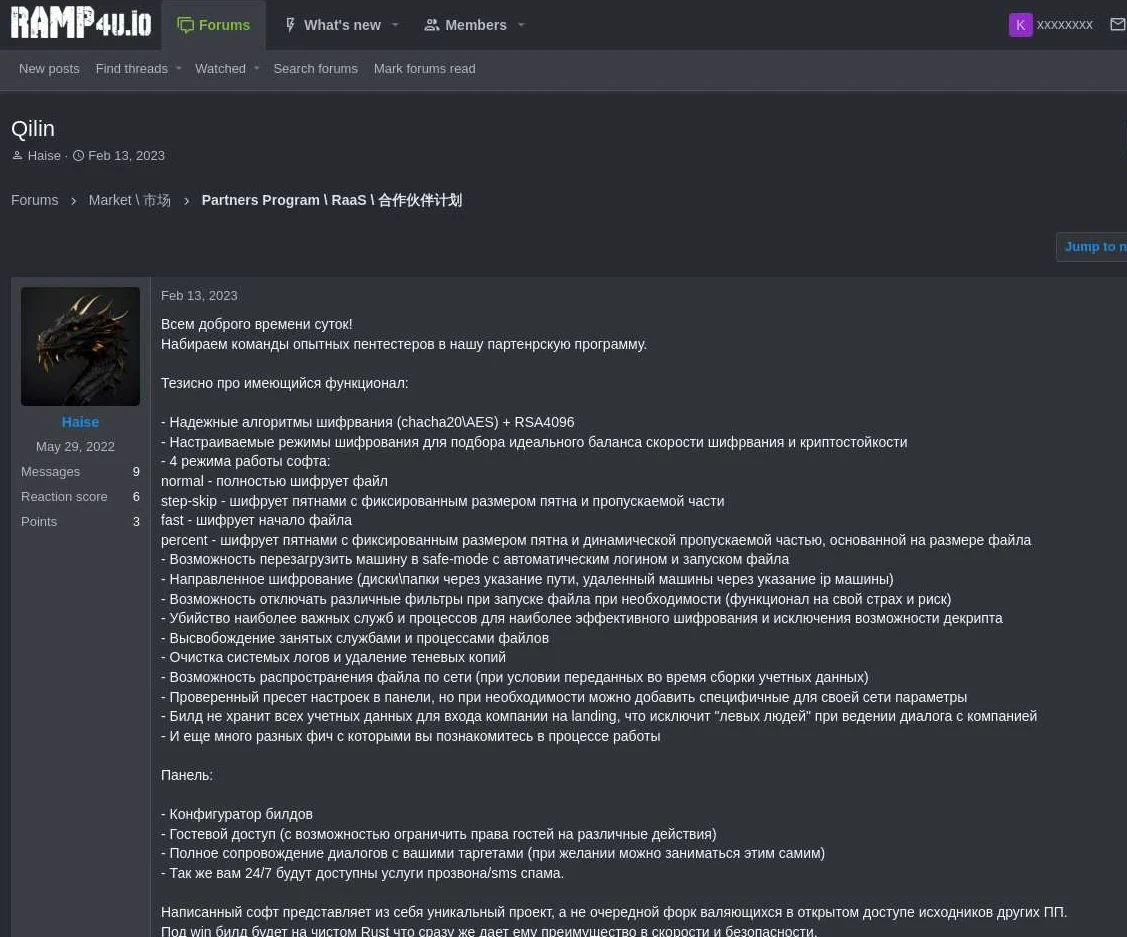
The global cybersecurity landscape was shaken once again as intelligence reports identified the driving force behind Qilin, currently the world’s most prolific ransomware-as-a-service (RaaS) affiliate program. Operating at an industrial scale, Qilin claimed at least 365 victim organizations within a single three-month window, establishing itself as a dominant and destructive force in the modern cybercrime ecosystem. Yet, despite sophisticated operational security (opsec) measures and the protective veil of operating from within the Russian Federation, the elusive administrator known by the alias "Haise" ultimately fell victim to a trail of digital breadcrumbs. Advanced threat intelligence analysis, combined with historical forum data and massive data breaches of Russian state infrastructure, has unmasked the administrator as 36-year-old Aleksey Mikhailovich Yakovtsev, a resident of St. Petersburg, Russia, holding a master’s degree in computing and information systems.
The Anatomy of Qilin: Operations, Extortion, and Alliances
Launched in September 2022, Qilin quickly ascended the ranks of the cybercriminal underworld. According to a quarterly threat intelligence report published by NCC Group, the Russia-based syndicate operates on a ransomware-as-a-service model, recruiting skilled affiliates to infiltrate corporate networks, deploy encryption tools, and extort victims.
To maximize leverage, Qilin relies on a "double extortion" strategy. Affiliates not only encrypt critical enterprise systems to halt business operations, but they also exfiltrate sensitive corporate data. If a victim refuses to pay the ransom demand, the gang threatens to leak proprietary information, intellectual property, or confidential customer records on public dark web leak sites.
What sets Qilin apart from many of its Russian-speaking counterparts is its pragmatic, business-first approach to recruitment. While traditional criminal groups often restrict partnerships to trusted Russian speakers, Qilin actively courts English-speaking affiliates. Offering an unusually generous split—at least 80 percent of any extortion payment goes directly to the affiliate—has fueled rapid adoption. Furthermore, communications attributed to the group’s leadership indicate active collaborations with notorious secondary syndicates, including Scattered Spider and RansomHub, cementing Qilin’s central role in the modern cybercrime supply chain.
From Petty Arbitrage to RaaS Supremacy: A Chronological Evolution

The investigation tracking Haise to his real-world identity highlights the cumulative risk of digital persistence. Cybercriminals frequently cycle through monikers to distance themselves from past mistakes. However, forum validation processes often force threat actors to reference historical aliases, bridging the gap between old, careless accounts and new, hardened profiles.
The chronological trail of the Qilin administrator spans nearly a decade, revealing a steady escalation in technical sophistication:
- 2018–2019: Early digital footprints show the individual operating under the radar as a low-level traffic arbitrageur and credit card fraudster, dabbling in basic illicit monetization schemes.
- 2020: The user adopted the handle "Rjun" on prominent Russian cybercrime forums such as Exploit and XSS. During this period, intelligence platforms like Flashpoint noted Rjun’s heavy involvement in acquiring Facebook logs and Google Ads accounts to facilitate fraudulent advertising and gambling operations. The user also frequently utilized the Telegram handle "Alexbigboss44."
- June 2022: Seeking to expand operations into the burgeoning ransomware market, Alexbigboss44 applied for membership on RAMP, a heavily guarded Russian-language cybercriminal forum established specifically as a sanctuary for ransomware affiliate programs. Direct message logs recovered after the FBI seized RAMP in January 2026 confirmed that the forum administrator approved the application under the name Haise, linking the new persona directly to the Alexbigboss44 Telegram account.
- September 2022: Qilin officially launched its ransomware operations, rapidly scaling into the industry powerhouse documented by NCC Group.
- Late 2025: A massive data breach struck Gosuslugi.ru, the official digital portal for municipal and state services in the Russian Federation. The leak exposed more than 20 million records containing full names, dates of birth, and associated contact information, inadvertently providing cybersecurity researchers with an unprecedented de-anonymization resource.
De-Anonymizing the Mastermind: The Convergence of Tech and Breaches
Connecting Haise to Aleksey Yakovtsev required a multidisciplinary approach combining artificial intelligence, stylometric analysis, and cross-referencing compromised databases. The breakthrough originated from IntelHawk, an AI-powered de-anonymization platform founded by Leo Bogod, which analyzed historical usernames, writing patterns, and technical signals to map out the threat actor’s evolution.
According to intelligence gathered by Intel 471, the forum account Rjun had long utilized the email address [email protected] across multiple historical crime platforms, including Darkmarket, Verified, and Zloy. Identity threat protection firm Spycloud discovered that this specific email account frequently used the password "Rjun132."
When the [email protected] address was queried against breach tracking records from Constella Intelligence, it matched data extracted from the compromised Gosuslugi.ru database. The state portal records formally linked the email address to Aleksey Mikhailovich Yakovtsev, born August 18, 1990.
Corroborating data further solidified the attribution. Flashpoint tracked Haise’s long-standing Telegram account (User ID 118329521), which recorded over 5,000 messages dating back to 2018. When this Telegram ID was cross-referenced in breach datasets, it linked to the Russian telephone number +79602347275.

IntelHawk established that this phone number belongs to Yakovtsev’s biological sister, an operational security shortcut where the suspect utilized family contact information and secondary email addresses—such as [email protected] and [email protected]—to register across various web services. Furthermore, educational records from Russia’s Rosobrnadzor confirmed that Yakovtsev attended grade school in Murmansk and successfully earned a master’s degree in computing and information systems, supplying the technical foundation required to orchestrate a global cybercrime empire.
Travel patterns recovered from Russian travel agency breaches provide a glimpse into the suspect’s physical movements. Flight manifests confirm that Yakovtsev flew multiple times between St. Petersburg and Murmansk between 2013 and 2014. More recent transit records indicate that while he has not traveled internationally by plane, he frequently commutes between St. Petersburg and Sochi, Russia’s premier Black Sea resort city located roughly 1,200 miles to the south.
Independent Verification and Industry Implications
The methodology and conclusions regarding Yakovtsev’s identity were independently corroborated by GangExposed, an anonymous OSINT research collective known for tracking and exposing ransomware operators. Utilizing IntelHawk’s analytical infrastructure, the collective reached identical conclusions regarding Haise’s real-world identity, publishing supporting documentation from deleted Telegram channels where Haise openly advertised the Qilin affiliate program.
Efforts by security researchers and journalists to reach Mr. Yakovtsev via his known email addresses and phone numbers were met with silence.
The identification of Qilin’s administrator underscores a persistent vulnerability within the cybercriminal elite: despite deploying sophisticated malware and maintaining stringent operational protocols online, perpetrators remain susceptible to long-term digital footprints, historical reuse of credentials, and the collateral damage of massive state-level data leaks. For law enforcement agencies and international cybersecurity firms, the unmasking of Haise offers critical intelligence that could pave the way for future indictments, asset freezes, and travel restrictions against key figures in the global ransomware economy.

