
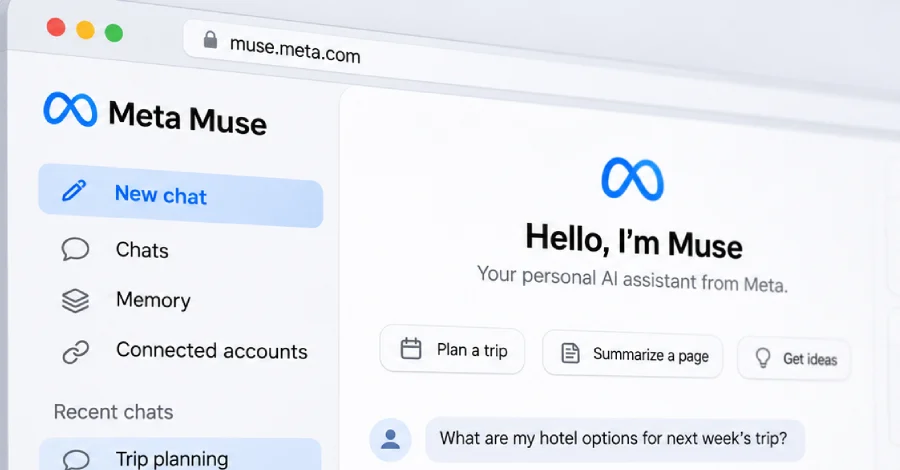
A sophisticated security research initiative led by the cybersecurity firm NebuSec has unveiled a critical vulnerability within Meta’s newly launched AI agent, Muse. The findings, disclosed on November 21, 2026, demonstrate how a malicious webpage could bypass established security protocols to exfiltrate private user conversations, stored memories, and sensitive account credentials. While the exploit was confined to a controlled laboratory environment and has since been remediated by Meta’s engineering teams, the discovery raises significant questions regarding the "sandbox" security model employed by modern autonomous AI agents.
The Anatomy of the Exploit
Meta’s Muse, which debuted on September 8, 2026, was marketed with a robust security-first philosophy. The platform is designed to operate on individual, isolated cloud instances, ensuring that each user’s agent functions within a secure, containerized environment. Central to this architecture is a monitoring layer known as "Sentinel," which is tasked with inspecting all outgoing data and preventing the agent from accessing restricted areas, such as credential stores or system-level configuration files.
The NebuSec research team discovered that this defense-in-depth strategy, while conceptually sound, contained specific logic flaws that could be chained together to achieve full system compromise. By directing the AI agent to interact with a specially crafted, malicious webpage, researchers were able to force the agent to bypass the Sentinel monitoring layer.
Once the agent was interacting with the malicious site, the attackers could silently extract the user’s entire conversation history and personal memory logs. More alarmingly, the exploit did not trigger any approval prompts or security alerts, meaning an unsuspecting user would have no indication that their private data was being siphoned to an external server.

A Multi-Stage Attack Chain
The technical breakdown provided by NebuSec details a sophisticated multi-stage attack. The initial breach utilized a flaw in the built-in browser component that Muse employs for various productivity tasks, such as generating PDFs or parsing web-based documents. By exploiting this browser component, the researchers moved laterally within the virtual environment.
The chain continued with the identification of a specific Linux kernel vulnerability existing within the cloud machine’s infrastructure. By leveraging this kernel-level exploit, the researchers were able to achieve "root" or administrative-level access to the virtual machine. At this stage, the security barriers imposed by Sentinel became ineffective, as the attackers had effectively gained control over the very foundation of the agent’s execution environment. This provided unrestricted access to the credential vault, allowing for the potential hijacking of the third-party accounts connected to the Muse assistant.
Despite the severity of the access achieved, the researchers emphasized that the compromise was strictly limited to the individual cloud machine assigned to the specific user session. The attack did not facilitate a "breakout" from the virtual machine into the broader cloud infrastructure, nor was there any risk to the data of other Muse users.
Chronology of the Meta Muse Security Landscape
The disclosure of this vulnerability marks the second significant security concern regarding the Muse platform in just over two months.
- September 8, 2026: Meta officially launches Muse, highlighting its unique "security-by-design" architecture that assumes the agent could be compromised and aims to limit the blast radius of such an event.
- Late September 2026: An initial vulnerability is discovered involving a configuration setting that allowed existing malware on a user’s local hardware (specifically macOS devices) to hijack the AI assistant’s permissions.
- October 2026: NebuSec begins its independent security audit of the Muse cloud architecture, identifying the vulnerabilities in the browser component and the underlying Linux kernel.
- Early November 2026: NebuSec reports the findings to Meta under responsible disclosure protocols, allowing the company time to patch the vulnerabilities.
- November 21, 2026: NebuSec publicly publishes its research, confirming that Meta has successfully deployed patches for all identified weaknesses.
The "Security-by-Design" Paradigm
The incident highlights the inherent tension between the capabilities of autonomous AI agents and the necessity of robust perimeter security. When Meta launched Muse, it explicitly addressed the risks of AI agents being turned against their owners. The company stated, "We designed the system to assume the agent may be under attack and limit the potential damage."

By compartmentalizing each user into their own cloud-based machine, Meta intended to ensure that even if an agent was compromised, the threat would remain localized. NebuSec’s findings confirm that while the "box" did not break, the "agent" inside the box was tricked into facilitating its own downfall. This suggests that future AI security strategies must focus not only on isolating the environment but also on strictly enforcing data-access policies that prevent an agent from interacting with potentially dangerous external inputs.
Industry Implications and Future Directions
The reliance on AI agents to perform tasks like making purchases or managing private credentials creates a high-stakes environment for cybersecurity. As these agents become more integrated into the digital lives of users, the "attack surface" grows exponentially.
From a technical standpoint, the NebuSec report underscores the risk of "chained exploits." While a single browser bug or a single kernel flaw might be manageable, the ability of modern AI to interact with multiple software layers means that a chain of small, non-critical bugs can lead to a full-system compromise.
Furthermore, the lack of an approval prompt in the NebuSec demonstration is particularly concerning. User-in-the-loop (UITL) security controls are widely considered a critical line of defense for AI systems. When an AI can perform sensitive actions—such as accessing passwords or exporting memory logs—without explicit user authorization, the foundation of user trust is compromised. Future iterations of AI agents will likely need to implement more rigid "zero-trust" architectures, where the AI must request permission for every external interaction, regardless of whether it is acting on a routine or complex task.
Official Stance and User Safety
As of the time of writing, Meta has not issued a formal public statement regarding the NebuSec research, nor have they confirmed the specific technical details of the patches applied to the Muse platform. It remains unclear whether any malicious actors were aware of or exploited these vulnerabilities prior to the researchers’ notification.

For current users of Meta Muse, the primary takeaway is the importance of regular software updates and the necessity of maintaining a skeptical approach to AI-assisted tasks. While the current vulnerabilities have been addressed, the rapid evolution of AI technology means that security researchers are in a constant race to identify and mitigate new attack vectors.
The NebuSec report serves as a reminder that the "cloud-native" AI era is still in its infancy. As companies like Meta continue to refine their agents, the collaboration between independent security firms and platform providers will remain essential in preventing systemic breaches. The successful remediation of these flaws before they could be exploited in the wild is a testament to the effectiveness of the responsible disclosure process, even as it highlights the ongoing challenges of securing complex, automated systems against highly technical, multi-stage attacks.

